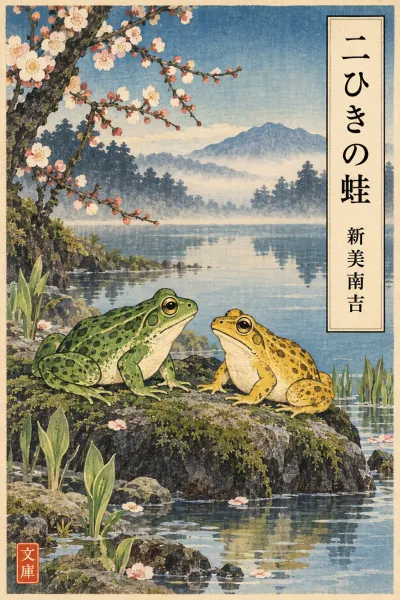
 N5 · easy
Simplified retelling · JLPT N5
二ひきの蛙 Nihiki no Kaeru in easy Japanese (N5)
This is our own simplified retelling of The Green Frog and the Yellow Frog, written for N5 learners and checked word by word against the N5 vocabulary list. A few story words and grammar patterns go beyond N5; the notes below give each one's level. It keeps the characters, events and ending of the original. When it feels easy, move on to the N4 version or the original text.
The story in brief
A green frog and a yellow frog meet in a field and quarrel about each other's colours. When the cold wind blows, they agree to finish the fight in spring and go underground to sleep. In spring they wash in a clear pond, then praise each other's colours and promise never to fight again.
AI translation · independently checked
みどりのかえるときいろのかえるが、はたけであいました。A green frog and a yellow frog met in a field.
「やあ、あなたはきいろだね。きたないいろだ。」"Hey, you're yellow, aren't you? What a dirty colour!"
みどりのかえるがいいました。So said the green frog.
「あなたはみどりだね。あなたのいろは、きれいなの?」"And you're green, aren't you? Is your colour so pretty, then?"
きいろのかえるがいいました。So said the yellow frog.
二ひきのかえるは、けんかになりました。And the two frogs got into a fight.
みどりのかえるは、きいろのかえるの上にとびました。The green frog jumped on top of the yellow frog.
みどりのかえるは、とぶのがとてもじょうずでした。The green frog was very good at jumping.
きいろのかえるは、うしろのあしで、すなをかけました。The yellow frog kicked sand at him with its back legs.
みどりのかえるのめに、すながたくさん入りました。A great deal of sand got into the green frog's eyes.
すると、さむいかぜがふいてきました。Just then, a cold wind came blowing.
「もうふゆが来るね。」"Winter's nearly here, isn't it?"
かえるは、ふゆは土の中でねます。Frogs, you see, sleep under the ground in winter.
「はるになったら、またけんかをしましょう。」"When spring comes, let's fight again!"
といって、みどりのかえるは土の中に入りました。With that, the green frog went down into the ground.
「今の話、わすれないで。」"Don't you forget what we just said!"
といって、きいろのかえるも土の中に入りました。With that, the yellow frog went down into the ground too.
さむいふゆが来ました。The cold winter came.
土の上に、つめたい北かぜがふきました。Over the ground blew a chilly north wind.
それから、はるが来ました。And then spring came.
かえるたちの上の土が、あたたかくなりました。The earth above the frogs grew warm.
先に、みどりのかえるがおきました。The green frog woke up first.
土の上に出ました。He came out onto the ground.
ほかのかえるは、まだいません。None of the other frogs were there yet.
「おきて、おきて。もうはるだよ。」"Wake up, wake up! It's spring already!"
みどりのかえるは、土の中によびました。The green frog called down into the ground.
すると、きいろのかえるが出てきました。And out came the yellow frog.
「やれやれ、はるになったね。」"Well, well, so spring is here."
「きょねんのけんか、わすれた?」"Have you forgotten last year's fight?"
とみどりのかえるがいいました。said the green frog.
「まって。からだの土をあらってから、しましょう。」"Wait. Let's do it after I wash the dirt off my body."
ときいろのかえるがいいました。said the yellow frog.
二ひきは、いけへ行きました。The two of them went to the pond.
いけには、あたらしい水がたくさんありました。The pond was full of fresh new water.
とてもきれいで、つめたい水です。It was very clear, cold water.
二ひきは、ぴょんと水に入りました。The two frogs hopped — plop! — into the water.
からだをあらってから、みどりのかえるがいいました。When they had washed themselves, the green frog spoke.
「やあ、あなたのきいろは、きれいだね。」"Why, your yellow is lovely, isn't it?"
「あなたのみどりも、とてもきれいだよ。」"And your green is very lovely too!"
ときいろのかえるがいいました。said the yellow frog.
二ひきのかえるは、「もうけんかは、しません。」といいました。The two frogs said, "We won't fight any more."
よくねたあとは、人もかえるも、やさしくなるのです。For after a good sleep, people and frogs alike become kinder.
Vocabulary
| Word | Meaning | JLPT |
|---|---|---|
| はたけはたけ | field (for growing vegetables)dictionary form: 畑A farm field, not a rice paddy (田んぼ). | N3 |
| けんかけんか | fight, quarreldictionary form: 喧嘩Used for both arguing and physical fighting. けんかをする = to fight. | N4 |
| とびましたとぶ | to jumpdictionary form: 跳ぶAlso written 飛ぶ, meaning 'to fly'. | N5 |
| じょうずじょうず | skilful, good atdictionary form: 上手A な-adjective; the opposite is へた. | N5 |
| すなすな | sanddictionary form: 砂 | N4 |
| かけましたかける | to throw on, splash (sand, water) atdictionary form: かけるかける has many meanings; here it means to scatter something over someone. | N5 |
| ふいてふく | to blow (of wind)dictionary form: 吹くかぜがふく = the wind blows. | N5 |
| 土つち | earth, soil, ground | N3 |
| おきましたおきる | to wake up, get updictionary form: 起きる | N5 |
| よびましたよぶ | to call (out to)dictionary form: 呼ぶ | N5 |
| きょねんきょねん | last yeardictionary form: 去年 | N5 |
| あらってあらう | to washdictionary form: 洗う | N5 |
| いけいけ | ponddictionary form: 池 | N5 |
| やさしくやさしい | kind, gentledictionary form: 優しいAn い-adjective; やさしく + なる = become kind. | N4 |
Grammar
〜になる N5 to become, to turn into
Noun or な-adjective + になる shows a change of state. With い-adjectives the form is 〜くなる, as in あたたかくなりました (grew warm).
二ひきのかえるは、けんかになりました。
And the two frogs got into a fight.
〜たら N4 when / if (something happens)
Past form + ら means 'once X happens, then…'. Here it points to a future time: when spring has come.
はるになったら、またけんかをしましょう。
When spring comes, let's fight again!
〜ましょう N5 let's (do)
The ます-stem + ましょう invites the listener to do something together.
またけんかをしましょう。
Let's fight again!
〜ないで N5 please don't (do)
The ない-form + で (short for ないでください) is a casual request not to do something.
今の話、わすれないで。
Don't you forget what we just said!
〜てから N5 after doing ~
The て-form + から means doing one action first and then the next.
からだの土をあらってから、しましょう。
Let's do it after I wash the dirt off my body.
〜のがじょうず N4 good at doing ~
の turns the verb とぶ into a noun ('jumping'), and が marks what the frog is good at.
みどりのかえるは、とぶのがとてもじょうずでした。
The green frog was very good at jumping.