Upper intermediate · JLPT N2
二ひきの蛙Nihiki no Kaeru — The Green Frog and the Yellow Frog
- JLPT N2
- 942 characters
- 1 part
- about 8 minutes
- 3 easier versions
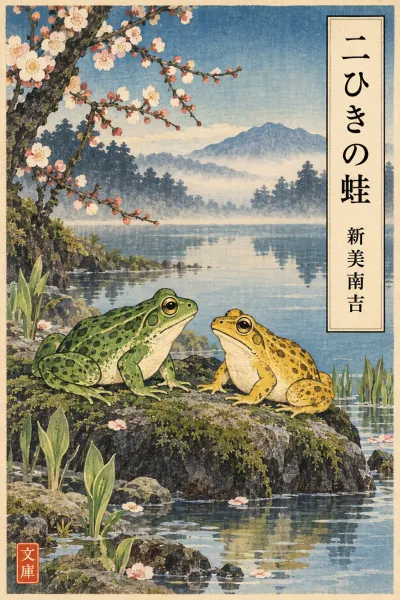
二ひきの蛙 is a very short fable by Niimi Nankichi, the writer of children's stories best known for ごんぎつね and 手袋を買いに. A green frog and a yellow frog run into each other in the middle of a field. Each thinks its own colour is the finer one, and insults quickly turn into a scuffle. Then the cold of late autumn arrives and interrupts the fight. The frogs go underground for the winter, promising to settle things once spring comes. The story reads like a gentle picture-book fable, told by a warm narrator who ends with a small moral aside. For learners, its brevity and simple situation make it an approachable first complete story. The challenge lies in the contrast of voices: the narration uses polite です/ます form with a few old-fashioned formal endings, while the frogs speak in brisk, boyish plain speech full of sentence-final particles and commands. Much of the text is written in hiragana, so learners need to find word boundaries without kanji to help them. Reading it closely is good practice in how register marks who is speaking.
Contents
Easier versions
This story is also retold in simpler Japanese. Reading an easier version first makes the original much more approachable.
Before you read
- Use the verb form to tell who is speaking. The narrator uses です/ます and a few stiff, old-fashioned endings such as 〜でありました and 〜ものであります. The frogs use plain forms. A sentence ending in ます is almost always narration.
- Learn the frogs' boyish command forms before you start. 〜たまえ is a slightly lofty 'do ~' (おきたまえ = 'wake up'). A plain verb + な is a blunt prohibition (わすれるな = 'don't forget'). ぞ and ぜ add emphatic, rough-and-ready force.
- The text is heavily written in hiragana, so read slowly and look for word boundaries. It helps to recognise key words in their kana spelling first: けんか (quarrel), ねむる (sleep), わすれる (forget), きげん (mood), うつくしい (beautiful).
- Colour words and seasons carry the plot. Make sure you know みどり/緑, きいろ/黄色, ふゆ/冬 and はる/春, as well as the counter ひき for small animals in the title (二ひき = 'two [frogs]').
- The closing moral uses 〜ものであります, a formal, old-fashioned version of 〜ものです ('that is how things naturally are'). Read it as the narrator stepping out of the story to address the reader directly.
Words to know
The most useful words from the notes across the story.
| Word | Meaning | JLPT |
|---|---|---|
| はらわねばはらう | to brush off, sweep awaydictionary form: 払うBesides 'to pay', 払う also means to brush dust or dirt off something. | N4 |
| ばったりばったり | unexpectedly, by chance (of meeting someone)Very often used with 会う or 出会う: ばったり会う, to bump into someone. | N3 |
| 得意とくい | good at, skilled in〜が得意だ means 'to be good at ~'. Its opposite is 苦手 (にがて). | N3 |
| きげんきげん | mood, temperdictionary form: 機嫌機嫌がいい: in a good mood. 機嫌が悪い: in a bad mood. | N3 |
| もぐってもぐる | to burrow into, dive underdictionary form: 潜るUsed for diving under water as well as burrowing into earth or under a blanket. | N2 |
| 勝負しょうぶ | contest, match; win or loss勝負をつける: to settle a contest, decide who wins. | N2 |
| めぐってめぐる | to come round again (of seasons)dictionary form: 巡るOften used for the cycle of the seasons: 季節がめぐる. | N2 |
| けとばしましたけとばす | to kick away, kick updictionary form: 蹴飛ばす | N1 |
| すがすがしいすがすがしい | refreshing, crisp and cleandictionary form: 清々しいUsed for fresh air, water or a clear morning, and also for a clear conscience. | N1 |
| ゆきあいましたゆきあう | to meet by chance, come acrossdictionary form: 行き会うAlso read いきあう. A slightly old-fashioned word for 出会う. | — |
| とびかかってとびかかる | to leap at, pounce ondictionary form: 飛びかかる飛ぶ (jump) + かかる (set upon). | — |
| 霜柱しもばしら | frost pillars, needle ice (ice columns pushing up from frozen soil)霜 (frost) + 柱 (pillar), with rendaku: はしら → ばしら. | — |
| たたえられてたたえる | to fill to the brim (passive たたえられる: to be filled with, e.g. water)dictionary form: 湛えるLiterary word. Do not confuse it with 称える (to praise), which has the same reading. | — |
| ぱちくりぱちくり | blinking (in surprise)Onomatopoeia. 目をぱちくりさせる means to blink one's eyes in surprise. | — |
Plot summary
Show the full summary (contains spoilers)
A green frog and a yellow frog meet in the middle of a field. Each calls the other's colour ugly and is proud of its own, and they start to fight. A cold wind reminds them that winter is coming. They agree to finish the fight in spring and burrow into the ground to sleep, warning each other not to forget. When spring arrives, the green frog wakes first and calls the yellow frog out of the earth. Both are covered in dirt, so before resuming the quarrel they go to the pond to wash. Clean and refreshed, each now finds the other's colour beautiful, and they decide to stop fighting. The narrator remarks that after a good sleep, frogs and people alike wake up in a better mood.
About the author
Niimi Nankichi was a Japanese writer of children's stories, poems and songs from Handa in Aichi Prefecture. The countryside of that area is widely thought to lie behind the village and hills of Gongitsune. He began writing as a young man. Gongitsune appeared in the children's magazine Akai Tori (The Red Bird), edited by Suzuki Miekichi. Niimi later worked as a teacher at a girls' school while continuing to write. His health was poor, and he died of tuberculosis while still in his twenties. Many of his works were published and became widely known only after his death. Besides Gongitsune, he is especially remembered for Tebukuro wo Kai ni (Buying Mittens).