 N4 · easy
Simplified retelling · JLPT N4
おじいさんのランプ Ojiisan no Ranpu in easy Japanese (N4)
This is our own simplified retelling of The Lamp in Grandfather's Storehouse, written for N4 learners and checked word by word against the N4 vocabulary list. A few story words and grammar patterns go beyond N4; the notes below give each one's level. It keeps the characters, events and ending of the original. When it feels easy, move on to the N3 version or the original text.
The story in brief
Tōichi finds an old lamp in the storehouse, and that night his grandfather tells him about his past. As a boy named Minosuke with no family, he brought lamps to his dark village, then learned to read at the village head's house. When electricity arrived he blamed the village head and set out to burn his house, but he realised he was wrong and that the age of lamps was over. He smashed some of his lamps by a pond and opened a bookshop instead.
AI translation · independently checked
東一くんは、友だちと家であそんでいました。Tōichi was playing at home with his friends.
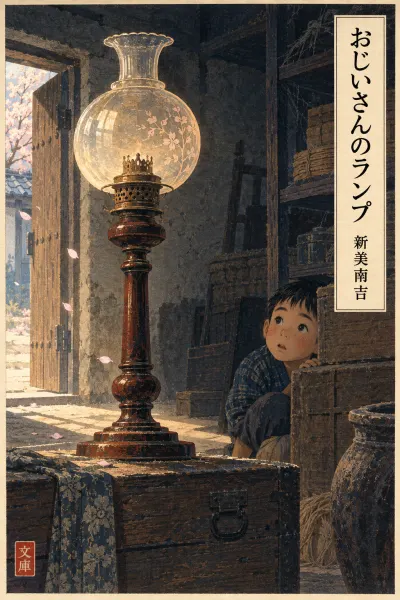
東一くんは、くらの中から古いランプを見つけて、持って出てきました。Tōichi found an old lamp inside the storehouse and came out carrying it.
へんな形のランプでした。It was a lamp with a strange shape.
おじいさんはそれを見て、おこりました。When Grandfather saw it, he got angry.
「くらの物を出してはいけない。外であそびなさい。」子どもたちは、しずかに外へ出ていきました。"You must not take things out of the storehouse. Go and play outside." The children went quietly outside.
その夜、東一くんはランプを見ていました。That night, Tōichi was looking at the lamp.
おじいさんが来ましたが、今度はおこりませんでした。Grandfather came, but this time he did not get angry.
「このランプを見て、むかしのことを思い出したよ。話をしてあげよう。」"Seeing this lamp has made me remember the old days. I'll tell you a story."
五十年ぐらい前、みのすけという十三さいの男の子がいました。About fifty years ago, there was a thirteen-year-old boy called Minosuke.
みのすけには家族がいませんでした。Minosuke had no family.
むらの人の仕事を手つだって、生きていました。He lived by helping the village people with their work.
でも、いつかりっぱな人になりたいと思っていました。But he hoped that one day he would become a fine, respectable man.
ある夏の日、みのすけはじんりきしゃを引く仕事をたのまれました。One summer day, Minosuke was asked to do a job pulling a rickshaw.
そして、大野の町へ行きました。And so he went to the town of Ōno.
むらを出たのは、はじめてでした。It was the first time he had ever left the village.
夜の町では、どの店にもランプがついていました。In the town at night, there was a lamp lit in every shop.
花のようにきれいに光っていました。They shone as beautifully as flowers.
みのすけのむらでは、夜は家の中がくらかったのです。In Minosuke's village, you see, the inside of the houses was dark at night.
みのすけは、ランプを売る店に入りました。Minosuke went into a shop that sold lamps.
でも、お金が少ししかありません。But he had only a little money.
「ぼくは、ランプを売る人になります。安く売ってください。」店の人はわらいました。"I'm going to be a lamp seller. Please sell them to me cheap." The shopkeeper laughed.
でも、みのすけがまじめだったので、安く売ってくれました。But because Minosuke was earnest, the shopkeeper sold them to him cheaply.
みのすけはランプに火をつけて、夜の道を帰りました。Minosuke lit a lamp and went home along the night road.
もう、こわくありませんでした。He was not afraid any more.
はじめは、むらの人はランプを買いませんでした。At first, the village people did not buy lamps.
そこで、みのすけはむらの店に、お金なしでランプを貸しました。So Minosuke lent a lamp to the village shop without charging any money.
五日後、店のおばあさんが話しました。Five days later, the old woman at the shop spoke to him.
「これはべんりだね。夜もおきゃくさんが来るよ。買いましょう。」ほかの人も、ランプをほしがりました。"This is handy, isn't it? Customers come even at night. I'll buy it." Other people wanted lamps too.
くらかった家に、ひとつずつランプの火がつきました。One by one, lamps were lit in the houses that had been dark.
みのすけはとてもうれしかったです。Minosuke was very happy.
みのすけは大人になって、家をたてて、けっこんしました。Minosuke grew up, built a house and got married.
ある日、ランプの下で新聞の字がよく見えることがわかりました。One day, he discovered that under a lamp he could see the letters in a newspaper clearly.
でも、みのすけは字が読めませんでした。But Minosuke could not read.
それで、毎ばんそんちょうさんの家へ行って、字を習いました。So every evening he went to the village head's house and learned to read.
一年で、よく読めるようになりました。In one year, he became able to read well.
ある日、大野の町に電気が来ました。One day, electricity came to the town of Ōno.
夜になると、店の中が昼のようになりました。When night fell, the inside of the shops became as bright as day.
ランプよりずいぶん光っていました。It shone far more brightly than lamps.
みのすけは、とてもいやな気持ちになりました。Minosuke felt very unhappy about it.
しばらくして、むらにも電気を引くことがきまりました。Some time later, it was decided that electricity would be brought to the village as well.
みのすけは、そんちょうさんが悪いと思いました。Minosuke thought the village head was to blame.
ある夜、そんちょうさんの家に火をつけようと思って、出かけました。One night, he set out, meaning to set fire to the village head's house.
でも、マッチがなかったので、火を出す古い道具を持っていきました。But because he had no matches, he took an old tool for making fire.
なかなか火が出ません。The fire just would not come.
「古い物は、だいじな時にやくに立たないな。」そして、みのすけは気がつきました。"Old things are no use when you really need them." And then Minosuke realised something.
ランプも、もう古い物なのです。Lamps, too, were already old things.
電気の新しい時代が来たのです。A new age of electricity had come.
みのすけは、じぶんが悪かったことがわかりました。Minosuke understood that he had been in the wrong.
みのすけは家に帰って、ランプにぜんぶせきゆを入れました。Minosuke went home and filled every one of his lamps with oil.
五十ぐらいありました。There were about fifty of them.
大きないけのそばへ持っていって、木にかけて、火をつけました。He carried them to the side of a big pond, hung them in the trees and lit them.
いけのまわりは昼のようになりました。All around the pond it became as bright as day.
水の中にも、ランプの火が見えました。The lamplight could be seen in the water, too.
みのすけはいしをひろって、いちばん大きなランプになげました。Minosuke picked up a stone and threw it at the biggest lamp.
ランプはこわれて、火がきえました。The lamp broke and its light went out.
「世界はすすんだ。電気の時代になった。」二つ目もこわしました。"The world has moved on. It is the age of electricity now." He broke a second one too.
三つ目をこわすと、ないてしまって、もうなげられませんでした。When he broke the third, he began to cry and could not throw any more.
こうして、みのすけはランプの仕事をやめました。And that is how Minosuke gave up the lamp trade.
そして、町で本を売る店を始めました。Then he opened a shop in town that sold books.
「そのみのすけが、わたしなんだよ。」東一くんはびっくりして、おじいさんのかおを見ました。"That Minosuke was me." Tōichi looked at his grandfather's face in surprise.
「ほかのランプはどうなったの。」「わからない。だれかが持っていったかもしれない。」「ざんねんだね。」"What happened to the other lamps?" "I don't know. Someone may have taken them." "That's a shame."
「そうだね。あれは、よくないやり方だった。でも、やめ方はりっぱだったと思う。世界がすすんで、じぶんの仕事がやくに立たなくなったら、古い仕事はすてる。そして、新しい仕事を始めるんだよ。」"Yes, it is. That was not a good way to do it. But I think the way I gave up was a fine one. When the world moves forward and your work is no longer useful, you throw away the old work. And then you start a new one."
東一くんは、長い間おじいさんのかおを見ていました。Tōichi looked at his grandfather's face for a long time.
そして、「おじいさんは、りっぱだったんだね」と話しました。Then he said, "Grandfather, you were a fine man."
それから、古いランプをやさしく見ました。After that, he looked gently at the old lamp.
Vocabulary
| Word | Meaning | JLPT |
|---|---|---|
| くらくら | storehouse (a thick-walled building for keeping valuables)dictionary form: 蔵Traditional Japanese houses often had a separate fireproof storehouse. | N1 |
| 見つけてみつける | to find, to discoverdictionary form: 見つける | N4 |
| 思い出したおもいだす | to remember, to recalldictionary form: 思い出す思う (think) + 出す (bring out). | N4 |
| 手つだっててつだう | to help (with work)dictionary form: 手伝う | N4 |
| りっぱなりっぱ | fine, admirable, respectabledictionary form: 立派な-adjective. | N5 |
| じんりきしゃじんりきしゃ | rickshawdictionary form: 人力車Kanji: person + power + vehicle; a cart pulled by a runner. | — |
| 貸しましたかす | to lenddictionary form: 貸すOpposite of 借りる (to borrow). | N5 |
| べんりべんり | convenient, handydictionary form: 便利 | N5 |
| そんちょうさんそんちょう | village head, village mayordictionary form: 村長村 (village) + 長 (chief); さん adds politeness. | — |
| 習いましたならう | to learn (from someone), to take lessonsdictionary form: 習う | N5 |
| 道具どうぐ | tool, implement | N4 |
| 気がつきましたきがつく | to notice, to realisedictionary form: 気がつく | — |
| 時代じだい | age, era, period | N4 |
| やくに立たないやくにたつ | to be useful (here negative: to be of no use)dictionary form: 役に立つ | N4 |
Grammar
〜てはいけない N5 must not ~
The て-form plus はいけない forbids an action. The grandfather uses it to tell the children firmly not to take things out.
くらの物を出してはいけない。
You must not take things out of the storehouse.
〜てくれる / 〜てあげる N4 do something for someone
〜てくれる is used when someone does a favour for the speaker's side (the shopkeeper for Minosuke); 〜てあげる is used when the speaker does a favour for someone else, as in 話をしてあげよう.
みのすけがまじめだったので、安く売ってくれました。
Because Minosuke was earnest, he sold them to him cheaply.
〜しか〜ない N4 only ~
しか always pairs with a negative verb and stresses that the amount is small or not enough.
お金が少ししかありません。
He had only a little money.
〜ようになる N4 come to be able to ~, reach the point where ~
〜ようになる shows a change of state: coming to do something, or coming to be able to do something. After the potential form 読める it means 'came to be able to read (well)'.
一年で、よく読めるようになりました。
In one year, he became able to read well.
〜ようと思う N4 intend to ~, think of doing ~
The volitional form (つけよう) plus と思う expresses an intention or plan the person has decided on.
そんちょうさんの家に火をつけようと思って、出かけました。
He set out, meaning to set fire to the village head's house.
〜てしまう N4 end up ~ (often unintentionally or with regret)
The て-form plus しまう shows an action that ends up happening, often beyond the person's control or with regret. Here Minosuke ended up crying (ないてしまって) and could not throw any more lamps.
三つ目をこわすと、ないてしまって、もうなげられませんでした。
When he broke the third, he began to cry and could not throw any more.