Upper intermediate · JLPT N2
おじいさんのランプOjiisan no Ranpu — The Lamp in Grandfather's Storehouse
- JLPT N2
- 11,843 characters
- 9 parts
- about 99 minutes
- 3 easier versions
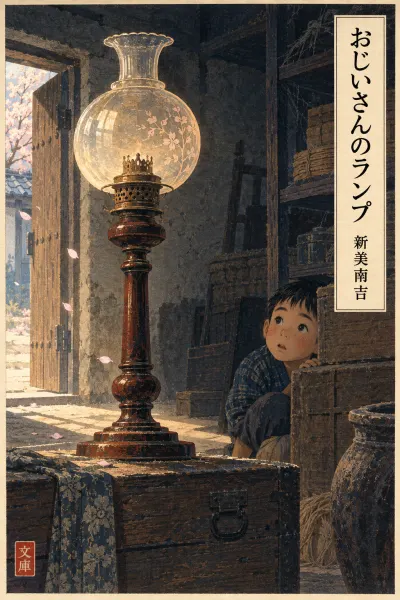
This is a story within a story. On a spring day, a boy named Tōichi finds a strange old lamp in the family storehouse while playing hide-and-seek. His grandfather is gruff at first, then softens and begins to tell the story behind it. The tale goes back to the late Meiji era, to an orphan boy in a dark village on the Chita Peninsula. There he first sees the bright glass lamps of a seaside town and decides his future lies in bringing that light home. The story follows his rise as a lamp seller and what happens when electricity arrives. It is warm and gently humorous, and it turns serious when a person has to face change. The narrator often speaks directly to the reader, like someone telling a story aloud. For learners, the narration is mostly clear plain-form Japanese. The challenges are the rustic village dialogue, some Meiji-era vocabulary such as 文明開化, and a few long, looping sentences. At about 11,800 characters in nine parts, it is a manageable first long read at around N2.
Contents
- An Odd Lamp from the Storehouse
- Minosuke, the Orphan Who Wanted More
- Ōno by Lamplight, and a Bold Request
- Minosuke Becomes a Lamp Seller
- Learning to Read, and Strange Poles
- Electric Light Comes to Ōno
- Minosuke's Midnight Revenge Plan
- A Farewell to the Lamps by Handa Pond
- The Last Lamps and a Grandfather's Lesson
Easier versions
This story is also retold in simpler Japanese. Reading an easier version first makes the original much more approachable.
Before you read
- Keep track of the two time layers. Part 1 and the end of Part 9 take place in the present, with the grandfather speaking brusquely to Tōichi. Parts 2–9 are his memories, told in plain-form (だ/である) narration, and the narrator sometimes addresses the reader directly.
- Expect Owari/Chita dialect in the village dialogue. だげな marks hearsay ('they say that…'), だのイ is a friendly sentence-ending tag, ええ means いい, and characters use おれ and わし for 'I'. Mentally convert these to standard forms and the sentences become simple.
- Learn the core vocabulary of the story's theme before you start: ランプ, 電気, 行灯 (andon lantern), 文明開化 ('civilisation and enlightenment'), 身を立てる ('make something of oneself') and 人力車 (rickshaw). They carry the story's central conflict between old and new light.
- Watch for the recurring grammar points: 〜かも知れない, 〜かと思ったら, 〜ほどだ, 〜させておく, stem + はしない, 〜たり〜たり, 〜ものだ (spoken as もんだ), 〜とて, 〜ねばならない and たとい〜としても. The last three have a slightly old-fashioned tone and appear at the story's moments of resolve.
- In Parts 7–8, read Minosuke's words to his flint and steel slowly. The whole turn of the story rests on him hearing his own complaint and applying it to the lamps.
Words to know
The most useful words from the notes across the story.
| Word | Meaning | JLPT |
|---|---|---|
| 文明開化ぶんめいかいか | 'civilisation and enlightenment': the Meiji-era slogan for WesternisationA key historical term for the modernisation of Japan after 1868. | — |
| 負けまける | to give a discount, knock down the pricedictionary form: 負けるBesides 'to lose'; 負からん (sentence 28) is the dialect negative of intransitive 負かる, 'the price won't come down'. | N4 |
| きっかけきっかけ | opportunity, starting point | N2 |
| 番頭ばんとう | head clerk (of a shop)Old-fashioned term for the senior employee who ran a merchant's shop. | — |
| 身を立てねばみをたてる | to make one's way in the world, establish oneselfdictionary form: 身を立てるA Meiji-era ideal of self-advancement through effort. | — |
| 卸値おろしね | wholesale priceContrast 小売値 (こうりね), the retail price. | — |
| まじまじとまじまじと | (to stare) hard, intently, with wide-open eyes (often in surprise) | — |
| 利器りき | useful device, convenient toolLiterary; mostly in 文明の利器 'the conveniences of civilisation'. | — |
| すっぱりすっぱり | cleanly; decisively; once and for allUsed for cutting ties or giving something up without hesitation. | — |
| 時世じせい | the times; an eraSomewhat formal or old-fashioned. | — |
| ひらけたひらける | to become developed or modern (of the world or a place)dictionary form: 開けるIntransitive verb, often written 開ける. | N5 |
| 支度したく | preparations | N4 |
| 電燈でんとう | electric lightOlder spelling of 電灯. 電燈がひける means electric lines are brought in. | N4 |
| えんりょえんりょ | reserve, holding backdictionary form: 遠慮えんりょなしに means frankly, without holding back. | N4 |
| 真剣しんけん | serious, earnestLiterally 'a real sword', as opposed to a wooden practice one. | N3 |
Plot summary
Show the full summary (contains spoilers)
Tōichi finds an old lamp in the storehouse, and his grandfather tells its story. Around the Russo-Japanese War, Minosuke, an orphan in Yanabe Shinden, is dazzled by the glass lamps of Ōno and persuades a shopkeeper to sell him one at the wholesale price. He lends it free to the village shop, which wins him customers. He becomes a lamp seller, marries and learns to read. Then electricity reaches Ōno. When the village council decides to adopt it, Minosuke resentfully tries to burn down the village head's house. His flint and steel won't light, and as he curses the useless tool, his own words stop him. He sees that the lamp's day is over and is ashamed of targeting an innocent man. At Handa Pond he hangs his lamps, lit, in the trees and smashes them with stones until tears stop him. He then becomes a bookseller. The grandfather reveals that he was Minosuke, and Tōichi looks at him with new respect.
About the author
Niimi Nankichi was a Japanese writer of children's stories, poems and songs from Handa in Aichi Prefecture. The countryside of that area is widely thought to lie behind the village and hills of Gongitsune. He began writing as a young man. Gongitsune appeared in the children's magazine Akai Tori (The Red Bird), edited by Suzuki Miekichi. Niimi later worked as a teacher at a girls' school while continuing to write. His health was poor, and he died of tuberculosis while still in his twenties. Many of his works were published and became widely known only after his death. Besides Gongitsune, he is especially remembered for Tebukuro wo Kai ni (Buying Mittens).