Part 1 of 9 · JLPT N2
おじいさんのランプ Ojiisan no Ranpu, part 1: An Odd Lamp from the Storehouse
In this part
During a game of hide-and-seek, Tōichi finds a strange bamboo-stand lamp in the family storehouse, and his grandfather scolds the children and sends them outside. That evening Tōichi secretly fiddles with the lamp and is caught again. This time his grandfather does not scold him but says the lamp brings back fond memories of long ago.
AI translation · independently checked
かくれんぼで、倉の隅にもぐりこんだ東一君がランプを持って出て来た。During a game of hide-and-seek, Tōichi, who had crawled into a corner of the storehouse, came out holding a lamp.
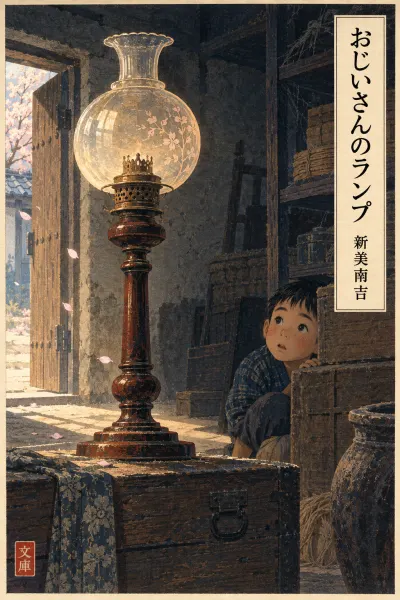
それは珍らしい形のランプであった。It was a lamp of a most unusual shape.
八十糎ぐらいの太い竹の筒が台になっていて、その上にちょっぴり火のともる部分がくっついている、そしてほやは、細いガラスの筒であった。A thick bamboo tube about eighty centimetres long served as its stand, and on top of that sat a small part where the flame burned; and its chimney was a slender glass tube.
はじめて見るものにはランプとは思えないほどだった。Anyone seeing it for the first time could hardly have believed it was a lamp at all.
そこでみんなは、昔の鉄砲とまちがえてしまった。And so everyone took it for an old-fashioned gun.
「何だア、鉄砲かア」と鬼の宗八君はいった。"What's that, then — a gun?" said Sōhachi, who was 'it'.
東一君のおじいさんも、しばらくそれが何だかわからなかった。Even Tōichi's grandfather could not make out for a while what it was.
眼鏡越しにじっと見ていてから、はじめてわかったのである。Only after staring hard at it through his spectacles did he finally understand.
ランプであることがわかると、東一君のおじいさんはこういって子供たちを叱りはじめた。As soon as he saw that it was a lamp, Tōichi's grandfather began to scold the children, saying:
「こらこら、お前たちは何を持出すか。まことに子供というものは、黙って遊ばせておけば何を持出すやらわけのわからん、油断もすきもない、ぬすっと猫のようなものだ。こらこら、それはここへ持って来て、お前たちは外へ行って遊んで来い。外に行けば、電信柱でも何でも遊ぶものはいくらでもあるに」"Now then, now then, what are you dragging out? Children are really the limit — leave them to play quietly by themselves and there's no knowing what they'll drag out next. You can't take your eyes off them for a moment; they're like thieving cats. Now then, bring that here to me, and off you go and play outside. There's plenty to play with out there — telegraph poles, or whatever you like."
こうして叱られると子供ははじめて、自分がよくない行いをしたことがわかるのである。It is only when they are scolded like this that children realise they have done something they shouldn't have.
そこで、ランプを持出した東一君はもちろんのこと、何も持出さなかった近所の子供たちも、自分たちみんなで悪いことをしたような顔をして、すごすごと外の道へ出ていった。So not only Tōichi, who had brought out the lamp, but also the neighbourhood children, who had brought out nothing at all, looked as though they had all done something wrong together, and trudged dejectedly out into the street.
外には、春の昼の風が、ときおり道のほこりを吹立ててすぎ、のろのろと牛車が通ったあとを、白い蝶がいそがしそうに通ってゆくこともあった。Outside, the midday spring breeze now and then whipped up the dust of the road as it went by, and sometimes, after an ox cart had lumbered slowly past, a white butterfly would come fluttering busily along behind it.
なるほど電信柱があっちこっちに立っている。Sure enough, there were telegraph poles standing here and there.
しかし子供たちは電信柱なんかで遊びはしなかった。But the children did not play with anything like telegraph poles.
大人が、こうして遊べといったことを、いわれたままに遊ぶというのは何となくばかげているように子供には思えるのである。To children, it somehow seems silly to play exactly as they are told when a grown-up says, "Play like this."
そこで子供たちは、ポケットの中のラムネ玉をカチカチいわせながら、広場の方へとんでいった。So, clicking the glass marbles in their pockets, the children raced off towards the open square.
そしてまもなく自分たちの遊びで、さっきのランプのことは忘れてしまった。And before long, caught up in their own games, they had forgotten all about the lamp.
日ぐれに東一君は家へ帰って来た。At dusk, Tōichi came back home.
奥の居間のすみに、あのランプがおいてあった。In a corner of the back sitting room, there stood that lamp.
しかし、ランプのことを何かいうと、またおじいさんにがみがみいわれるかも知れないので、黙っていた。But he said nothing, for if he mentioned the lamp at all, his grandfather might start grumbling at him again.
夕御飯のあとの退屈な時間が来た。Then came the dull stretch of time after supper.
東一君はたんすにもたれて、ひき出しのかんをカタンカタンといわせていたり、店に出てひげを生やした農学校の先生が『大根栽培の理論と実際』というような、むつかしい名前の本を番頭に注文するところを、じっと見ていたりした。Tōichi leaned against the chest of drawers, rattling the drawer handles clack, clack, or went out into the shop and stood watching intently as a bearded teacher from the agricultural school ordered from the head clerk a book with some difficult title like *The Theory and Practice of Radish Cultivation*.
そういうことにも飽くと、また奥の居間にもどって来て、おじいさんがいないのを見すまして、ランプのそばへにじりより、そのほやをはずしてみたり、五銭白銅貨ほどのねじをまわして、ランプの芯を出したりひっこめたりしていた。When he grew tired even of that, he came back to the back sitting room, made sure his grandfather was not about, and edged up close to the lamp, where he tried taking off its chimney and turned the screw, about the size of a five-sen nickel coin, to wind the wick up and down.
すこしいっしょうけんめいになっていじくっていると、またおじいさんにみつかってしまった。He was fiddling with it rather intently when his grandfather caught him again.
けれどこんどはおじいさんは叱らなかった。This time, though, his grandfather did not scold him.
ねえやにお茶をいいつけておいて、すっぽんと煙管筒をぬきながら、こういった。He told the maid to bring some tea, pulled his pipe out of its case with a pop, and said:
「東坊、このランプはな、おじいさんにはとてもなつかしいものだ。長いあいだ忘れておったが、きょう東坊が倉の隅から持出して来たので、また昔のことを思い出したよ。こうおじいさんみたいに年をとると、ランプでも何でも昔のものに出合うのがとても嬉しいもんだ」"Tō-bō, this lamp, now — it's something very dear to your old grandfather. I'd forgotten about it for a long time, but today you brought it out from the corner of the storehouse, and it's set me remembering the old days again. When you get old like your grandfather, it's a real joy to come across things from the past, be it a lamp or anything else."
Vocabulary
| Word | Meaning | JLPT |
|---|---|---|
| 倉くら | storehouse (a fireproof building for storing family goods)Traditional houses often had a separate earth-walled 倉 (also written 蔵) for valuables and old things. | N1 |
| もぐりこんだもぐりこむ | to crawl into, burrow into, slip intodictionary form: もぐりこむもぐる (dive, go under) + こむ (into). | — |
| ほやほや | lamp chimney (the glass cover around the flame)dictionary form: 火屋Old word, usually written in kana; literally 'fire house'. | — |
| 油断もすきもないゆだんもすきもない | you can't let your guard down for a momentdictionary form: 油断も隙もないSet phrase for someone who will take advantage the instant you look away. | — |
| すごすごとすごすご | dejectedly, crestfallendictionary form: すごすごDescribes leaving quietly after being scolded or disappointed. | — |
| 電信柱でんしんばしら | telegraph pole柱 becomes ばしら (rendaku). Today also 電柱 (でんちゅう). | — |
| ラムネ玉らむねだま | glass marbleOriginally the glass ball used as a stopper in ramune soda bottles; children collected them as marbles. | — |
| がみがみがみがみ | naggingly, grumbling loudly (at someone)Onomatopoeic; usually がみがみ言う 'to nag, tell off'. | — |
| 番頭ばんとう | head clerk (of a shop)Old-fashioned term for the senior employee who ran a merchant's shop. | — |
| 見すましてみすます | to make sure (by looking), to watch carefully and confirmdictionary form: 見すますHere: checking that Grandfather is not there before acting. | — |
| にじりよりにじりよる | to edge up close, shuffle nearerdictionary form: にじり寄るOriginally moving forward on one's knees on tatami. | — |
| 白銅貨はくどうか | nickel (cupronickel) coinThe five-sen coin was a common coin of the period; a sen (銭) was one hundredth of a yen. | — |
| 煙管筒きせるづつ | pipe case (for a long Japanese tobacco pipe)煙管 (きせる) is a traditional thin pipe; 筒 becomes づつ by rendaku. | — |
| なつかしいなつかしい | dear, fondly remembered, bringing back memoriesdictionary form: 懐かしいNo single English equivalent; expresses warm nostalgia for something from the past. | N2 |
Grammar
〜ほどだ N3 to the extent that…, so much that…
ほど marks the degree of something. Here the lamp looked so odd that a first-time viewer could not even think of it as a lamp.
はじめて見るものにはランプとは思えないほどだった。
Anyone seeing it for the first time could hardly have believed it was a lamp.
〜させておく N3 to let (someone) keep doing…, leave (someone) to…
The causative 遊ばせる ('let play') plus 〜ておく ('leave in that state'). With 〜ば it means 'if you just leave them to play…'.
黙って遊ばせておけば何を持出すやらわけのわからん
leave them to play quietly by themselves and there's no knowing what they'll drag out
Verb stem + はしない N2 emphatic negation: did not (do) at all
Inserting は between the verb stem and しない stresses the negative, contrasting with what was expected. The grown-up suggested telegraph poles, but the children certainly did not play with them.
しかし子供たちは電信柱なんかで遊びはしなかった。
But the children did not play with anything like telegraph poles.
〜かも知れない N4 might, may
Expresses possibility. Tōichi fears his grandfather might nag him again, so he stays quiet.
またおじいさんにがみがみいわれるかも知れないので、黙っていた。
His grandfather might start grumbling at him again, so he said nothing.
〜たり〜たりする N5 doing things like… and…; (alternating) … and …
Lists representative actions, or, with opposite verbs, a back-and-forth action. 出したりひっこめたり shows the wick going up and down again and again.
ランプの芯を出したりひっこめたりしていた。
he wound the wick up and down.
〜ものだ (もんだ) N3 it's natural that…, that's how things are
States a general truth or feeling based on experience. もんだ is the casual spoken form, fitting the grandfather's familiar speech.
昔のものに出合うのがとても嬉しいもんだ
it's a real joy to come across things from the past