Part 1 of 3 · JLPT N3
おきなぐさ Okinagusa, part 1: The Flower Everyone Loves
In this part
The narrator introduces the uzu no shuge, or pasqueflower, and explains why its folk name suits it better than its botanical one. An ant tells him how much the ants love the flower, which glows red in sunlight and whose silver hairs they use to soothe the sick, and a wild mountain man forgets his meal to gaze at one. The narrator then recalls a clear, breezy day at this same time of year, a year earlier, when two of these flowers were blooming south of Koiwai Farm.
AI translation · independently checked
うずのしゅげを知っていますか。Do you know the uzu no shuge?
うずのしゅげは、植物学ではおきなぐさと呼ばれますが、おきなぐさという名はなんだかあのやさしい若い花をあらわさないようにおもいます。In botany the uzu no shuge is called okinagusa (pasqueflower), but somehow I feel that the name okinagusa does not express that gentle young flower.
そんならうずのしゅげとはなんのことかと言われても私にはわかったようなまたわからないような気がします。So if you ask me what 'uzu no shuge' actually means, I feel as though I understand it, and yet I don't.
それはたとえば私どもの方で、ねこやなぎの花芽をべんべろと言いますが、そのべんべろがなんのことかわかったようなわからないような気がするのと全くおなじです。It is just like this: where I come from, we call the flower buds of the pussy willow 'benbero,' and I feel as though I understand what 'benbero' means, and yet I don't.
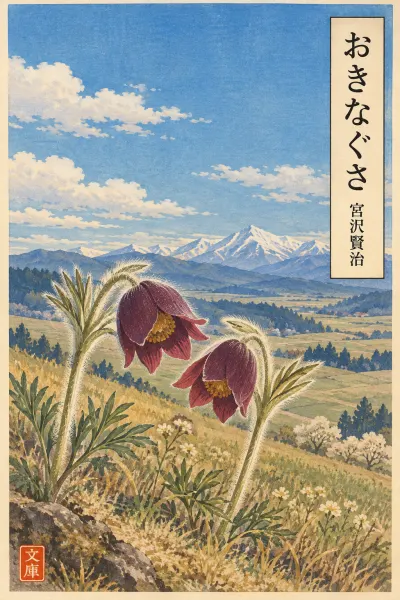
とにかくべんべろという語のひびきの中に、あの柳の花芽の銀びろうどのこころもち、なめらかな春のはじめの光のぐあいが実にはっきり出ているように、うずのしゅげというときは、あの毛茛科のおきなぐさの黒朱子の花びら、青じろいやはり銀びろうどの刻みのある葉、それから六月のつやつや光る冠毛がみなはっきりと眼にうかびます。In any case, the sound of the word 'benbero' brings out very clearly the silver-velvet feel of those willow buds and the smooth quality of early spring light. In the same way, when I say 'uzu no shuge,' everything comes clearly before my eyes: the black-satin petals of that pasqueflower of the buttercup family, its pale bluish leaves, notched and likewise like silver velvet, and then the glossy, shining plumes of seed-down in June.
まっ赤なアネモネの花の従兄、きみかげそうやかたくりの花のともだち、このうずのしゅげの花をきらいなものはありません。It is a cousin of the bright red anemone and a friend of the lily of the valley and the dogtooth violet, and there is no one who dislikes this uzu no shuge flower.
ごらんなさい。Just look.
この花は黒朱子ででもこしらえた変わり型のコップのように見えますが、その黒いのは、たとえば葡萄酒が黒く見えると同じです。This flower looks like an oddly shaped cup made of black satin, but its blackness is like the way red wine looks black.
この花の下を始終往ったり来たりする蟻に私はたずねます。I put a question to an ant that is forever going back and forth beneath this flower.
「おまえはうずのしゅげはすきかい、きらいかい」"Do you like the uzu no shuge, or do you dislike it?"
蟻は活発に答えます。The ant answers briskly.
「大すきです。誰だってあの人をきらいなものはありません」"I love it. There is no one at all who dislikes her."
「けれどもあの花はまっ黒だよ」"But that flower is pitch black, you know."
「いいえ、黒く見えるときもそれはあります。けれどもまるで燃えあがってまっ赤な時もあります」"No. There are times, it's true, when she looks black. But there are also times when she is bright red, as if she were blazing up in flames."
「はてな、お前たちの眼にはそんなぐあいに見えるのかい」"Well, now. Is that how she looks to your eyes?"
「いいえ、お日さまの光の降る時なら誰にだってまっ赤に見えるだろうと思います」"No, I think that when the sunlight is pouring down, she would look bright red to anyone."
「そうそう。もうわかったよ。お前たちはいつでも花をすかして見るのだから」"Yes, yes. Now I understand. You always look at the flower with the light shining through it."
「そしてあの葉や茎だって立派でしょう。やわらかな銀の糸が植えてあるようでしょう。私たちの仲間では誰かが病気にかかったときはあの糸をほんのすこうしもらって来てしずかにからだをさすってやります」"And her leaves and stem are splendid too, aren't they? It's as if soft silver threads had been planted in them. Among us, when someone falls ill, we fetch just the tiniest bit of that thread and gently rub their body with it."
「そうかい。それで、結局、お前たちはうずのしゅげは大すきなんだろう」"I see. So, after all that, you really do love the uzu no shuge, don't you?"
「そうです」"Yes, we do."
「よろしい。さよなら。気をつけておいで」"Very good. Goodbye. Take care as you go."
この通りです。There, you see how it is.
また向こうの、黒いひのきの森の中のあき地に山男がいます。And over there, in a clearing in the dark cypress woods, is a wild mountain man.
山男はお日さまに向いて倒れた木に腰掛けて何か鳥を引き裂いてたべようとしているらしいのですが、なぜあの黝んだ黄金の眼玉を地面にじっと向けているのでしょう。The mountain man is sitting on a fallen tree, facing the sun. He seems to be about to tear apart some bird and eat it, but why is he fixing those darkened golden eyeballs of his so steadily on the ground?
鳥をたべることさえ忘れたようです。He seems to have forgotten even to eat the bird.
あれは空地のかれ草の中に一本のうずのしゅげが花をつけ風にかすかにゆれているのを見ているからです。It is because he is watching a single uzu no shuge blooming among the withered grass of the clearing and swaying faintly in the wind.
私は去年のちょうど今ごろの風のすきとおったある日のひるまを思い出します。I remember the midday hours of a certain day last year, at just about this time, when the wind was clear and transparent.
それは小岩井農場の南、あのゆるやかな七つ森のいちばん西のはずれの西がわでした。It was south of Koiwai Farm, on the western side of the farthest western edge of gentle Nanatsumori.
かれ草の中に二本のうずのしゅげが、もうその黒いやわらかな花をつけていました。Among the withered grass, two uzu no shuge were already wearing their soft black flowers.
まばゆい白い雲が小さな小さなきれになって砕けてみだれて、空をいっぱい東の方へどんどんどんどん飛びました。Dazzling white clouds broke apart into tiny, tiny scraps and scattered, and they flew on and on, faster and faster, eastward across the whole sky.
お日さまは何べんも雲にかくされて銀の鏡のように白く光ったり、またかがやいて大きな宝石のように蒼ぞらの淵にかかったりしました。Again and again the sun was hidden by clouds and shone white like a silver mirror, and then it would blaze out again and hang like a great jewel at the edge of the deep blue sky.
山脈の雪はまっ白に燃え、眼の前の野原は黄いろや茶の縞になってあちこち掘り起こされた畑は鳶いろの四角なきれをあてたように見えたりしました。The snow on the mountain range burned pure white, the fields before my eyes lay in stripes of yellow and brown, and here and there the ploughed-up fields looked like square patches of kite-brown cloth sewn on.
Vocabulary
| Word | Meaning | JLPT |
|---|---|---|
| うずのしゅげうずのしゅげ | pasqueflower (local folk name)A dialect name from Iwate for the okinagusa. It is kept in romanised form because the story is about the feeling of the name itself. | — |
| べんべろべんべろ | pussy-willow catkins (dialect)A local word. The narrator says it is hard to explain but perfectly evocative. | — |
| ねこやなぎねこやなぎ | pussy willowdictionary form: 猫柳Literally 'cat willow', named for its furry catkins. | — |
| 花芽はなめ | flower budBotanical term for a bud that will become a flower. Compare 葉芽 (はめ), a leaf bud. | — |
| ひびきひびき | sound, ring, echo (of a word)dictionary form: 響き | N2 |
| 冠毛かんもう | pappus; the silky plume on a seedThose white, hair-like plumes are what make the flower 'old-man grass'. | — |
| こしらえたこしらえる | to make, to craftdictionary form: 拵えるA homely, slightly old-fashioned word for 作る. | N2 |
| 始終しじゅう | constantly, all the timeLiterally 'beginning and end'. | N2 |
| 活発かっぱつ | lively, brisk | N1 |
| すかしてすかす | to look through something against the lightdictionary form: 透かす透かして見る means to see light shining through something, which is why the petals look red to the ants. | — |
| さすってさする | to stroke, to rub gentlydictionary form: 擦る | — |
| 山男やまおとこ | wild mountain man (a folklore figure)In Tōhoku legend, a huge wild man who lives in the mountains. He appears often in Kenji's stories. | — |
| すきとおったすきとおる | to be clear, transparentdictionary form: 透き通るA favourite word of Kenji's, used here for clear spring wind. | N2 |
| まばゆいまばゆい | dazzling, blindingdictionary form: 眩い | — |
Grammar
〜ような気がする N3 to feel as if ~, to have a feeling that ~
The phrase expresses a vague impression rather than a firm statement. Here two such clauses are paired to mean 'I feel I understand, and yet I feel I don't.'
わかったようなまたわからないような気がします
I feel as though I understand it, and yet I don't.
誰だって N3 anyone at all, everyone
だって after a question word is a casual form of でも, meaning 'any ~ at all'. Followed by a negative, as here, it gives a strong 'no one'.
誰だってあの人をきらいなものはありません
There is no one at all who dislikes her.
〜てやる N4 to do something for someone (of lower or equal status)
やる is the plain counterpart of あげる. Here it shows the ants doing a kind deed for their sick companions.
しずかにからだをさすってやります
we gently rub their body with it.
〜ようとしているらしい N3 seems to be about to ~
The volitional form plus としている means 'trying to' or 'about to'. らしい adds that this is the narrator's inference from what he sees.
何か鳥を引き裂いてたべようとしているらしいのですが
He seems to be about to tear apart some bird and eat it, but…
〜さえ N3 even ~
さえ marks something extreme or unexpected. Forgetting to eat his very meal shows how absorbed the mountain man is.
鳥をたべることさえ忘れたようです。
He seems to have forgotten even to eat the bird.
〜たり〜たりする N4 doing ~ and ~ (by turns)
Lists actions that alternate or repeat. Here the sun keeps switching between shining white like a silver mirror and blazing out like a great jewel.
銀の鏡のように白く光ったり、またかがやいて大きな宝石のように蒼ぞらの淵にかかったりしました。
It shone white like a silver mirror, and then it would blaze out again and hang like a great jewel at the edge of the deep blue sky.