Part 3 of 3 · JLPT N3
おきなぐさ Okinagusa, part 3: The Wind Comes and the Flowers Fly
In this part
The skylark comforts the two pasqueflowers, and a clear wind arrives. The flowers say goodbye, burst apart, and their silver hairs fly off to the north, while the skylark flies straight up and sings a short song. The narrator believes the flowers' souls went to heaven and became two small variable stars.
AI translation · independently checked
「そうです、そうです。なんにもこわいことはありません。僕だってもういつまでこの野原にいるかわかりません。もし来年もいるようだったら来年は僕はここへ巣をつくりますよ」"That's right, that's right. There's nothing at all to be afraid of. Even I don't know how much longer I'll be on this meadow. If it looks as though I'll still be here next year, then next year I'll build my nest here."
「ええ、ありがとう。ああ、僕まるで息がせいせいする。きっと今度の風だ。ひばりさん、さよなら」"Yes, thank you. Ah, I can breathe so freely now. This next wind must be the one. Goodbye, Mr Skylark."
「僕も、ひばりさん、さよなら」"Me too, Mr Skylark. Goodbye."
「じゃ、さよなら、お大事においでなさい」"Well then, goodbye. Please take good care of yourselves on your way."
奇麗なすきとおった風がやって参りました。A lovely, clear, transparent wind came along.
まず向こうのポプラをひるがえし、青の燕麦に波をたてそれから丘にのぼって来ました。First it set the poplars over there fluttering, sent waves running through the green oats, and then it came climbing up the hill.
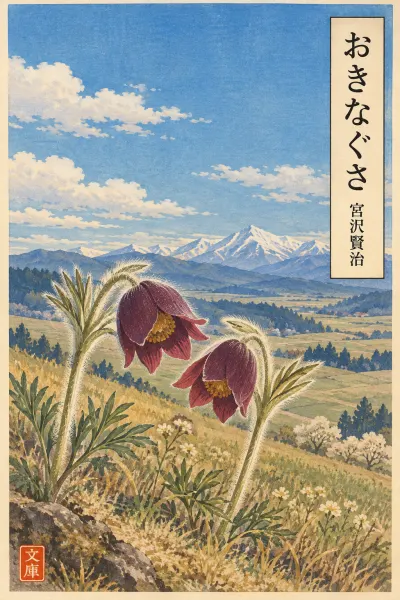
うずのしゅげは光ってまるで踊るようにふらふらして叫びました。The uzu no shuge shone and swayed this way and that as if they were dancing, and they cried out.
「さよなら、ひばりさん、さよなら、みなさん。お日さん、ありがとうございました」"Goodbye, Mr Skylark! Goodbye, everyone! Thank you, Mr Sun!"
そしてちょうど星が砕けて散るときのように、からだがばらばらになって一本ずつの銀毛はまっしろに光り、羽虫のように北の方へ飛んで行きました。And just as when a star shatters and scatters, their bodies came apart, and each silver hair, one by one, shone pure white and flew away to the north like a little winged insect.
そしてひばりは鉄砲玉のように空へとびあがって鋭いみじかい歌をほんのちょっと歌ったのでした。And the skylark shot up into the sky like a bullet and sang a sharp, short song, just for a moment.
私は考えます。This is what I think.
なぜひばりはうずのしゅげの銀毛の飛んで行った北の方へ飛ばなかったか、まっすぐに空の方へ飛んだか。Why did the skylark not fly north, where the uzu no shuge's silver hairs had gone? Why did it fly straight up toward the sky?
それはたしかに、二つのうずのしゅげのたましいが天の方へ行ったからです。It is surely because the souls of the two uzu no shuge went up toward heaven.
そしてもう追いつけなくなったときひばりはあのみじかい別れの歌を贈ったのだろうと思います。And I think that when it could no longer catch up with them, the skylark sent them that short song of farewell.
そんなら天上へ行った二つの小さなたましいはどうなったか、私はそれは二つの小さな変光星になったと思います。Then what became of the two little souls that went up to heaven? I believe they became two small variable stars.
なぜなら変光星はあるときは黒くて天文台からも見えず、あるときは蟻が言ったように赤く光って見えるからです。For a variable star is sometimes dark and cannot be seen even from an observatory, and at other times it shines red, just as the ant said.
Vocabulary
| Word | Meaning | JLPT |
|---|---|---|
| 巣す | nest巣をつくる = to build a nest. | N3 |
| せいせいするせいせいする | to feel refreshed, free and relievedOften written 清々する. Here, breathing feels light and open. | — |
| お大事におだいじに | take care (of yourself)Usually said to someone who is ill. おいでなさい here means 'go', so the whole phrase means 'go safely'. | N2 |
| ひるがえしひるがえす | to make something flutter or flip overdictionary form: 翻すUsed of flags and leaves turned over by the wind. | — |
| 燕麦えんばく | oatsHere the author gives it the special reading オート ('oats'). | — |
| ふらふらふらふら | swaying, unsteadilyA mimetic word for loose, wobbling movement. | — |
| 砕けてくだける | to shatter, to break into piecesdictionary form: 砕けるIntransitive. The transitive form is 砕く. | N2 |
| 散るちる | to scatter, to fall (of petals)Often used of blossoms falling. | N2 |
| ばらばらばらばら | in pieces, apartばらばらになる = to come apart. | — |
| 銀毛ぎんもう | silver hairsThe fluffy seed hairs of the pasqueflower. | — |
| 鉄砲玉てっぽうだま | bullet〜のように here means 'fast and straight, like a bullet'. | — |
| 贈ったおくる | to give as a gift, to presentdictionary form: 贈るWritten 贈る for gifts and 送る for sending or seeing someone off. | N3 |
| 変光星へんこうせい | variable starA star whose brightness changes. Kanji: 変 'change' + 光 'light' + 星 'star'. | — |
| 天文台てんもんだい | observatory | — |
Grammar
〜だって N3 even ~, ~ too
A casual form of でも/も that follows a noun. Here it stresses that the skylark is in the same uncertain situation as the flowers.
僕だってもういつまでこの野原にいるかわかりません。
Even I don't know how much longer I'll be on this meadow.
〜ようだったら N3 if it seems that ~
ようだ ('it seems') combined with the conditional たら. It sets up a condition the speaker is not sure about.
もし来年もいるようだったら来年は僕はここへ巣をつくりますよ
If it looks as though I'll still be here next year, then next year I'll build my nest here.
まるで〜ように N3 just as if ~
まるで strengthens a comparison made with ように. The flowers' swaying is compared to dancing.
うずのしゅげは光ってまるで踊るようにふらふらして叫びました。
The uzu no shuge shone and swayed this way and that as if they were dancing, and they cried out.
〜のだろうと思います N3 I think it must be that ~
The narrator gives a gentle guess about the reason behind what happened. の(だ) marks an explanation, and だろう adds that it is a supposition.
ひばりはあのみじかい別れの歌を贈ったのだろうと思います。
I think the skylark sent them that short song of farewell.
なぜなら〜からです N3 the reason is that ~
It starts a sentence that explains the previous claim. なぜなら opens the explanation and からです closes it.
なぜなら変光星はあるときは黒くて天文台からも見えず、あるときは蟻が言ったように赤く光って見えるからです。
For a variable star is sometimes dark and cannot be seen even from an observatory, and at other times it shines red, just as the ant said.
〜ず (連用形) N2 not ~, and ...
A written negative form that links clauses, equivalent to 〜なくて. 見えず means 'cannot be seen, and ...'.
あるときは黒くて天文台からも見えず
Sometimes it is dark and cannot be seen even from an observatory.