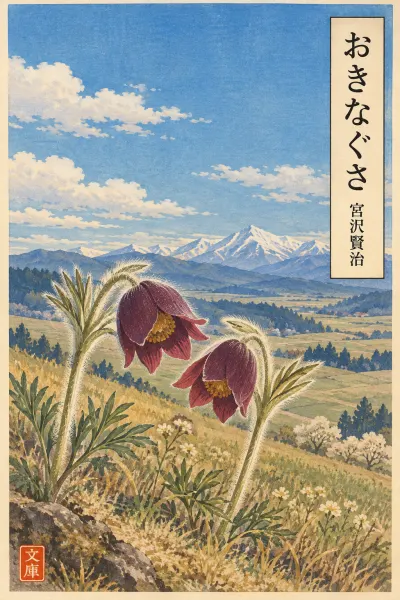
Part 2 of 3 · JLPT N3
おきなぐさ Okinagusa, part 2: Cloud Shadows and Silver Plumes
In this part
The two pasqueflowers watch cloud shadows race across the fields and mountains and wonder where clouds come from. A skylark blown down by the wind tells them that in two months they will have to fly. Two months later the narrator returns to find the flowers turned into silver seed plumes, ready and unafraid to be carried away by the wind.
AI translation · independently checked
おきなぐさはその変幻の光の奇術の中で夢よりもしずかに話しました。Amid that ever-changing magic trick of light, the pasqueflowers talked together more quietly than a dream.
「ねえ、雲がまたお日さんにかかるよ。そら向こうの畑がもう陰になった」"Hey, a cloud's going over the sun again. Look, the field over there is already in shadow."
「走って来る、早いねえ、もうから松も暗くなった。もう越えた」"Here it comes running. Isn't it fast! Now the larches have gone dark too. Now it's past them."
「来た、来た。おおくらい。急にあたりが青くしんとなった」"It's here, it's here. Ooh, it's dark. All of a sudden everything around us has turned blue and hushed."
「うん、だけどもう雲が半分お日さんの下をくぐってしまったよ。すぐ明るくなるんだよ」"Yeah, but half the cloud has already slipped past under the sun. It'll be bright again soon."
「もう出る。そら、ああ明るくなった」"It's coming out now. Look—ah, it's bright again."
「だめだい。また来るよ、そら、ね、もう向こうのポプラの木が黒くなったろう」"No good. Another one's coming. Look, see? The poplar over there has already gone black, hasn't it?"
「うん。まるでまわり燈籠のようだねえ」"Yeah. It's just like a revolving lantern, isn't it?"
「おい、ごらん。山の雪の上でも雲のかげがすべってるよ。あすこ。そら。ここよりも動きようがおそいねえ」"Hey, look. The cloud shadows are sliding over the snow on the mountain too. Over there. See? They move slower than they do here."
「もうおりて来る。ああこんどは早い早い、まるで落ちて来るようだ。もうふもとまで来ちゃった。おや、どこへ行ったんだろう、見えなくなってしまった」"Now it's coming down. Oh, this time it's fast, so fast, it's like it's falling. It's already reached the foot of the mountain. Huh, where did it go? I can't see it anymore."
「不思議だねえ、雲なんてどこから出て来るんだろう。ねえ、西のそらは青じろくて光ってよく晴れてるだろう。そして風がどんどん空を吹いてるだろう。それだのにいつまでたっても雲がなくならないじゃないか」"Isn't it strange? Where do clouds even come from? Look, the western sky is pale blue and shining and nice and clear, right? And the wind is blowing hard across the sky, right? And yet, no matter how long we wait, the clouds never run out."
「いいや、あすこから雲が湧いて来るんだよ。そら、あすこに小さな小さな雲きれが出たろう。きっと大きくなるよ」"No, the clouds come welling up from over there. Look, a tiny, tiny scrap of cloud has appeared over there, see? I bet it'll get bigger."
「ああ、ほんとうにそうだね、大きくなったねえ。もう兎ぐらいある」"Oh, you're right, it has got bigger. It's already as big as a rabbit."
「どんどんかけて来る。早い早い、大きくなった、白熊のようだ」"It's racing toward us. So fast, so fast—it's got bigger, it's like a polar bear."
「またお日さんへかかる。暗くなるぜ、奇麗だねえ。ああ奇麗。雲のへりがまるで虹で飾ったようだ」"It's going over the sun again. It's going to get dark, you know. Isn't it beautiful! Oh, so beautiful. The edge of the cloud looks just as if it were trimmed with a rainbow."
西の方の遠くの空でさっきまで一生けん命啼いていたひばりがこの時風に流されて羽を変にかしげながら二人のそばに降りて来たのでした。Just then a skylark, which until a moment before had been singing with all its might far away in the western sky, was swept along by the wind and came down beside the two of them, its wings tilted oddly.
「今日は、風があっていけませんね」"Good day. This wind is quite a nuisance, isn't it?"
「おや、ひばりさん、いらっしゃい。今日なんか高いとこは風が強いでしょうね」"Oh, Mr. Skylark, welcome. On a day like today it must be windy up high, isn't it?"
「ええ、ひどい風ですよ。大きく口をあくと風が僕のからだをまるで麦酒瓶のようにボウと鳴らして行くくらいですからね。わめくも歌うも容易のこっちゃありませんよ」"Yes, it's a terrible wind. If I open my beak wide, the wind goes rushing through me and makes my whole body boom like a beer bottle. Shouting or singing is no easy matter, I assure you."
「そうでしょうね。だけどここから見ているとほんとうに風はおもしろそうですよ。僕たちも一ぺん飛んでみたいなあ」"I suppose not. But watching from down here, the wind really looks like fun. We'd love to try flying just once too."
「飛べるどこじゃない。もう二か月お待ちなさい。いやでも飛ばなくちゃなりません」"Try flying? It's more than that. Just wait two more months. You'll have to fly whether you like it or not."
それから二か月めでした。Then two months went by.
私は御明神へ行く途中もう一ぺんそこへ寄ったのでした。On my way to Gomyōjin, I stopped by that place once more.
丘はすっかり緑でほたるかずらの花が子供の青い瞳のよう、小岩井の野原には牧草や燕麦がきんきん光っておりました。The hill was all green, the gromwell flowers were like children's blue eyes, and in the fields of Koiwai the pasture grass and oats were glittering brightly.
風はもう南から吹いていました。The wind was already blowing from the south.
春の二つのうずのしゅげの花はすっかりふさふさした銀毛の房にかわっていました。The two uzu no shuge flowers of spring had turned completely into tufts of fluffy silver down.
野原のポプラの錫いろの葉をちらちらひるがえし、ふもとの草が青い黄金のかがやきをあげますと、その二つのうずのしゅげの銀毛の房はぷるぷるふるえて今にも飛び立ちそうでした。When the wind set the tin-coloured leaves of the poplars in the fields fluttering and the grass at the foot of the hills gave off a blue-golden gleam, the silver tufts of the two uzu no shuge trembled and quivered as if they might take off at any moment.
そしてひばりがひくく丘の上を飛んでやって来たのでした。And then the skylark came flying low over the hill.
「今日は。いいお天気です。どうです。もう飛ぶばかりでしょう」"Good day. Lovely weather. Well now? You must be just about ready to fly."
「ええ、もう僕たち遠いとこへ行きますよ。どの風が僕たちを連れて行くかさっきから見ているんです」"Yes, we're off to somewhere far away now. We've been watching for a while to see which wind will take us."
「どうです。飛んで行くのはいやですか」"Tell me, do you mind flying away?"
「なんともありません。僕たちの仕事はもう済んだんです」"Not at all. Our work is already done."
「こわかありませんか」"Aren't you frightened?"
「いいえ、飛んだってどこへ行ったって野はらはお日さんのひかりでいっぱいですよ。僕たちばらばらになろうたって、どこかのたまり水の上に落ちようたって、お日さんちゃんと見ていらっしゃるんですよ」"No. However far we fly, wherever we go, the fields are full of sunlight. Even if we get scattered apart, even if we fall onto some puddle somewhere, the sun is always watching over us."
Vocabulary
| Word | Meaning | JLPT |
|---|---|---|
| 変幻へんげん | ever-changing, shifting in and out of viewLiterary word; often in 変幻自在 'changing freely'. | — |
| 奇術きじゅつ | magic trick, conjuringHere glossed with the loanword トリック 'trick'. | — |
| くぐってくぐる | to pass under, to slip throughdictionary form: くぐるUsed for going under something such as a gate, bridge or rope. | N1 |
| まわり燈籠まわりどうろう | revolving lanterndictionary form: 回り灯籠A lantern whose spinning inner frame casts moving shadow pictures; 燈 is the old form of 灯. | — |
| 湧いてわく | to well up, to spring updictionary form: 湧くUsed for water from a spring, and also for clouds or feelings arising. | N2 |
| 啼いてなく | to sing, to call (of a bird)dictionary form: 啼くOlder kanji; modern writing uses 鳴く. | N5 |
| かしげかしげる | to tilt, to tip to one sidedictionary form: 傾げるCommon in 首をかしげる 'tilt one's head (in doubt)'. | — |
| 容易ようい | easy, simpleFormal; 容易なことではない = 'it is no easy matter'. | N3 |
| うずのしゅげうずのしゅげ | pasqueflower (local folk name)Iwate dialect name for おきなぐさ; kept as a romanised name in the English. | — |
| 房ふさ | tuft, tassel, clusterHere the fluffy seed head; ふさふさ 'fluffy, bushy' comes from the same idea. | — |
| ひるがえしひるがえす | to flutter, to flip overdictionary form: 翻すUsed for leaves or flags turning in the wind. | — |
| 済んだすむ | to be finished, to be overdictionary form: 済むThe flowers' work of blooming is complete. | N4 |
| たまり水たまりみず | standing water, puddledictionary form: 溜まり水From 溜まる 'to collect, pile up'. | — |
Grammar
まるで〜ようだ N3 just like ~, as if ~
まるで strengthens the comparison made with 〜ようだ. Here the cloud's edge is compared to something trimmed with a rainbow.
雲のへりがまるで虹で飾ったようだ
The edge of the cloud looks just as if it were trimmed with a rainbow.
〜どこじゃない N2 far from ~, it's more than ~
A casual form of 〜どころではない. The skylark means that 'trying to fly' understates things: the flowers will soon have no choice.
飛べるどこじゃない。
Try flying? It's more than that.
〜なくちゃならない N4 must, have to
なくちゃ is a spoken contraction of なくては. With いやでも 'even if unwilling', it stresses that flying is unavoidable.
いやでも飛ばなくちゃなりません
You'll have to fly whether you like it or not.
〜ばかり N2 just about to ~, all that's left is to ~
After a dictionary-form verb, ばかり means everything is ready and only that action remains. The skylark sees the seed plumes are ready to go.
もう飛ぶばかりでしょう
You must be just about ready to fly.
〜ようたって N1 even if ~ (should happen)
The volitional form plus たって (a casual ても) gives 'even if it turns out that ~'. Two such clauses are listed to show that nothing can shake the flowers' calm.
僕たちばらばらになろうたって、どこかのたまり水の上に落ちようたって
Even if we get scattered apart, even if we fall onto some puddle somewhere
〜かありません (〜くはありません) N2 isn't ~ (contracted)
In casual speech the く of an i-adjective merges with the topic particle は: こわくは becomes こわか. The meaning is simply 'not frightening'.
こわかありませんか
Aren't you frightened?