Intermediate · JLPT N3
おきなぐさOkinagusa — Two Flowers and a Skylark
- JLPT N3
- 3,389 characters
- 3 parts
- about 28 minutes
- 2 easier versions
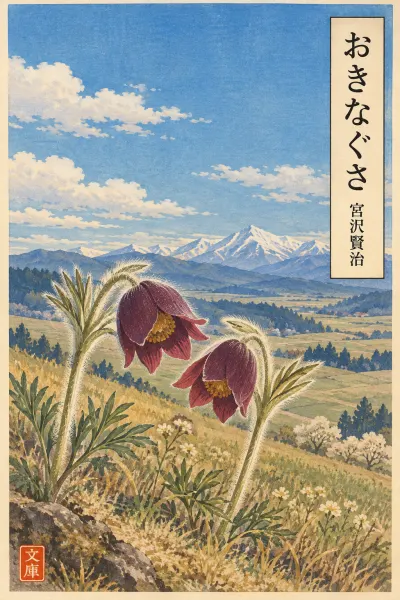
おきなぐさ is a short nature tale by Miyazawa Kenji, told by a gentle first-person narrator who speaks directly to the reader. It is about the pasqueflower, a small, hairy spring wildflower that local people call 'uzu no shuge.' The narrator begins with the flower's names and with what others see in it: an ant who adores it and a rough mountain man who stops eating to stare at one. He then recalls a breezy spring day on the hills south of Koiwai Farm, where two of these flowers chat like young boys, watch cloud shadows sweep over the fields, and meet a skylark who tells them something about their future. The tone is quiet and lyrical, full of light, wind and colour, with a touch of melancholy. For learners, the text is short and the sentences are mostly clear. It is especially useful for hearing two registers side by side: the narrator's polite desu/masu storytelling and the flowers' casual boyish dialogue. The main challenges are descriptive nature vocabulary, a few local dialect words, and Kenji's habit of piling up vivid comparisons.
Contents
Easier versions
This story is also retold in simpler Japanese. Reading an easier version first makes the original much more approachable.
Before you read
- Notice the two voices. The narrator (and the ant) use polite desu/masu, but the two flowers speak casually like young boys, with ぼく, 〜だよ, 〜ぜ and 〜だい. Spotting the sentence endings tells you who is talking even when the speaker is not named.
- Learn the core nature words before you start, because they recur throughout: 雲 (cloud), 影 (shadow), 風 (wind), ひばり (skylark), 蟻 (ant), 銀 (silver), 毛 (hair), 日光 (sunlight) and 山 (mountain).
- Expect a few local words. うずのしゅげ is the local name for the pasqueflower. The narrator admits he cannot say exactly what it means, only that it feels right to him. べんべろ is a dialect word for catkins. You do not need to analyse these words. Treat them as names.
- Watch for the comparison and emphasis patterns Kenji uses to paint scenes: まるで〜ようだ, 〜ような気がする, 〜さえ, 〜ばかり and 〜たり〜たりする. They often carry the imagery of light and movement.
- In the flowers' and skylark's dialogue, casual obligation and conjecture forms appear, such as 〜なくちゃならない (have to), 〜ようとしているらしい (seems to be about to) and 〜どこじゃない (far from just ...). Recognising them makes the conversation about the flowers' future much easier to follow.
Words to know
The most useful words from the notes across the story.
| Word | Meaning | JLPT |
|---|---|---|
| うずのしゅげうずのしゅげ | pasqueflower (local folk name)A dialect name from Iwate for the okinagusa. It is kept in romanised form because the story is about the feeling of the name itself. | — |
| ひるがえしひるがえす | to flutter, to flip overdictionary form: 翻すUsed for leaves or flags turning in the wind. | — |
| 啼いてなく | to sing, to call (of a bird)dictionary form: 啼くOlder kanji; modern writing uses 鳴く. | N5 |
| 済んだすむ | to be finished, to be overdictionary form: 済むThe flowers' work of blooming is complete. | N4 |
| 容易ようい | easy, simpleFormal; 容易なことではない = 'it is no easy matter'. | N3 |
| 巣す | nest巣をつくる = to build a nest. | N3 |
| 贈ったおくる | to give as a gift, to presentdictionary form: 贈るWritten 贈る for gifts and 送る for sending or seeing someone off. | N3 |
| ひびきひびき | sound, ring, echo (of a word)dictionary form: 響き | N2 |
| こしらえたこしらえる | to make, to craftdictionary form: 拵えるA homely, slightly old-fashioned word for 作る. | N2 |
| 始終しじゅう | constantly, all the timeLiterally 'beginning and end'. | N2 |
| すきとおったすきとおる | to be clear, transparentdictionary form: 透き通るA favourite word of Kenji's, used here for clear spring wind. | N2 |
| 湧いてわく | to well up, to spring updictionary form: 湧くUsed for water from a spring, and also for clouds or feelings arising. | N2 |
| お大事におだいじに | take care (of yourself)Usually said to someone who is ill. おいでなさい here means 'go', so the whole phrase means 'go safely'. | N2 |
| 砕けてくだける | to shatter, to break into piecesdictionary form: 砕けるIntransitive. The transitive form is 砕く. | N2 |
| 散るちる | to scatter, to fall (of petals)Often used of blossoms falling. | N2 |
Plot summary
Show the full summary (contains spoilers)
The narrator explains that the pasqueflower is known locally as 'uzu no shuge' and feels this name suits it. An ant tells him how much the ants love the flower, and a mountain man forgets his meal to gaze at it. The narrator then recalls a spring day a year earlier, when two pasqueflowers south of Koiwai Farm watched cloud shadows race across the land and wondered about the clouds. A skylark blown down by the wind told them that in two months they would have to fly. When the narrator returned two months later, the flowers had become silver seed plumes and were not afraid. The skylark comforted them, a clear wind came, and the flowers said goodbye and burst apart. Their silver hairs flew north while the skylark rose singing. The narrator believes their souls went to heaven and became two small variable stars.
About the author
Miyazawa Kenji was a poet and writer of children's stories from Hanamaki in Iwate Prefecture. He studied agricultural science in Morioka and later taught at an agricultural school. He devoted much of his life to helping local farmers improve their methods and their cultural lives. He was a devout Buddhist, and his faith, love of nature and interest in science run through his writing. His fame came after his death, with works such as 銀河鉄道の夜, 風の又三郎 and the poem 雨ニモマケズ.