 N4 · easy
Simplified retelling · JLPT N4
おきなぐさ Okinagusa in easy Japanese (N4)
This is our own simplified retelling of Two Flowers and a Skylark, written for N4 learners and checked word by word against the N4 vocabulary list. A few story words and grammar patterns go beyond N4; the notes below give each one's level. It keeps the characters, events and ending of the original. When it feels easy, move on to the original text.
The story in brief
The narrator introduces the uzu no shuge, or pasqueflower, a small dark flower that everyone loves, even the ants and a mountain man. One spring he watches two of these flowers chatting about the clouds and a skylark who visits them, and in June he returns to see their white fluff carried away by the wind. He believes their souls went up to heaven and became two little variable stars.
AI translation · independently checked
みなさんは、うずのしゅげの花を知っていますか。Do you all know the flower called uzu no shuge?
本の中では、おきなぐさとよばれています。In books, it is called the pasqueflower.
でも私は、うずのしゅげの名前のほうが、このやさしくてわかい花に合っていると思います。But I think the name uzu no shuge suits this gentle young flower better.
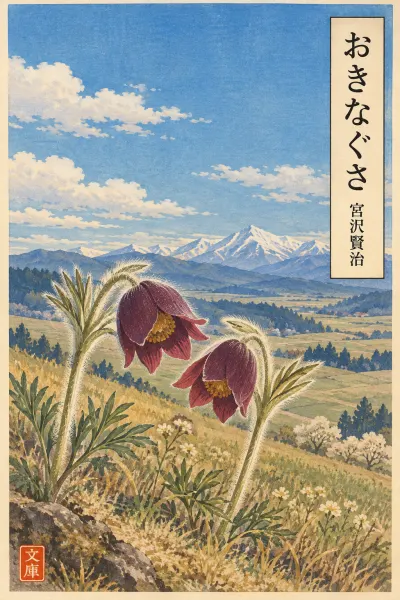
うずのしゅげの花は黒くて、小さなコップのようなかたちです。The uzu no shuge flower is black, and shaped like a little cup.
くきやはには、白いけがたくさんあります。Its stems and leaves are covered with lots of white hairs.
この花がきらいな人はいません。There is no one who dislikes this flower.
ある日、私は花の下を歩いているありに聞きました。One day, I asked an ant that was walking along beneath the flowers.
「おまえはうずのしゅげがすきかい。」"Do you like the uzu no shuge?"
「大すきです。みんな、あの花がすきですよ。」"I love them. Everyone loves those flowers, you know."
「でも、あの花は黒いよ。」"But those flowers are black."
「黒く見えることもあります。でも、火のように赤く見えることもあります。お日さまのひかりが花を通ると、赤く見えるんです。」"Sometimes they look black. But sometimes they look as red as fire. When the sunlight passes through the flower, it looks red."
「そうか。きみたちは下から花を見るからだね。」"I see. That's because you look at the flowers from below."
「それに、けはやわらかい白いいとのようです。友だちが病気になると、私たちはそのけを少しもらって来ます。そして、体をやさしくさわってあげます。」"And their hairs are like soft white thread. When a friend falls ill, we go and get a little of that fluff. Then we gently stroke our friend's body with it."
また、くらいもりの中には山男がいます。And in the dark forest there is a mountain man.
山男は鳥を食べるのもわすれて、下を見ています。The mountain man forgets even to eat the bird, and gazes down below.
くさの中で、一本のうずのしゅげが風にゆれているからです。That is because, in the grass, a single uzu no shuge is swaying in the wind.
去年の春のことです。This happened last spring.
私は山の近くへ行きました。I went out near the mountains.
茶色いくさの中に、二本のうずのしゅげが黒い花をつけていました。Among the brown grass, two uzu no shuge were wearing their black flowers.
空では白いくもが、東へどんどん走っていました。Up in the sky, white clouds were racing steadily toward the east.
お日さまは、くもに入ったり出たりしていました。The sun kept slipping into the clouds and coming out again.
二本の花は、しずかに話していました。The two flowers were talking quietly.
「ほら、くもがまたお日さまの前に来るよ。」"Look, a cloud's coming in front of the sun again."
「来た、来た。ああ、くらくなった。」"Here it comes, here it comes. Oh, it's gone dark."
「ほら、もう出る。ああ、また晴れた。」"Look, it's about to come out. Oh, it's sunny again."
「山のゆきの上でも、くもの黒いかたちが動いているよ。」"Even up on the snow on the mountains, the dark shapes of the clouds are moving."
「風が強いのに、くもはなくならないね。どこから来るんだろう。」"The wind's so strong, but the clouds never run out. Where do they come from, I wonder?"
「あそこを見て。小さなくもが生まれたよ。」"Look over there. A little cloud's just been born."
「本当だ。もう大きな動物のようになった。」"It's true. It's already turned into something like a big animal."
そこへ、とおくの空で歌っていたひばりが、風におされておりて来ました。Just then, a skylark that had been singing far off in the sky came down, pushed along by the wind.
「こんにちは。今日は風が強くて、たいへんです。」"Good day to you. The wind is so strong today, it is quite hard going."
「ひばりさん、いらっしゃい。高いところは、風が強いでしょうね。」"Welcome, Mr Skylark. The wind must be strong up high, isn't it?"
「ええ。口を開けると、風が私の体をならします。歌うのもたいへんですよ。」"Yes. When I open my mouth, the wind whistles right through my body. Even singing is hard work, I assure you."
「でも、ここから見ると、風はおもしろそうです。私たちも一度とんでみたいなあ。」"But from down here, the wind looks like fun. We'd like to try flying just once, too."
「もう少し待ってください。夏が来れば、いやでもとばなければなりません。」"Please wait a little longer. When summer comes, you will have to fly whether you like it or not."
六月に、私はもう一度そこへ行きました。In June, I went there once more.
山はみんなみどりになっていました。The mountains had all turned green.
風は南からふいていました。The wind was blowing from the south.
二本の花は、もう白くひかるけになっていました。The two flowers had already turned into shining white fluff.
けは風にゆれて、もうとんで行きそうでした。The fluff swayed in the wind and looked ready to fly away at any moment.
そこへ、ひばりがとんで来ました。Just then, the skylark came flying down.
「こんにちは。いいお天気ですね。もうとんで行くんでしょう。」"Good day. What lovely weather. You will be flying away soon, I suppose."
「ええ。私たちはとおいところへ行きます。どの風が私たちをつれて行くか、待っているんです。」"Yes. We're going somewhere far away. We're waiting to see which wind will take us."
「とんで行くのは、いやですか。」"Do you mind flying away?"
「いいえ。私たちの仕事は、もうすみました。」"No. Our work is already done."
「こわくありませんか。」"Are you not afraid?"
「いいえ。どこへ行っても、お日さまのひかりがいっぱいです。こまかくわかれても、水の上におちても、お日さまが見ていてくださいます。」"No. Wherever we go, there's plenty of sunlight. Even if we break into tiny pieces, even if we fall onto the water, the sun will be watching over us."
「そうです。何もこわくありません。私も、いつまでここにいるかわかりません。もし来年もいたら、ここに家を作りますよ。」"That is so. There is nothing at all to fear. I don't know how long I will stay here, either. If I am still here next year, I will build my nest right here."
「ありがとう。ああ、きっとつぎの風です。ひばりさん、さようなら。」"Thank you. Oh, that must be the next wind. Goodbye, Mr Skylark."
「ひばりさん、さようなら。」"Goodbye, Mr Skylark."
「じゃあ、さようなら。お元気で。」"Well then, goodbye. Take good care of yourselves."
きれいな風が来ました。A beautiful wind came.
うずのしゅげはひかって、おどるようにゆれました。The uzu no shuge shone and swayed as if they were dancing.
「さようなら、ひばりさん。さようなら、みなさん。お日さま、ありがとう。」"Goodbye, Mr Skylark. Goodbye, everyone. Thank you, Sun."
すると、二本の花の体は、こまかくわかれました。And then the bodies of the two flowers broke apart into tiny pieces.
白くひかるけは、一本一本、小さなむしのように北へとんで行きました。One by one, the shining white hairs flew off to the north like little insects.
ひばりは空へまっすぐ高くとんで、みじかい歌を少しだけ歌いました。The skylark flew straight up high into the sky and sang a short song, just a little.
ひばりは、なぜ北ではなく、空へとんだのでしょう。Why do you suppose the skylark flew up into the sky instead of to the north?
私はこう考えます。This is what I think.
二本の花のたましいは、空の上の天へ行ったのです。The souls of the two flowers had gone to heaven, high above the sky.
ひばりはもうそこまで行けなくなって、別れの歌を送ったのだと思います。I think the skylark could no longer follow them that far, and so it sent them a song of farewell.
天へ行った二つのたましいは、二つの小さな変光星になったと思います。I think the two souls that went to heaven became two little variable stars.
変光星は、黒くて見えないこともあります。Sometimes a variable star is dark and cannot be seen.
でも、ありが話したように、赤くひかることもあるからです。That is because, just as the ant said, sometimes it shines red.
Vocabulary
| Word | Meaning | JLPT |
|---|---|---|
| うずのしゅげうずのしゅげ | pasqueflower (folk name)A local dialect name from Iwate. The standard name is おきなぐさ, literally 'old-man grass', because of its white hairy seed heads. | — |
| くきくき | stem, stalk (of a plant)dictionary form: 茎 | N1 |
| やわらかいやわらかい | softdictionary form: 柔らかい | N4 |
| 山男やまおとこ | mountain man; a wild man of the mountainsIn Tōhoku folklore, a strange giant-like being living deep in the forest. | — |
| ゆれてゆれる | to sway, to shakedictionary form: 揺れる | N4 |
| お日さまおひさま | the sundictionary form: お日様A warm, childlike word for the sun, often used in stories. | — |
| ひばりひばり | skylarkdictionary form: 雲雀A small bird famous for singing while flying high in the sky. | — |
| おされておす | to push (here passive: being pushed)dictionary form: 押す | N5 |
| ふいてふく | to blow (of wind)dictionary form: 吹く | N5 |
| すみましたすむ | to be finished, to be donedictionary form: 済む | N4 |
| こまかくこまかい | small, fine, into tiny piecesdictionary form: 細かい | N4 |
| わかれてもわかれる | to split, to dividedictionary form: 分かれるWritten 分かれる (to split). Compare 別れる (to part from someone), which appears as 別れ in 別れの歌. | N2 |
| たましいたましい | soul, spiritdictionary form: 魂 | N1 |
| 変光星へんこうせい | variable star (a star whose brightness changes)変 change + 光 light + 星 star. | — |
Grammar
〜たり〜たりする N4 doing things such as A and B; doing A and B by turns
Two verbs in the た-form plus り, followed by する, list actions that happen over and over or alternate. Here the sun keeps going into the clouds and coming out again.
お日さまは、くもに入ったり出たりしていました。
The sun kept slipping into the clouds and coming out again.
〜てみたい N4 want to try doing
The て-form plus みる means 'try doing something', and adding たい makes it 'want to try'. The flowers have never flown and want to try it once.
私たちも一度とんでみたいなあ。
We'd like to try flying just once, too.
〜ば、〜なければなりません N4 if/when ~, (you) must ~
The ば-form (来れば) sets a condition, and なければなりません expresses obligation. いやでも adds 'whether you like it or not'.
夏が来れば、いやでもとばなければなりません。
When summer comes, you will have to fly whether you like it or not.
〜そうだ (looks about to) N4 looks as if it is about to ~
The verb stem (行き) plus そう describes how something looks right now: it seems ready to happen at any moment.
けは風にゆれて、もうとんで行きそうでした。
The fluff swayed in the wind and looked ready to fly away at any moment.
〜ても N4 even if ~; no matter ~
The て-form plus も means 'even if'. With a question word, as in どこへ行っても, it means 'no matter where'.
どこへ行っても、お日さまのひかりがいっぱいです。
Wherever we go, there's plenty of sunlight.
〜ように (like, as if) N4 as if ~, like ~
ように after a verb or noun + の describes the manner of an action by comparing it to something else. Here the flowers sway as if they were dancing.
うずのしゅげはひかって、おどるようにゆれました。
The uzu no shuge shone and swayed as if they were dancing.