 N5 · easy
Simplified retelling · JLPT N5
おきなぐさ Okinagusa in easy Japanese (N5)
This is our own simplified retelling of Two Flowers and a Skylark, written for N5 learners and checked word by word against the N5 vocabulary list. A few story words and grammar patterns go beyond N5; the notes below give each one's level. It keeps the characters, events and ending of the original. When it feels easy, move on to the N4 version or the original text.
The story in brief
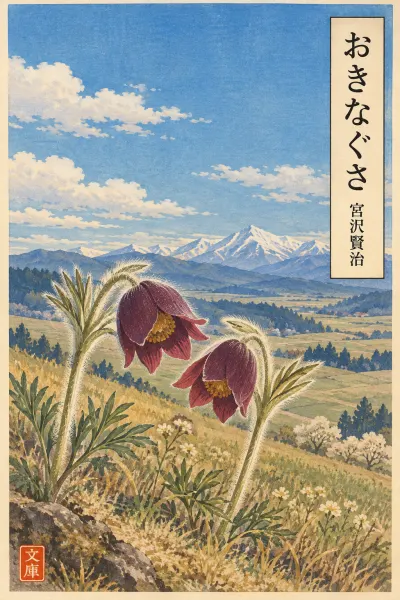
The narrator introduces a small dark flower called uzu no shuge, the pasqueflower, which an ant says looks bright red in the sun. One spring the narrator hears two of these flowers chatting about clouds and the sun, and a skylark tells them they will fly in summer. When summer comes the flowers have turned into white fluff, say goodbye, and fly away on the wind; the narrator thinks they rose into the sky and became two small stars.
AI translation · independently checked
うずのしゅげというはなを知っていますか。Do you know the flower called uzu no shuge?
おきなぐさともいいます。It is also called the pasqueflower.
春に、くろいはなが小さくさきます。In spring, it blooms with small black flowers.
みんな、このはながだいすきです。Everyone loves this flower.
わたしは、ありに聞きました。I asked an ant about it.
「うずのしゅげは、すきですか。」"Do you like the uzu no shuge?"
「はい、大すきです。」"Yes, I love it."
「でも、くろいはなですよ。」"But it's a black flower, isn't it?"
「いいえ。おひさまが出ていると、とてもあかいですよ。」"No. When the sun is out, it's very red, you know."
ありは、いつもはなの下から上を見ています。The ant always looks up at the flower from underneath.
だから、あかいのです。That is why it looks red.
「それに、このはなには白いけがあります。友だちがびょうきになると、そのけを少しもらいます。そして、からだをきれいにします。」"Besides, this flower has white hairs. When a friend gets sick, we take a little of that fluff. Then we clean their body with it."
山の中に、大きな男がいます。In the mountains there lives a big man.
男は、とりを食べるのをわすれて、下を見ています。The man forgets to eat his bird and gazes down at the ground.
くさの中で、うずのしゅげが一本さいているからです。That is because a single uzu no shuge is blooming in the grass.
きょねんの春、わたしは山の西のほうへ行きました。Last spring, I went over toward the west side of the hills.
くさの中に、うずのしゅげが二本さいていました。Two uzu no shuge were blooming in the grass.
そらでは、白いくもが東へどんどんとんでいました。In the sky, white clouds were flying steadily eastward.
おひさまは、くもに入ったり、出たりしました。The sun kept slipping into the clouds and coming out again.
二本のはなは、しずかに話していました。The two flowers were talking quietly.
「あ、くもがおひさまの前に来たよ。」"Oh, a cloud's come in front of the sun."
「くらくなったね。」"It's gone dark, huh."
「でも、すぐにあかるくなるよ。」"But it'll get bright again soon."
「あ、あかるくなった。」"Oh, it's bright again."
「くもは、どこから来るのかな。」"I wonder where the clouds come from."
「西のそらからだよ。小さいくもが出たね。」"From the western sky. Look, a little cloud just came out."
「大きくなった。白くて、きれいだね。」"It's gotten big. It's white and pretty, isn't it?"
そこへ、ひばりがとんで来ました。Just then, a skylark came flying over.
「こんにちは。今日はかぜがつよくて、たいへんです。」"Good day. The wind is so strong today, it's quite hard work."
「でも、かぜの中をとぶのは、たのしいでしょうね。わたしたちも、とびたいです。」"But flying in the wind must be fun. We want to fly too."
「夏まで待ってね。夏になったら、あなたたちもとびますよ。」"Please wait until summer. When summer comes, you will fly too."
夏になって、わたしはもう一ど、そこへ行きました。When summer came, I went there once more.
山はみどりで、かぜは南からふいていました。The hills were green, and the wind was blowing from the south.
二本のはなは、白いけになっていました。The two flowers had turned into white fluff.
ひばりが来ました。The skylark came.
「こんにちは。いい天気ですね。もうとびますか。」"Good day. Lovely weather, isn't it? Will you be flying now?"
「はい。とおいところへ行きます。」"Yes. We're going somewhere far away."
「とぶのは、いやですか。」"Do you mind flying away?"
「いいえ。わたしたちのしごとは、もうおわりました。」"No. Our work is already done."
「だいじょうぶですか。」"Will you be all right?"
「はい。どこへ行っても、おひさまが見ていますから。」"Yes. Wherever we go, the sun will be watching over us."
「ほんとうですね。来年もここにいたら、わたしはここに家を作ります。」"That's very true. If I'm still here next year, I'll build my home right here."
「あ、このかぜです。ひばりさん、げんきでね。」"Oh, this is the wind. Take care, Skylark."
「じゃあ、げんきで。」"Well then, take care."
きれいなかぜが来ました。A clear, lovely wind came.
うずのしゅげは、ひかって、大きなこえでいいました。The uzu no shuge shone and called out in loud voices.
「ひばりさん、みなさん、げんきで。おひさま、ありがとう。」"Skylark, everyone, take care. Thank you, Sun."
そして、たくさんの白いけになって、北のほうへとんで行きました。And they became lots of white fluff and flew away toward the north.
ひばりは、まっすぐそらの上へとんで、みじかいうたをうたいました。The skylark flew straight up into the sky and sang a short song.
どうして、ひばりは北へ行かないで、上へとんだのでしょう。Why do you think the skylark flew upward instead of going north?
二つのはなは、そらの上へ行ったからです。Because the two flowers had gone up into the sky.
二つのはなは、小さなほしになったのでしょう。The two flowers must have become little stars.
そのほしは、くろくて見えないよるもあります。On some nights those stars are black and cannot be seen.
でも、あかくひかるよるもあります。But on other nights they shine red.
ありが話したはなと、おなじです。It is just like the flower the ant talked about.
Vocabulary
| Word | Meaning | JLPT |
|---|---|---|
| うずのしゅげうずのしゅげ | uzu no shuge, a folk name for the pasqueflowerDialect name; the standard name is おきなぐさ (翁草), literally 'old-man grass', from its white, beard-like fluff. | — |
| さきますさく | to bloom, to flowerdictionary form: 咲くUsed only for flowers; さいている means 'is in bloom'. | N5 |
| ありあり | antdictionary form: 蟻 | — |
| おひさまおひさま | the sundictionary form: お日様A warm, childlike way to say 太陽 or 日; often treated almost as a person. | — |
| けけ | hair; here the soft white fluff of the flowerdictionary form: 毛 | N4 |
| びょうきびょうき | illness; びょうきになる = to get sickdictionary form: 病気 | N5 |
| わすれてわすれる | to forgetdictionary form: 忘れる | N5 |
| くもくも | clouddictionary form: 雲 | N4 |
| どんどんどんどん | steadily, one after another, quicklySound-symbolic word showing continuous, rapid movement. | N4 |
| ひばりひばり | skylarkdictionary form: 雲雀A small bird famous for flying high and singing in spring. | — |
| かぜかぜ | winddictionary form: 風Don't confuse it with 風邪 (かぜ, a cold). | N5 |
| しごとしごと | work, jobdictionary form: 仕事 | N5 |
| ひかってひかる | to shine, to glowdictionary form: 光る | N4 |
| ほしほし | stardictionary form: 星 | N4 |
Grammar
〜と (natural result) N4 when / whenever …
Plain form + と shows that the second part always or naturally follows the first. Whenever the sun is out, the flower looks red.
おひさまが出ていると、とてもあかいですよ。
When the sun is out, it's very red, you know.
〜のです N4 it is that …; that is why …
のです adds an explanation for something just said. Here it explains why the ant sees the black flower as red.
だから、あかいのです。
That is why it looks red.
〜たり〜たりする N4 doing things like A and B; going back and forth between A and B
The た-form + り is used for two actions, and する goes at the end. Here it shows the sun going in and out of the clouds again and again.
おひさまは、くもに入ったり、出たりしました。
The sun kept slipping into the clouds and coming out again.
〜たら N4 when / if …
The た-form + ら means 'once A happens, then B'. The skylark promises that the flowers will fly once summer arrives.
夏になったら、あなたたちもとびますよ。
When summer comes, you will fly too.
疑問詞+〜ても N4 no matter where / what …
A question word with the て-form + も means 'whatever / wherever'. どこへ行っても means 'wherever we go'.
どこへ行っても、おひさまが見ていますから。
Wherever we go, the sun will be watching over us.
〜ないで N4 without doing …; instead of doing …
The ない-form + で shows that one action is not done and another is done instead. The skylark does not go north; it flies upward.
どうして、ひばりは北へ行かないで、上へとんだのでしょう。
Why do you think the skylark flew upward instead of going north?