 N3 · easy
Simplified retelling · JLPT N3
オツベルと象 Otsuberu to Zō in easy Japanese (N3)
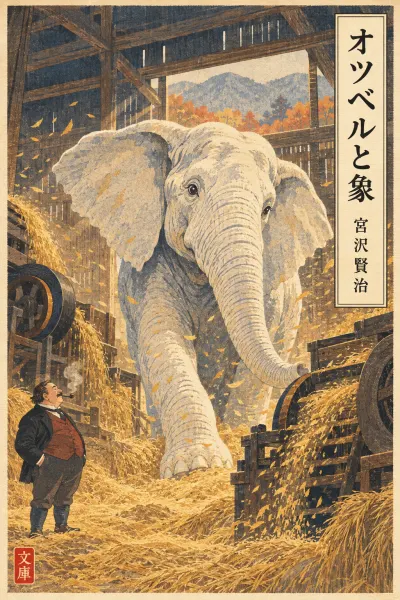
This is our own simplified retelling of The White Elephant Who Wandered into Otsuberu's Threshing Shed, written for N3 learners and checked word by word against the N3 vocabulary list. A few story words and grammar patterns go beyond N3; the notes below give each one's level. It keeps the characters, events and ending of the original. When it feels easy, move on to the original text.
The story in brief
A cowherd tells how a white elephant wanders into rich Otsuberu's threshing shed. Otsuberu tricks him with a clock, chains and weights, then works him harder while feeding him less, until the elephant nearly dies. With help from the moon and a mysterious child, the elephant sends a letter to his friends in the mountains, and they storm the estate, crush Otsuberu and set him free.
AI translation · independently checked
これは、牛をかう男が話した話です。This is a story told by a fellow who raised cattle.
オツベルは、大きな小屋で米をとるきかいを六台も動かしている、お金持ちの男です。Otsuberu was a rich man who ran no fewer than six rice-threshing machines in his big shed.
十六人の男たちが、毎日そこで働いています。Sixteen men worked there every single day.
ある日、白いぞうが小屋に来ました。One day, a white elephant came to the shed.
働く人たちはこわくて、見ないようにしていました。The workers were scared, so they did their best not to look at him.
ぞうはのんびりと小屋に入って来ました。The elephant strolled into the shed, easy as you please.
米がパチパチと体に当たります。Rice grains went pitter-pat, pitter-pat against his body.
「ああ、すなが歯に当たるよ。」とぞうはきれいな声で言いました。"Oh dear, the sand keeps hitting my teeth," said the elephant in a lovely voice.
オツベルは決心して話しかけました。Otsuberu made up his mind and spoke to him.
「ここはおもしろいかい。ずっとここにいたらどうだい。」「いてもいいよ。」オツベルは顔を真っ赤にして喜びました。"Having fun here? Why not stay here for good?" "Sure, I don't mind staying." Otsuberu went bright red in the face with delight.
こうして、ぞうはオツベルの物になりました。And that's how the elephant came to belong to Otsuberu.
ぞうは力が強くて、よく働きました。The elephant was mighty strong, and he worked hard.
オツベルは「時計はいらないか。」と言って、大きな時計をぞうの首にかけました。Otsuberu said, "Wouldn't you like a clock?" and hung a big clock around the elephant's neck.
それから、百キロのくさりを前の足につけました。Then he fastened a hundred-kilo chain to his front legs.
紙の靴もはかせて、その上に四百キロのおもりをつけました。He put paper shoes on him too, and on top of those he attached four-hundred-kilo weights.
ぞうは「なかなかいいね。」と喜びました。"Not bad at all," said the elephant, pleased as could be.
次の日、時計と靴はこわれて、くさりとおもりだけが残りました。The next day the clock and the shoes fell apart, and only the chain and the weights were left.
「すまないが、ぜいきんが高いから、川から水をくんでくれ。」ぞうは喜んで、五十ぱいも水を運びました。"Sorry to ask, but taxes are awful high, so fetch me some water from the river." The elephant happily carried fifty whole loads of water.
その晩、わらを十たば食べながら、月を見て言いました。That night, as he munched ten bundles of straw, he looked up at the moon and said:
「ああ、働くのは楽しいなあ。」"Ah, working sure is fun!"
次の日は、もりからたきぎを九百たば運びました。The next day he hauled nine hundred bundles of firewood from the forest.
その晩のわらは八たばでした。That night his straw came to eight bundles.
「ああ、気持ちがいい。サンタマリア。」"Ah, that feels good. Santa Maria."
その次の日は、かじばで半日、すみの火を息で吹きました。The day after that, he spent half the day in the smithy, blowing on the charcoal fire with his breath.
わらは七たばでした。His straw was seven bundles.
「ああ、疲れたな。うれしいな。サンタマリア。」"Ah, I'm tired. I'm happy. Santa Maria."
オツベルは、だんだんぞうにひどくしました。Little by little, Otsuberu treated the elephant more and more cruelly.
わらは五たば、三たばと少なくなりました。The straw dwindled to five bundles, then three.
ぞうはもう笑わなくなりました。The elephant didn't laugh anymore.
時々、赤い目でじっとオツベルを見ました。Now and then he stared hard at Otsuberu with red eyes.
ある晩、ぞうは月を見て言いました。One night, the elephant looked at the moon and said:
「苦しいです。サンタマリア。」"I'm suffering. Santa Maria."
次の晩、ぞうは倒れて、わらも食べずに言いました。The next night, the elephant collapsed, and without even touching his straw, he said:
「もう、さようなら、サンタマリア。」すると月が言いました。"Goodbye now, Santa Maria." And then the moon spoke.
「体は大きいのに、弱いなあ。なかまに手紙を書いたらいい。」「ふでも紙もありません。」ぞうはなき出しました。"Such a big body, and yet so weak! You ought to write a letter to your friends." "I haven't got a brush or any paper." The elephant began to cry.
すると、赤い着物の子どもが、ふでと紙を持って立っていました。Then a child in a red kimono was standing there, holding a brush and paper.
ぞうは手紙を書きました。The elephant wrote a letter.
「ぼくはひどい目にあっている。みんなで来て、助けてくれ。」子どもは手紙を持って、山へ行きました。"I'm having a terrible time. Please, all of you, come and help me." The child took the letter and went off to the mountains.
山のぞうたちは手紙を読むと、いっせいに立ち上がりました。The moment the mountain elephants read the letter, they all rose up as one.
「オツベルをやっつけよう。」「グララアガア、グララアガア。」ぞうたちはあらしのように野原を走って行きました。"Let's get Otsuberu!" "GRALLA-AGAH! GRALLA-AGAH!" The elephants went charging across the fields like a storm.
そのとき、オツベルは昼寝をしていました。Right then, Otsuberu was taking a nap.
「ご主人さま、ぞうが来ました。」働く人たちがさけびました。"Boss, sir, the elephants are here!" the workers hollered.
オツベルはすぐに分かりました。Otsuberu understood right away.
「小屋の入口をしめろ。まるたで出られないようにしろ。もんもしめろ。心配するな。」でも、働く人たちは白いぬのをうでにまきました。"Shut the shed door! Bar it with logs so he can't get out! Shut the gate too! Don't you worry!" But the workers tied white cloths around their arms.
「戦いません」というしるしです。That was the sign for "We won't fight."
ぞうたちが家のまわりに来ました。The elephants came all around the house.
「今助けるから、安心しろよ。」「ありがとう。うれしいよ。」小屋からも声がします。"We'll save you right now, so don't you worry!" "Thank you. I'm so glad!" A voice answered from the shed too.
へいはかたくて、なかなかこわせません。The wall was hard, and it just wouldn't break.
ぞうたちはなかまの体に乗って、へいをこえようとしました。The elephants climbed onto one another's bodies and tried to get over the wall.
大きな顔を見て、オツベルの犬は気を失いました。One look at those huge faces, and Otsuberu's dog fainted clean away.
オツベルはピストルをうちました。Otsuberu fired his pistol.
でも、たまははね返ります。But the bullets just bounced right off.
「うるさいねえ。顔にパチパチ当たるんだ。」一頭のぞうが言いました。"What a nuisance. They keep going pitter-pat against my face," said one of the elephants.
オツベルは、この言葉をどこかで聞いたと思いました。Otsuberu thought he'd heard those words somewhere before.
そのとき、五頭のぞうがへいから落ちて来て、オツベルはつぶれてしまいました。Just then, five elephants came tumbling down off the wall, and Otsuberu was squashed flat.
ぞうたちは小屋のまるたを折りました。The elephants snapped the logs of the shed.
白いぞうはとてもやせて、出て来ました。Out came the white elephant, terribly thin.
なかまたちはしずかにそばに来て、くさりとおもりをはずしました。His friends came quietly up beside him and took off the chain and the weights.
「ありがとう。ほんとうに助かったよ。」白いぞうは、さびしそうに笑いました。"Thank you. You've really saved me," said the white elephant, with a lonely sort of smile.
Vocabulary
| Word | Meaning | JLPT |
|---|---|---|
| かうかう | to keep, to raise (animals)dictionary form: 飼うDifferent kanji from 買う (to buy), same sound. | N3 |
| 決心けっしん | determination; making up one's mind決心する = to decide firmly. | N3 |
| くさりくさり | chaindictionary form: 鎖 | N3 |
| おもりおもり | weight (a heavy object)dictionary form: 重りFrom 重い (heavy). | — |
| ぜいきんぜいきん | taxdictionary form: 税金 | N3 |
| くんでくむ | to draw, to fetch (water)dictionary form: 汲む | N2 |
| たきぎたきぎ | firewooddictionary form: 薪 | — |
| かじばかじば | smithy, blacksmith's workshopdictionary form: 鍛冶場 | — |
| ひどい目にあっているひどいめにあう | to have a terrible experience, to be treated badlydictionary form: ひどい目にあう目 here means 'experience'. | — |
| いっせいにいっせいに | all at once, all togetherdictionary form: 一斉に | — |
| やっつけようやっつける | to beat, to get (an enemy)dictionary form: やっつけるCasual, spoken word. | N2 |
| 気を失いましたきをうしなう | to faint, to lose consciousnessdictionary form: 気を失う | — |
| つぶれてつぶれる | to be crushed, to be squasheddictionary form: 潰れる | N2 |
| はずしましたはずす | to take off, to removedictionary form: 外す | N3 |
Grammar
〜ないようにする N4 to try not to do; to make a point of not doing
Plain negative + ようにする shows a conscious effort to avoid something. Here the workers deliberately avoid looking at the elephant.
働く人たちはこわくて、見ないようにしていました。
The workers were scared, so they did their best not to look at him.
〜たらどうだい N4 why don't you …? (suggestion)
た-form + ら + どう makes a suggestion. だい is a casual, rather masculine question ending, like だ + question.
ずっとここにいたらどうだい。
Why not stay here for good?
〜ずに N3 without doing
ない-stem + ずに is a more written way of saying 〜ないで. Here the elephant speaks without eating his straw.
ぞうは倒れて、わらも食べずに言いました。
The elephant collapsed, and without even touching his straw, he said.
〜のに N4 even though, and yet
のに joins two facts where the second is surprising or disappointing given the first. The moon finds it odd that such a big body is so weak.
体は大きいのに、弱いなあ。
Such a big body, and yet so weak!
〜ようとする N3 to try to do; to attempt
Volitional form + とする shows an attempt, often one that is difficult or not yet successful.
ぞうたちはなかまの体に乗って、へいをこえようとしました。
The elephants climbed onto one another's bodies and tried to get over the wall.
〜そうに N4 looking (a certain way), in a … manner
Adjective stem + そう means 'looks …'; with に it describes how someone does an action. The white elephant smiles in a way that looks lonely.
白いぞうは、さびしそうに笑いました。
The white elephant gave a lonely sort of smile.