Upper intermediate · JLPT N2
オツベルと象Otsuberu to Zō — The White Elephant Who Wandered into Otsuberu's Threshing Shed
- JLPT N2
- 5,641 characters
- 4 parts
- about 47 minutes
- 3 easier versions
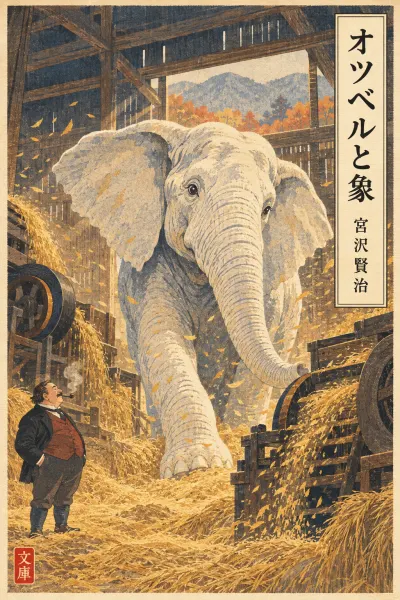
Otsuberu and the Elephant is a short fable by Miyazawa Kenji, told aloud by an unnamed cowherd to a listener. Otsuberu is a rich man whose threshing shed roars with machines and farmhands. One day a white elephant wanders in from the forest. Otsuberu sees his chance and, with a show of friendliness, makes the trusting animal his own. The rest of the story follows how he uses that trust, and what the elephant does when he can no longer bear it. The narrator's voice sets the tone: chatty, sly and full of mock admiration for Otsuberu, so much of the humour and criticism works through irony. For learners, the text is short but lively. It is packed with Kenji's inventive sound words, casual spoken endings like ぜ, ねえ and もんだ, and three distinct speech styles: the storyteller, the gentle elephant and the rough farmhands. The sentences are mostly simple. The challenge is hearing the tone behind them: telling when the narrator is praising and when he is mocking, and noticing how the elephant's speech changes as his situation worsens.
Contents
Easier versions
This story is also retold in simpler Japanese. Reading an easier version first makes the original much more approachable.
Before you read
- Read the narrator's praise as irony. Phrases like オツベルときたら大したもんだ sound admiring, but 〜ときたら often signals exasperation or mockery. Ask yourself whether each compliment to Otsuberu is sincere.
- Learn the storyteller's spoken endings before you start: ぜ, ねえ, もんだ, and the command 〜たまえ (見たまえ, 'just look'). They appear throughout and mark him as someone talking directly to you.
- Treat onomatopoeia like のんのん (the machines) and グララアガア (the elephants) as sound effects, not vocabulary. Many are Kenji's own coinages that you won't find in a dictionary, so read them aloud and move on.
- Track the elephant's speech. He normally uses plain speech with ぼく, then shifts to polite です/ます when he is suffering. That shift tells you how he feels. Otsuberu's suggestions in 〜たらどうだい form are orders disguised as friendly offers.
- Expect slurred, rough speech from the farmhands, such as 押し寄せやした for 押し寄せました. Mentally convert these forms back to standard polite Japanese rather than memorizing them.
Words to know
The most useful words from the notes across the story.
| Word | Meaning | JLPT |
|---|---|---|
| 百姓ひゃくしょう | farmer, farmhandWith どもが it sounds rough and looks down on them; the word itself can be felt as rude today. | — |
| けいざいけいざい | economical, cheap to rundictionary form: 経済This is an older usage meaning 'thrifty'; today one says 経済的. | N4 |
| 瘠せてやせる | to become thindictionary form: 瘠せるThe usual modern kanji is 痩せる. | N4 |
| 覚悟かくご | resolve, readiness覚悟をきめる = to make up one's mind to face something. | N3 |
| 財産ざいさん | property, fortune, assets | N3 |
| 大したたいした | remarkable, quite something大したもんだ is the narrator's ironic refrain; used here as mock praise. | N3 |
| 稼ぐかせぐ | to work hard and earn; to toilIt usually means 'earn money', but here it means doing productive work. | N3 |
| 税金ぜいきん | taxesOtsuberu uses taxes as his excuse for every new task. | N3 |
| 塀へい | wall, fence (around a property)A boundary wall, not the wall of a room (壁 かべ). | N3 |
| 文句もんく | words, phraseHere it means a phrase someone said. It also commonly means 'complaint' (文句を言う). | N3 |
| 鎖くさり | chain | N3 |
| 呑気のんき | carefree, easygoing, unconcerned | N2 |
| 汲んでくむ | to draw or fetch (water)dictionary form: 汲む | N2 |
| 据えつけてすえつける | to install, to set up (machinery)dictionary form: 据えつける | N1 |
| 頑丈がんじょう | sturdy, solidly built | N1 |
Plot summary
Show the full summary (contains spoilers)
A white elephant strolls into rich Otsuberu's threshing shed, and Otsuberu coaxes him into staying. He then 'gives' the elephant a tin clock, a chain, paper boots and a heavy iron weight. Blaming taxes, he sets harder and harder work each day, from hauling water and firewood to blowing the forge fire, while cutting the elephant's straw ration. The cheerful elephant slowly weakens and one night says goodbye to the moon. The moon tells him to write to his friends. A child in red brings him paper and ink and carries the letter to the mountains. The wild elephants charge down. Otsuberu barricades his estate while his farmhands give up. The elephants climb the wall, shrug off his pistol shots and crush him as they tumble over. They free the white elephant, now terribly thin, who thanks them with a sad smile.
About the author
Miyazawa Kenji was a poet and writer of children's stories from Hanamaki in Iwate Prefecture. He studied agricultural science in Morioka and later taught at an agricultural school. He devoted much of his life to helping local farmers improve their methods and their cultural lives. He was a devout Buddhist, and his faith, love of nature and interest in science run through his writing. His fame came after his death, with works such as 銀河鉄道の夜, 風の又三郎 and the poem 雨ニモマケズ.