Part 1 of 4 · JLPT N2
オツベルと象(第一日曜) Otsuberu to Zō, part 1: A White Elephant Wanders In
In this part
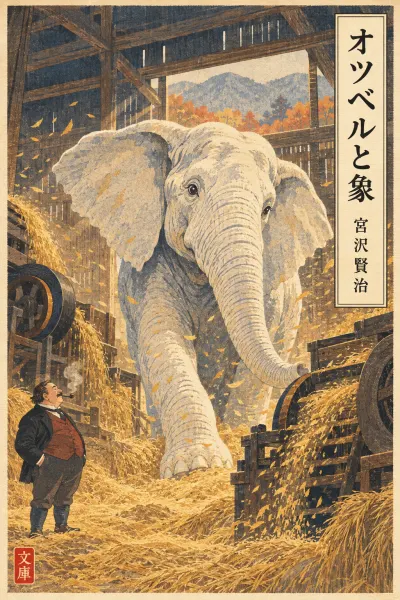
Otsuberu, a rich man, runs a noisy threshing shed with six machines and sixteen farmhands. One day a white elephant strolls in from the forest and climbs into the shed. The workers are frightened, but Otsuberu pretends not to care, invites the elephant to stay, and so the innocent animal becomes his property.
AI translation · independently checked
……ある牛飼いがものがたる……as told by a certain cowherd
オツベルときたら大したもんだ。Now, that Otsuberu, he was really something.
稲扱器械の六台も据えつけて、のんのんのんのんのんのんと、大そろしない音をたててやっている。He had six whole threshing machines set up, and he kept them going with a tremendous racket, whirr-whirr-whirr-whirr-whirr-whirr.
十六人の百姓どもが、顔をまるっきりまっ赤にして足で踏んで器械をまわし、小山のように積まれた稲を片っぱしから扱いて行く。Sixteen farmhands, their faces flushed bright red, worked the machines by treading on them with their feet, threshing one after another the rice stalks that were piled up like small hills.
藁はどんどんうしろの方へ投げられて、また新らしい山になる。The straw was thrown back behind them, heap after heap, until it made a whole new hill.
そこらは、籾や藁から発ったこまかな塵で、変にぼうっと黄いろになり、まるで沙漠のけむりのようだ。The whole place turned a strange, hazy yellow from the fine dust that rose off the husks and straw, just like smoke over a desert.
そのうすくらい仕事場を、オツベルは、大きな琥珀のパイプをくわえ、吹殻を藁に落さないよう、眼を細くして気をつけながら、両手を背中に組みあわせて、ぶらぶら往ったり来たりする。Through that dim workshop Otsuberu would stroll back and forth, with a big amber pipe between his teeth and his hands clasped behind his back, narrowing his eyes and taking care not to drop any ash on the straw.
小屋はずいぶん頑丈で、学校ぐらいもあるのだが、何せ新式稲扱器械が、六台もそろってまわってるから、のんのんのんのんふるうのだ。The shed was very sturdy, about as big as a schoolhouse, but with six brand-new threshing machines all turning at once, the whole thing shook, whirr-whirr-whirr-whirr.
中にはいるとそのために、すっかり腹が空くほどだ。Just going inside was enough to make you good and hungry.
そしてじっさいオツベルは、そいつで上手に腹をへらし、ひるめしどきには、六寸ぐらいのビフテキだの、雑巾ほどあるオムレツの、ほくほくしたのをたべるのだ。And sure enough, Otsuberu worked up a fine appetite that way, and at lunchtime he'd eat a beefsteak about six inches across and a nice fluffy omelette the size of a floor rag.
とにかく、そうして、のんのんのんのんやっていた。Anyway, that's how things were going, whirr-whirr-whirr-whirr.
そしたらそこへどういうわけか、その、白象がやって来た。And then, for some reason or other, along came the white elephant.
白い象だぜ、ペンキを塗ったのでないぜ。A white elephant, mind you, and not one that had been painted, either.
どういうわけで来たかって?Why did it come, you ask?
そいつは象のことだから、たぶんぶらっと森を出て、ただなにとなく来たのだろう。Well, it was an elephant, so it probably just wandered out of the forest and came along for no particular reason.
そいつが小屋の入口に、ゆっくり顔を出したとき、百姓どもはぎょっとした。When it slowly poked its face into the doorway of the shed, the farmhands got a real fright.
なぜぎょっとした?Why were they frightened?
よくきくねえ、何をしだすか知れないじゃないか。You sure ask a lot of questions! Who could tell what it might start doing?
かかり合っては大へんだから、どいつもみな、いっしょうけんめい、じぶんの稲を扱いていた。Getting mixed up with it would mean big trouble, so every last one of them kept threshing his own rice for all he was worth.
ところがそのときオツベルは、ならんだ器械のうしろの方で、ポケットに手を入れながら、ちらっと鋭く象を見た。But just then, Otsuberu, over behind the row of machines, gave the elephant a quick, sharp glance, his hands in his pockets.
それからすばやく下を向き、何でもないというふうで、いままでどおり往ったり来たりしていたもんだ。Then he quickly looked down and went on walking back and forth just as before, as if it were nothing at all.
するとこんどは白象が、片脚床にあげたのだ。Next thing you know, the white elephant lifted one foot onto the floor.
百姓どもはぎょっとした。The farmhands got a real fright.
それでも仕事が忙しいし、かかり合ってはひどいから、そっちを見ずに、やっぱり稲を扱いていた。But they were busy with their work, and getting mixed up with it would be awful, so they didn't look that way and just kept on threshing their rice.
オツベルは奥のうすくらいところで両手をポケットから出して、も一度ちらっと象を見た。Back in the dim far end, Otsuberu took both hands out of his pockets and gave the elephant another quick glance.
それからいかにも退屈そうに、わざと大きなあくびをして、両手を頭のうしろに組んで、行ったり来たりやっていた。Then, looking ever so bored, he gave a big yawn on purpose, clasped his hands behind his head, and kept walking back and forth.
ところが象が威勢よく、前肢二つつきだして、小屋にあがって来ようとする。But then the elephant boldly thrust out both front legs and started trying to climb up into the shed.
百姓どもはぎくっとし、オツベルもすこしぎょっとして、大きな琥珀のパイプから、ふっとけむりをはきだした。The farmhands jumped, and even Otsuberu was a little startled and let out a puff of smoke from his big amber pipe.
それでもやっぱりしらないふうで、ゆっくりそこらをあるいていた。Still, he went on acting as if he hadn't noticed, walking slowly around the place.
そしたらとうとう、象がのこのこ上って来た。And at last the elephant came clambering right up.
そして器械の前のとこを、呑気にあるきはじめたのだ。Then it started strolling along in front of the machines without a care in the world.
ところが何せ、器械はひどく廻っていて、籾は夕立か霰のように、パチパチ象にあたるのだ。But, you see, the machines were spinning like mad, and the husks went pitter-patter against the elephant like a summer downpour or a hailstorm.
象はいかにもうるさいらしく、小さなその眼を細めていたが、またよく見ると、たしかに少しわらっていた。The elephant seemed to find it very annoying and was squinting its little eyes, but if you looked closely, it was definitely smiling a little too.
オツベルはやっと覚悟をきめて、稲扱器械の前に出て、象に話をしようとしたが、そのとき象が、とてもきれいな、鶯みたいないい声で、こんな文句を云ったのだ。Otsuberu finally made up his mind, stepped out in front of the threshing machines and was about to speak to the elephant, when the elephant said this, in a very lovely, fine voice like a bush warbler's:
「ああ、だめだ。あんまりせわしく、砂がわたしの歯にあたる。」"Oh, this won't do. The sand keeps hitting my teeth so fast."
まったく籾は、パチパチパチパチ歯にあたり、またまっ白な頭や首にぶっつかる。And sure enough, the husks went pitter-patter, pitter-patter against its teeth, and bumped against its snow-white head and neck, too.
さあ、オツベルは命懸けだ。Well, now Otsuberu was risking his life.
パイプを右手にもち直し、度胸を据えて斯う云った。He shifted his pipe to his right hand, screwed up his courage, and said:
「どうだい、此処は面白いかい。」"Well, now, do you like it here?"
「面白いねえ。」象がからだを斜めにして、眼を細くして返事した。"It's fun, all right," the elephant replied, tilting its body and narrowing its eyes.
「ずうっとこっちに居たらどうだい。」"Why not stay here for good, then?"
百姓どもははっとして、息を殺して象を見た。The farmhands gasped and stared at the elephant, holding their breath.
オツベルは云ってしまってから、にわかにがたがた顫え出す。Once the words were out, Otsuberu suddenly started shaking all over.
ところが象はけろりとしてBut the elephant, cool as you please,
「居てもいいよ。」と答えたもんだ。answered, "I don't mind staying."
「そうか。それではそうしよう。そういうことにしようじゃないか。」オツベルが顔をくしゃくしゃにして、まっ赤になって悦びながらそう云った。"Is that so? Then that's what we'll do. Let's call it settled, shall we?" said Otsuberu, his face all crinkled up and bright red with delight.
どうだ、そうしてこの象は、もうオツベルの財産だ。How about that? Just like that, this elephant belonged to Otsuberu.
いまに見たまえ、オツベルは、あの白象を、はたらかせるか、サーカス団に売りとばすか、どっちにしても万円以上もうけるぜ。Just you watch: whether he puts that white elephant to work or sells it off to a circus, either way Otsuberu's going to make more than ten thousand yen.
Vocabulary
| Word | Meaning | JLPT |
|---|---|---|
| 稲扱器械いねこききかい | rice-threshing machine扱く(こく)means to strip grain from the stalks; 器械 is an older spelling often used for 機械. | — |
| 据えつけてすえつける | to install, to set up (machinery)dictionary form: 据えつける | N1 |
| 百姓ひゃくしょう | farmer, farmhandWith どもが it sounds rough and looks down on them; the word itself can be felt as rude today. | — |
| 片っぱしからかたっぱしから | one after another, working through everythingdictionary form: 片っ端からColloquial; suggests dealing with a whole pile without stopping. | — |
| 籾もみ | unhulled rice grains, husks | — |
| 頑丈がんじょう | sturdy, solidly built | N1 |
| ぎょっとしたぎょっとする | to be startled, get a frightdictionary form: ぎょっとするCompare ぎくっとする in the same passage, a sudden jolt of alarm. | — |
| かかり合ってはかかりあう | to get involved, get mixed up (with trouble)dictionary form: かかり合う | — |
| 呑気のんき | carefree, easygoing, unconcerned | N2 |
| 覚悟かくご | resolve, readiness覚悟をきめる = to make up one's mind to face something. | N3 |
| 命懸けいのちがけ | risking one's life, desperateHere the ironic, exaggerating tone of the narrator. | — |
| 度胸どきょう | nerve, courage度胸を据える = to steel one's nerves. | — |
| けろりとしてけろりと | coolly, as if nothing had happeneddictionary form: けろりと | — |
| 財産ざいさん | property, fortune, assets | N3 |
Grammar
〜ときたら N1 as for ~ / speaking of ~ (with strong feeling)
Marks a topic the speaker has strong feelings about, often criticism or amazement. Here the cowherd uses it with ironic admiration for Otsuberu.
オツベルときたら大したもんだ。
Now, that Otsuberu, he was really something.
Number + も N3 as many as ~
も after a quantity stresses that the number is large. 六台も means 'a whole six machines', showing off Otsuberu's wealth.
稲扱器械の六台も据えつけて
He had six whole threshing machines set up
〜ないよう(に) N3 so as not to ~
Shows the purpose of an action: to avoid something happening. Otsuberu is careful so that the ash does not fall on the straw.
吹殻を藁に落さないよう、眼を細くして気をつけながら
narrowing his eyes and taking care not to drop any ash on the straw
〜(よ)うとする N3 to try to ~ / be about to ~
The volitional form plus とする shows an attempt or an action just starting. The elephant is trying to climb into the shed.
前肢二つつきだして、小屋にあがって来ようとする。
thrust out both front legs and started trying to climb up into the shed.
〜たらどうだい N4 why don't you ~?
A suggestion: 'how would it be if you ~?'. どうだい is a casual, masculine version of どうですか.
「ずうっとこっちに居たらどうだい。」
"Why not stay here for good, then?"
〜たまえ N1 (do) ~ (casual command)
An old-fashioned, masculine command form added to the verb stem, used toward equals or people below the speaker. 見たまえ means 'just watch'.
いまに見たまえ、オツベルは、あの白象を、はたらかせるか、サーカス団に売りとばすか
Just you watch: whether he puts that white elephant to work or sells it off to a circus