 N4 · easy
Simplified retelling · JLPT N4
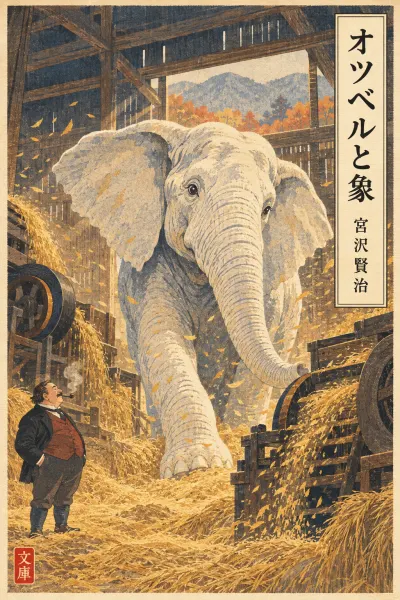
オツベルと象 Otsuberu to Zō in easy Japanese (N4)
This is our own simplified retelling of The White Elephant Who Wandered into Otsuberu's Threshing Shed, written for N4 learners and checked word by word against the N4 vocabulary list. A few story words and grammar patterns go beyond N4; the notes below give each one's level. It keeps the characters, events and ending of the original. When it feels easy, move on to the N3 version or the original text.
The story in brief
A white elephant wanders into rich Otsuberu's threshing shed, and Otsuberu gets him to stay, then chains him and works him harder every day. When the elephant is close to collapse, the moon tells him to write to his friends, and the elephants from the mountains rush to Otsuberu's estate. Otsuberu is crushed beneath the elephants, and the thin, worn-out white elephant is set free.
AI translation · independently checked
オツベルは大きなこやを持っているお金持ちです。Otsuberu was a rich man who owned a great big shed.
こやの中では、六つのきかいが大きな音を出して動いています。Inside the shed, six machines were running and making a terrific racket.
十六人の男たちが、毎日そのきかいでこめの仕事をしています。Sixteen men worked the rice on those machines every single day.
ある日、白いぞうがこやに来ました。One day, a white elephant came to the shed.
もりからさんぽに来たようです。It seems he had come out of the forest for a stroll.
男たちはびっくりしましたが、何もいいませんでした。The men got a real fright, but they didn't say a word.
オツベルも、知らないかおで歩いていました。Otsuberu kept walking about too, looking like he hadn't noticed a thing.
ぞうはゆっくりこやに入って、きかいの前を歩きました。The elephant slowly came into the shed and walked in front of the machines.
きかいから小さなこめが、ぞうのかおに飛んできます。Little grains of rice came flying out of the machines and hit the elephant in the face.
「ああ、だめだ。すながはに入るよ。」ぞうは目をほそくして、少しわらっていました。"Oh, no good. The grit's getting in my teeth." The elephant narrowed his eyes and gave a little smile.
オツベルは聞きました。Otsuberu asked.
「ここはおもしろいかい。」"Having fun here, are you?"
「おもしろいねえ。」"This is fun, isn't it?"
「ここに住んだらどうだい。」"How about living here, then?"
「住んでもいいよ。」"Sure, I could live here."
オツベルは赤いかおをして、よろこびました。Otsuberu went red in the face and was delighted.
こうして、ぞうはオツベルの物になりました。And that's how the elephant came to belong to Otsuberu.
次の週、オツベルはぞうに大きな時計をあげました。The next week, Otsuberu gave the elephant a big clock.
それから、とても重いくさりを足につけました。After that, he fastened a very heavy chain to its leg.
赤いくつもはかせて、その上に四百キロのおもりをつけました。He also made him wear red shoes, and on top of them he fixed a four-hundred-kilo weight.
ぞうは「なかなかいいね。」とよろこびました。"Pretty nice, this," said the elephant happily.
オツベルは毎日、ぞうに仕事をたのみました。Every day, Otsuberu asked the elephant to do some work.
「お金がいるから、川から水を運んでくれ。」ぞうはよろこんで水を運びました。"I need money, so carry water up from the river for me." The elephant gladly carried the water.
次の日は、もりから木を運びました。The next day, he carried wood from the forest.
その次の日は、火にいきをふく仕事をしました。The day after that, his job was blowing on the fire.
夜、ぞうはわらを食べながら、月を見ていいました。At night, as he ate his straw, the elephant looked at the moon and said:
「はたらくのは楽しいね。」でも、わらは毎日少なくなりました。"Working sure is fun." But every day there was less and less straw.
オツベルの仕事は、だんだんひどくなりました。The work Otsuberu gave him grew harsher and harsher.
ぞうはもうわらいません。The elephant didn't smile anymore.
ある夜、ぞうはたおれて、わらも食べないで月を見ました。One night, the elephant fell down and, without even eating his straw, looked up at the moon.
「もう、さようなら。」"This is goodbye, then."
月がいいました。The moon spoke.
「山の友だちに手紙を書いたらいいよ。」"You should write a letter to your friends in the mountains."
「紙もペンもありません。」ぞうはなきました。"I don't have any paper or a pen," the elephant wept.
すると、赤い着物の子どもが、紙を持って来ました。Just then, a child in a red kimono came along carrying some paper.
ぞうは手紙を書きました。The elephant wrote a letter.
「とても大へんです。みんなで来て、たすけてください。」子どもは手紙を持って、山へ行きました。"I'm in terrible trouble. Please, all of you, come and help me." The child took the letter and went off to the mountains.
山のぞうたちは手紙を読んで、みんな立ちました。The elephants in the mountains read the letter, and they all stood up.
「オツベルのところへ行こう。」ぞうたちは大きなこえでなきながら、はやく走りました。"Let's go to Otsuberu's place!" Trumpeting loudly, the elephants ran fast.
小さな木は、みんなたおれました。All the small trees toppled over.
その時、オツベルはベッドでねていました。Right then, Otsuberu was asleep in his bed.
男たちが「ぞうが来ます。」と大きなこえでよびました。The men shouted in loud voices, "The elephants are coming!"
オツベルは起きて、いいました。Otsuberu got up and said:
「こやの戸をしめろ。もんもしめろ。しんぱいするな。」でも男たちはこわくて、白いハンカチを持って、まけたという気持ちを見せました。"Shut the shed doors! Shut the gate too! Don't you worry!" But the men were scared, and they held up white handkerchiefs to show they'd given up.
ぞうたちは、家のまわりを走りました。The elephants ran round and round the house.
かべは強くて、なかなかこわれません。The walls were strong and just wouldn't break.
「今たすけるから、安心して。」やさしいこえが聞こえます。"We're going to save you right now, so don't worry." A kind voice could be heard.
こやの中から、白いぞうが答えました。From inside the shed, the white elephant answered.
「来てくれて、ほんとうにうれしいよ。」"I'm so, so happy you came."
ぞうたちは友だちの体の上にのって、かべの上からかおを出しました。The elephants climbed up on their friends' backs and poked their faces over the top of the wall.
オツベルの犬は、それを見てたおれました。Otsuberu's dog saw that and keeled over.
オツベルはピストルをうちました。Otsuberu fired his pistol.
でも、ぞうはいいました。But the elephants just said:
「うるさいねえ。かおに何か飛んでくるよ。」"What a nuisance. Something keeps flying at my face."
そして、五ひきのぞうが、かべの上からおちてきました。Then five elephants came tumbling down from the top of the wall.
オツベルはその下になって、死にました。Otsuberu ended up underneath them and died.
ぞうたちはこやの木をおって、白いぞうを出しました。The elephants broke the shed's timbers and let the white elephant out.
白いぞうは、とてもやせていました。The white elephant had grown terribly thin.
みんなはしずかに、くさりとおもりをとってあげました。Quietly, they all took the chain and the weights off him.
「よかったね。」「ほんとうに、うれしいよ。」白いぞうは、さびしくわらいました。"Thank goodness." "Really, I'm so glad." The white elephant gave a lonely smile.
Vocabulary
| Word | Meaning | JLPT |
|---|---|---|
| 動いてうごく | to move; to run (of a machine)dictionary form: 動くIntransitive; the machine moves by itself. The transitive form is 動かす. | N4 |
| びっくりしましたびっくりする | to be surprised, to get a frightdictionary form: びっくりするCasual and very common; more everyday than おどろく. | — |
| くさりくさり | chainKanji 鎖. A key story word: the chain is how Otsuberu traps the elephant. | N3 |
| おもりおもり | weight (a heavy object tied on)From 重い (heavy). Kanji 重り or 錘. | — |
| たのみましたたのむ | to ask (someone to do something)dictionary form: たのむKanji 頼む. Used as 人に仕事をたのむ. | N5 |
| 運んではこぶ | to carry, to transportdictionary form: 運ぶ | N4 |
| わらわら | straw (the elephant's food)Kanji 藁. Don't confuse it with わらう (to laugh), which also appears in this passage. | N1 |
| だんだんだんだん | gradually, more and moreOften used with 〜くなる / 〜になる to show a slow change. | N1 |
| たおれてたおれる | to fall down, to collapsedictionary form: たおれるKanji 倒れる. Also used for trees falling over. | N4 |
| たすけてたすける | to help, to rescuedictionary form: たすけるKanji 助ける. たすけて! on its own means "Help!" | N3 |
| こわれませんこわれる | to break, to be brokendictionary form: こわれるIntransitive. The transitive form is こわす (to break something). | N4 |
| 安心あんしん | relief; peace of mind安心する = to feel relieved or stop worrying. The opposite of しんぱいする. | N4 |
| やせてやせる | to become thindictionary form: やせるやせている describes the resulting state: "is thin". | N4 |
| 着物きもの | kimono, traditional Japanese clothing | N4 |
Grammar
〜ようです N4 it seems that…
Added to the plain form of a verb, ようです gives the speaker's guess based on what he sees. The storyteller doesn't know for sure where the elephant came from.
もりからさんぽに来たようです。
Seems he'd just strolled over from the forest.
〜たらどうだい N4 how about doing…?
The た-form plus ら followed by どう makes a suggestion. だい is a casual, masculine question ending, so this sounds friendly and a little pushy.
ここに住んだらどうだい。
How about living here, then?
〜てもいい N5 it's okay to…; I don't mind…
The て-form plus もいい gives or asks for permission. Here the elephant casually agrees to stay.
住んでもいいよ。
Sure, I could live here.
〜てくれ N4 do … for me (rough command)
くれ is the imperative of くれる. The て-form plus くれ is a blunt, masculine way of asking a favour, and it fits Otsuberu's bossy tone.
川から水を運んでくれ。
Carry water up from the river for me.
〜ないで N4 without doing…
The ない-form plus で links two actions and shows that the first one did not happen. With も (わらも) it means "without even…".
わらも食べないで月を見ました。
Without even eating his straw, he looked up at the moon.
Imperative 〜ろ / Prohibition 〜な N4 do…! / don't…!
しめろ is the command form of しめる. The dictionary form plus な (しんぱいするな) means "don't…". Both are strong, rough orders.
こやの戸をしめろ。もんもしめろ。しんぱいするな。
Shut the shed doors! Shut the gate too! Don't you worry!