Part 1 of 3 · JLPT N2
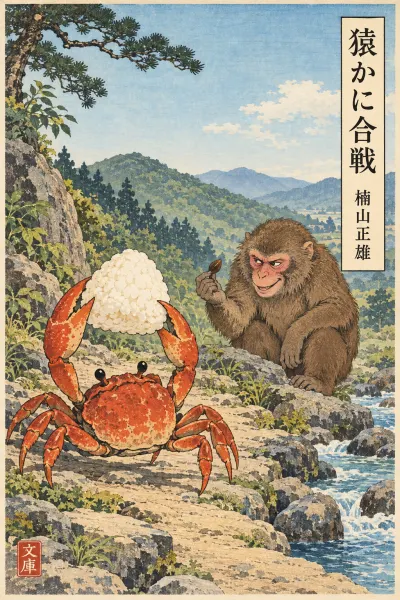
猿かに合戦 Saru ka ni Kassen, part 1: A Seed for a Rice Ball
In this part
A monkey talks a crab into trading a rice ball for a persimmon seed and eats the rice ball in front of him. The crab plants the seed and threatens it until it grows into a tree heavy with fruit, but he cannot climb it. The monkey offers to pick the persimmons for him, then eats the ripe ones himself and throws the crab a hard green one.
AI translation · independently checked
一One
むかし、むかし、あるところに、猿とかにがありました。Once upon a time, long, long ago, in a certain place, there lived a monkey and a crab.
ある日猿とかにはお天気がいいので、連れだって遊びに出ました。One day the weather was so fine that the monkey and the crab went out together to play.
その途中、山道で猿は柿の種を拾いました。On the way, on a mountain path, the monkey picked up a persimmon seed.
またしばらく行くと、川のそばでかにはおむすびを拾いました。When they had gone on a little farther, the crab picked up a rice ball beside a river.
かには、The crab
「こんないいものを拾った。」"Look what a nice thing I found!"
と言って猿に見せますと、猿も、said, showing it to the monkey, and the monkey said too,
「わたしだってこんないいものを拾った。」"Well, I found something nice too!"
と言って、柿の種を見せました。and showed him the persimmon seed.
けれど猿はほんとうはおむすびがほしくってならないものですから、かにに向かって、But really the monkey wanted that rice ball so badly he could hardly stand it, so he turned to the crab
「どうだ、この柿の種と取りかえっこをしないか。」"Tell you what, how about a swap for this persimmon seed?"
と言いました。and said.
「でもおむすびの方が大きいじゃないか。」"But the rice ball's bigger, isn't it?"
とかには言いました。said the crab.
「でも柿の種は、まけば芽が出て木になって、おいしい実がなるよ。」"Yes, but if you plant a persimmon seed, it sprouts and grows into a tree, and lovely tasty fruit grows on it!"
と猿は言いました。said the monkey.
そう言われるとかにも種がほしくなって、When he heard it put like that, the crab began to want the seed too, and
「それもそうだなあ。」"Well, that's true enough."
と言いながら、とうとう大きなおむすびと、小さな柿の種とを取りかえてしまいました。he said, and in the end he went and traded the big rice ball for the little persimmon seed.
猿はうまくかにをだましておむすびをもらうと、見せびらかしながらうまそうにむしゃむしゃ食べて、Having cleverly tricked the crab out of the rice ball, the monkey showed it off as he gobbled it up, munch, munch, looking as if it were the tastiest thing in the world, and
「さようなら、かにさん、ごちそうさま。」"Goodbye, Mr. Crab, thanks for the meal!"
と言って、のそのそ自分のうちへ帰っていきました。he said, and off he plodded to his own house.
二Two
かには柿の種をさっそくお庭にまきました。Right away the crab planted the persimmon seed in his garden.
そして、Then
「早く芽を出せ、柿の種。"Hurry up and sprout, persimmon seed!
出さぬと、はさみでちょん切るぞ。」If you don't, I'll snip you off with my pincers!"
と言いました。he said.
すると間もなく、かわいらしい芽がにょきんと出ました。And before long a pretty little sprout came popping up out of the ground.
かにはその芽に向かって毎日、Every day the crab turned to the sprout and
「早く木になれ、柿の芽よ。"Hurry up and be a tree, persimmon sprout!
ならぬと、はさみでちょん切るぞ。」If you don't, I'll snip you off with my pincers!"
と言いました。he would say.
すると柿の芽はずんずんのびて、大きな木になって、枝が出て、葉が茂って、やがて花が咲きました。Then the persimmon sprout grew and grew and grew into a big tree. It put out branches, its leaves grew thick, and before long it burst into flower.
かにはこんどはその木に向かって毎日、Now every day the crab turned to the tree and
「早く実がなれ、柿の木よ。"Hurry up and bear fruit, persimmon tree!
ならぬと、はさみでちょん切るぞ。」If you don't, I'll snip you off with my pincers!"
と言いました。he would say.
すると間もなく柿の木にはたくさん実がなって、ずんずん赤くなりました。And before long the persimmon tree was covered in fruit, and it grew redder and redder.
それを下からかには見上げて、The crab looked up at it from below and
「うまそうだなあ。早く一つ食べてみたい。」"Ooh, they look tasty! I want to try one right now."
といって、手をのばしましたが、背がひくくってとどきません。he said, stretching out his claw, but he was too short to reach.
こんどは木の上に登ろうとしましたが、横ばいですからいくら登っても登っても落ちてしまいます。Next he tried to climb up the tree, but he could only walk sideways, so however much he climbed and climbed, he always fell off.
とうとうかにもあきらめて、それでも毎日、くやしそうに下からながめていました。At last even the crab gave up, but still, every day, he gazed up at the fruit from below, looking terribly frustrated.
するとある日猿が来て、鈴なりになっている柿を見上げてよだれをたらしました。Then one day the monkey came along, looked up at the persimmons hanging in great thick bunches, and began to drool.
そしてこんなにりっぱな実がなるなら、おむすびと取りかえっこをするのではなかったと思いました。And he thought that if such splendid fruit was going to grow, he never should have swapped the seed for that rice ball.
それを見てかには、Seeing this, the crab
「猿さん、ながめていないで、登って取ってくれないか。お礼には柿を少し上げるよ。」"Mr. Monkey, instead of just staring, won't you climb up and pick some for me? I'll give you a few persimmons for your trouble."
と言いました。said.
猿は、The monkey,
「しめた。」"Just what I wanted!"
と言わないばかりの顔をして、with a look on his face that all but said it out loud,
「よしよし、取って上げるから待っておいで。」"All right, all right, I'll pick them for you, so you wait right there."
と言いながら、するする木の上に登っていきました。he said, and up the tree he went, scrambling quick and smooth.
そして枝と枝との間にゆっくり腰をかけて、まず一つ、うまそうな赤い柿をもいで、わざと、「どうもおいしい柿だ。」と言い言い、むしゃむしゃ食べはじめました。Then he settled himself comfortably between two branches, first picked one red, tasty-looking persimmon, and, saying over and over on purpose, "My, what a delicious persimmon!", began munching away at it.
かにはうらやましそうに下でながめていましたが、The crab watched enviously from below, and
「おい、おい、自分ばかり食べないで、早くここへもほうっておくれよ。」"Hey, hey, don't eat them all yourself! Hurry up and toss some down here too!"
と言いますと、猿は、「よし、よし。」と言いながら、わざと青い柿をもいでほうり出しました。he said. The monkey said, "All right, all right," and on purpose picked a green persimmon and flung it down.
かにはあわてて拾って食べてみますと、それはしぶくって口がまがりそうでした。The crab hurriedly picked it up and took a bite, but it was so bitter and puckery it nearly twisted his mouth out of shape.
かにが、The crab,
Vocabulary
| Word | Meaning | JLPT |
|---|---|---|
| 連れだってつれだつ | to go together, to go along with someonedictionary form: 連れ立つUsually in the て-form, used like an adverb: 連れ立って出かける. | — |
| 取りかえっことりかえっこ | a swap, a tradedictionary form: 取り替えっこ〜っこ is a childish suffix for doing something back and forth with someone, as in 取りかえっこ and 見せっこ. | — |
| だましてだます | to trick, to deceivedictionary form: 騙す | N2 |
| 見せびらかしながらみせびらかす | to show off, to flauntdictionary form: 見せびらかすAlways negative in tone: showing something off in order to make others jealous. | N1 |
| さっそくさっそく | right away, without delaydictionary form: 早速 | N2 |
| ちょん切るちょんぎる | to snip off, to chop offちょん is the sound of a quick snip. The crab's はさみ ('scissors') are its pincers. | — |
| 間もなくまもなく | soon, before longHere 間 is read ま, not あいだ. | N2 |
| ずんずんずんずん | rapidly and steadily (of growth or progress)Mimetic word for something moving forward without stopping. | — |
| 横ばいよこばい | crawling sidewaysdictionary form: 横這いDescribes how a crab walks. In modern news it also means 'flat, unchanged' (of prices). | — |
| 鈴なりすずなり | hanging in thick clustersdictionary form: 鈴生りLiterally 'like bunches of bells'. Also used for crowds packed tightly together. | — |
| よだれよだれ | drool, salivadictionary form: 涎よだれをたらす means 'to drool'. | — |
| もいでもぐ | to pick or pluck (fruit) with a twistdictionary form: もぐ | — |
| うらやましそうにうらやましい | enviousdictionary form: 羨ましい〜そうに means 'looking ...' and describes how someone appears. | N2 |
| しぶくってしぶい | astringent, puckery (like an unripe persimmon)dictionary form: 渋い〜くって is a colloquial form of 〜くて. 渋い also means 'tasteful, subdued' as in 渋い色. | N1 |
Grammar
〜てならない N2 can't help ...; terribly ...
Attached to the て-form of a feeling word, it shows a feeling so strong that it can't be held back. ほしくって is a colloquial form of ほしくて, so the monkey wants the rice ball unbearably.
猿はほんとうはおむすびがほしくってならないものですから
the monkey really wanted the rice ball so badly he could hardly stand it, so
〜ぬと N2 if (you) don't ...
ぬ is an old-fashioned negative ending that means the same as ない, so 出さぬと = 出さないと. It gives the crab's chant a traditional, threatening ring.
出さぬと、はさみでちょん切るぞ。
If you don't, I'll snip you off with my pincers!
いくら〜ても N3 no matter how much ...
いくら with a て-form + も means 'however much you do it, the result doesn't change'. Repeating 登っても makes the crab's useless effort feel endless.
いくら登っても登っても落ちてしまいます
however much he climbed and climbed, he always fell off
〜のではなかった N3 I shouldn't have ...
Plain form + のではなかった (casually, 〜んじゃなかった) expresses regret about something already done. The monkey regrets the trade.
おむすびと取りかえっこをするのではなかったと思いました
he thought he never should have swapped it for that rice ball
〜と言わないばかり N1 as if about to say ...; all but saying ...
This is an older form of 〜と言わんばかり. The face shows the feeling so plainly that the words might as well have been spoken.
と言わないばかりの顔をして
with a look on his face that all but said it
〜ておくれ N3 please do ... (for me)
おくれ is the command form of おくれる, an older form of くれる. It makes a soft, familiar request, like 〜てちょうだい.
早くここへもほうっておくれよ
hurry up and toss some down here too