Part 3 of 3 · JLPT N2
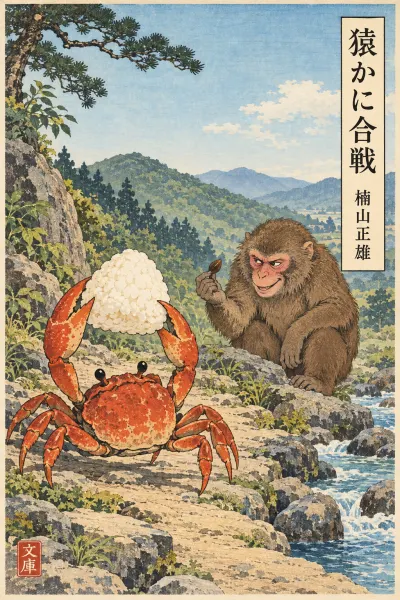
猿かに合戦 Saru ka ni Kassen, part 3: The Friends Spring Their Trap
In this part
The chestnut, bee, kelp and mortar hide around the monkey's house and wait. When the tired monkey comes home, the chestnut burns him, the bee stings him, he slips on the kelp, and the mortar falls on top of him. Finally the young crab comes out and clamps its pincers on the monkey's neck to avenge its parent.
AI translation · independently checked
と臼が言いますと、みんなはさんせいして、いちばんに栗が、When the mortar said this, everyone agreed, and the chestnut went first:
「わたしはここにかくれよう。」"I'll hide here."
と言って、炉の灰の中にもぐり込みました。And it burrowed down into the ashes of the hearth.
「わたしはここだよ。」"I'll be over here."
と言いながら、蜂は水がめの陰にかくれました。Saying this, the bee hid behind the water jar.
「わたしはここさ。」"And I'll be here."
と、昆布は敷居の上に長々と寝そべりました。And the kelp stretched itself out long and flat across the threshold.
「じゃあ、わたしはここに乗っていよう。」"Well then, I'll sit up here."
と臼は言って、かもいの上にはい上がりました。The mortar said this and crawled up onto the lintel.
夕方になって、猿はくたびれて、外から帰って来ました。When evening came, the monkey came home from outside, worn out.
そして炉ばたにどっかり座り込んで、He plonked himself down heavily beside the hearth,
「ああ、のどが渇いた。」"Ah, I'm so thirsty."
と言いながら、いきなりやかんに手をかけますと、灰の中にかくれていた栗がぽんとはね出して、とび上がって、猿の鼻面を力まかせにけつけました。Saying this, he suddenly reached for the kettle, and the chestnut that had been hiding in the ashes popped out with a bang, leapt up, and kicked the monkey on the snout with all its might.
「あつい。」"Ow, hot!"
と猿はさけんであわてて鼻面をおさえて、台所へかけ出しました。The monkey shrieked, clapped his hands over his snout in a panic, and ran off to the kitchen.
そしてやけどをひやそうと思って、水がめの上に顔を出しますと、陰から蜂がぶんととび出して、猿の目の上をいやというほど刺しました。He meant to cool his burn, so he leaned his face over the water jar, and the bee shot out from behind it with a bzzz and stung him above the eye as hard as it could.
「いたい。」"Ow, that hurts!"
と猿はさけんで、またあわてておもてへ逃げ出しました。The monkey shrieked, and once again he fled in a panic toward the front of the house.
逃げ出すひょうしに、敷居の上に寝ていた昆布でつるりとすべって、腹んばいに倒れました。Just as he was running out, he slipped — whoosh! — on the kelp lying across the threshold and fell flat on his belly.
その上に臼が、どさりところげ落ちて、うんとこしょと重しになってしまいました。Down on top of him tumbled the mortar with a great thud, and heave-ho, it pinned him down like a heavy weight.
猿は赤い顔をありったけ赤くして苦しがって、うんうんうなりながら、手足をばたばたやっていました。The monkey's red face turned as red as it could possibly go, and he groaned and moaned in pain, his arms and legs flailing about.
そのとき、お庭の隅から子がにがちょろちょろはい出してきて、Just then the little crab came scuttling out from a corner of the garden,
「親のかたき、覚えたか。」"This is revenge for my parent — do you remember what you did?"
と言いながら、はさみをふり上げて、猿の首をちょきんとはさみではさんでしまいました。Saying this, it raised its pincers high and — snip! — clamped them around the monkey's neck.
Vocabulary
| Word | Meaning | JLPT |
|---|---|---|
| 炉ろ | sunken hearth (fireplace set into the floor)In old Japanese houses the 炉 (also 囲炉裏 いろり) was used for heating and cooking; 炉ばた is the area beside it. | — |
| 灰はい | ash, ashes | N3 |
| もぐり込みもぐりこむ | to burrow into, to slip down insidedictionary form: もぐり込むもぐる (dive, go under) + 込む (into). | — |
| 敷居しきい | threshold (grooved wooden sill under a sliding door) | — |
| 寝そべりねそべる | to lie sprawled outdictionary form: 寝そべるMore relaxed and sprawling than 寝る or 横になる. | — |
| かもいかもい | lintel (grooved beam above a sliding door)dictionary form: 鴨居The upper partner of 敷居; sliding doors run between the two. | — |
| くたびれてくたびれる | to get tired, to be worn outdictionary form: くたびれるColloquial near-synonym of 疲れる. | N2 |
| どっかりどっかり | heavily, with a thump (of sitting down)Mimetic word for plonking oneself down. | — |
| 鼻面はなづら | snout, the tip of the noseNote the rendaku: つら → づら. | — |
| 力まかせにちからまかせ | with all one's strengthdictionary form: 力まかせ | — |
| いやというほどいやというほど | terribly hard; more than enoughLiterally 'so much that one would say "no more"'. | — |
| ひょうしひょうし | the moment, the instant (when something happens)dictionary form: 拍子〜ひょうしに: 'just as ~, in the act of ~'. | — |
| 腹んばいはらばい | lying flat on one's stomachdictionary form: 腹ばい腹んばい is a colloquial form of 腹ばい. | — |
| かたきかたき | enemy one seeks revenge ondictionary form: 敵親のかたき is a set phrase: 'the one who killed my parent' — a classic line of a revenge story. | N1 |
Grammar
〜(よ)う N4 volitional: I'll ~ / let's ~
The volitional form expresses the speaker's own decision. Each hider uses it to announce where it is going to wait.
わたしはここにかくれよう。
I'll hide here.
〜ながら N4 while doing ~
Attached to the verb stem, it shows two actions happening at the same time. Here the bee speaks as it hides.
と言いながら、蜂は水がめの陰にかくれました。
Saying this, the bee hid behind the water jar.
〜ますと N4 when ~ (then something happens)
Conditional と after a polite verb links an action to what follows immediately and often unexpectedly. The monkey reaches for the kettle, and at that moment the chestnut leaps out.
いきなりやかんに手をかけますと、灰の中にかくれていた栗がぽんとはね出して
he suddenly reached for the kettle, and the chestnut that had been hiding in the ashes popped out
〜(よ)うと思う N4 to intend to ~, to think of doing ~
Volitional form + と思う shows what someone plans to do. The monkey goes to the water jar intending to cool his burn.
やけどをひやそうと思って
meaning to cool his burn
〜ひょうしに N1 just as ~, in the act of ~
After a plain verb, it marks the instant during which something else happens, usually by accident. The monkey slips at the very moment he dashes out.
逃げ出すひょうしに、敷居の上に寝ていた昆布でつるりとすべって
just as he was running out, he slipped on the kelp lying across the threshold
〜てしまう N4 to do completely; to end up ~
to do completely; to end up ~. It stresses that an action is carried through to completion. Here it marks the crab's decisive final move against the monkey. Example: 猿の首をちょきんとはさみではさんでしまいました。 — snip! — it clamped the monkey's neck in its pincers.
猿の首をちょきんとはさみではさんでしまいました。
snip! — it cut right through the monkey's neck with them.