Part 2 of 3 · JLPT N2
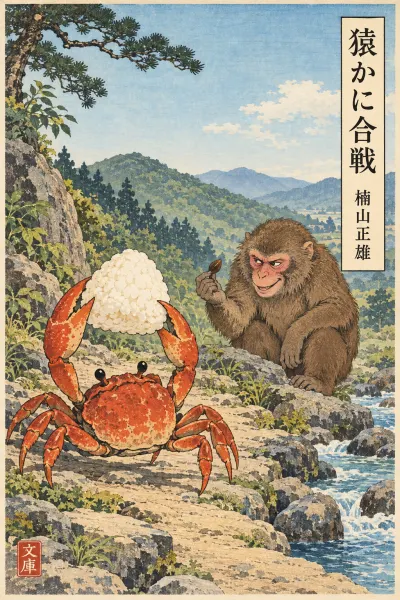
猿かに合戦 Saru ka ni Kassen, part 2: The Monkey's Cruel Trick and the Crab's New Friends
In this part
The monkey throws a hard green persimmon at the crab, kills it, and runs off with all the ripe fruit. The crab's child comes home, finds its parent dead and weeps, until a chestnut, a bee, a piece of kelp and a mortar each promise to take revenge on the monkey. Together they go to the monkey's house, find it empty, and decide to hide inside and wait.
AI translation · independently checked
「これこれ、こんなしぶいのはだめだよ。もっとあまいのをおくれよ。」"Hey, hey, a bitter one like this is no good. Give me a sweeter one!"
と言いますと、猿は「よし、よし。」と言いながら、もっと青いのをもいで、ほうりました。When the crab said this, the monkey said, "All right, all right," picked an even greener one, and tossed it down.
かにが、The crab said,
「こんどもやっぱりしぶくってだめだ。ほんとうにあまいのをおくれよ。」"This one's bitter too, it's no good. Give me one that's really sweet!"
と言いますと、猿はうるさそうに、At that the monkey looked annoyed and said,
「よし、そんならこれをやる。」"All right, then, have this!"
と言いながら、いちばん青い硬いのをもいで、あおむいて待っているかにの頭をめがけて力いっぱい投げつけますと、かには、「あっ。」と言ったなり、ひどく甲羅をうたれて、目をまわして、死んでしまいました。And with that he picked the very greenest, hardest one and hurled it with all his strength, aiming straight at the head of the crab, who was waiting below with its face turned up. The crab gave just one cry, "Oh!", and that was all; its shell was struck so hard that it fainted and died.
猿は、「ざまをみろ。」と言いながら、こんどこそあまい柿を一人じめにして、おなかのやぶれるほどたくさん食べて、その上両手にかかえきれないほど持って、あとをも見ずにどんどん逃げて行ってしまいました。"Serves you right!" said the monkey, and this time he kept all the sweet persimmons to himself and ate so many that his belly nearly burst; then, on top of that, he took more than he could carry in both arms and ran off as fast as he could without even looking back.
猿が行ってしまったあとへ、そのときちょうど裏の小川へ友だちと遊びに行っていた子がにが帰って来ました。After the monkey had gone, the little crab came home; it had just then gone off to play with its friends at the stream behind the house.
見ると柿の木の下に親がにが甲羅をくだかれて死んでいます。When it looked, there under the persimmon tree lay its parent, dead, with its shell smashed.
子がにはびっくりしておいおい泣き出しました。The little crab was so shocked that it burst out sobbing, boo-hoo, boo-hoo.
泣きながら、「いったいだれがこんなひどいことをしたのだろう。」と思ってよく見ますと、さっきまであれほどみごとになっていた柿がきれいになくなって、青い青いしぶ柿ばかりが残っていました。Still crying, it wondered, "Who on earth could have done such a terrible thing?", and when it took a good look around, it saw that the persimmons which had been growing so splendidly only a little while ago were all completely gone, and only green, green bitter persimmons were left.
「じゃあ、猿のやつが殺して、柿を取っていったのだな。」"Then it was that monkey who killed my parent and took the persimmons!"
とかにはくやしがって、またおいおい泣き出しました。The crab was so vexed that it burst out sobbing again, boo-hoo, boo-hoo.
するとそこへ栗がぽんとはねて来て、Just then a chestnut came bouncing along, boing!, and
「かにさん、かにさん、なぜ泣くの。」"Little crab, little crab, why are you crying?"
と聞きました。it asked.
子がには、猿が親がにを殺したから、かたきを討ちたいと言いますと、栗は、The little crab said that the monkey had killed its parent, so it wanted to take revenge, and the chestnut
「にくい猿だ。よしよし、おじさんがかたきをとってやるから、お泣きでない。」"What a hateful monkey! There, there, your uncle here will take revenge for you, so don't you cry."
と言いました。said.
それでも子がには泣いていますと、こんどは蜂がぶんとうなって来て、But the little crab kept on crying, and this time a bee came buzzing along, bzzz!, and
「かにさん、かにさん、なぜ泣くの。」"Little crab, little crab, why are you crying?"
と聞きました。it asked.
子がには猿が親がにを殺したから、かたきを討ちたいと言いました。The little crab said that the monkey had killed its parent, so it wanted to take revenge.
すると蜂も、Then the bee also
「にくい猿だ。よしよし、おじさんがかたきをとってやるから、お泣きでない。」"What a hateful monkey! There, there, your uncle here will take revenge for you, so don't you cry."
と言いました。said.
それでも子がにがまだ泣いていますと、こんどは昆布がのろのろすべって来て、But the little crab was still crying, and this time a piece of kelp came slowly sliding along, slip, slip, and
「かにさん、かにさん、なぜ泣くの。」"Little crab, little crab, why are you crying?"
と聞きました。it asked.
子がには猿が親がにを殺したから、かたきを討ちたいと言いました。The little crab said that the monkey had killed its parent, so it wanted to take revenge.
すると昆布も、Then the kelp also
「にくい猿だ。よしよし、おじさんがかたきをとってやるから、お泣きでない。」"What a hateful monkey! There, there, your uncle here will take revenge for you, so don't you cry."
と言いました。said.
それでも子がにがまだ泣いていますと、こんどは臼がころころころがって来て、But the little crab was still crying, and this time a mortar came rolling along, roll, roll, roll, and
「かにさん、かにさん、なぜ泣くの。」"Little crab, little crab, why are you crying?"
と聞きました。it asked.
子がには猿が親がにを殺したから、かたきを討ちたいと言いました。The little crab said that the monkey had killed its parent, so it wanted to take revenge.
すると臼も、Then the mortar also
「にくい猿だ。よしよし、おじさんがかたきをとってやるから、お泣きでない。」"What a hateful monkey! There, there, your uncle here will take revenge for you, so don't you cry."
と言いました。said.
子がにはこれですっかり泣きやみました。At this the little crab stopped crying altogether.
栗と蜂と昆布と臼とは、みんなよって、かたき討ちの相談をはじめました。The chestnut, the bee, the kelp and the mortar all gathered together and began to talk over how to take their revenge.
三III
相談がやっとまとまると、臼と昆布と蜂と栗は、子がにを連れて猿のうちへ出かけて行きました。When at last they had agreed on a plan, the mortar, the kelp, the bee and the chestnut set off for the monkey's house, taking the little crab with them.
猿はたんと柿を食べて、おなかがくちくなって、おなかこなしに山へでも遊びに行ったとみえて、うちにはいませんでした。The monkey had eaten so many persimmons that his belly was stuffed full, and it seemed he had gone off to the mountain or somewhere to play and walk off his meal, for he was not at home.
「ちょうどいい。この間にみんなでうちの中にかくれて待っていよう。」"Just right. Meanwhile, let's all hide inside the house and wait."
Vocabulary
| Word | Meaning | JLPT |
|---|---|---|
| もいでもぐ | to pick (fruit), to pluck offdictionary form: もぐUsed for twisting fruit off a branch; often written 捥ぐ. | — |
| ほうりましたほうる | to toss, to throwdictionary form: 放るA casual, careless kind of throw. | N2 |
| めがけてめがける | to aim atdictionary form: 目掛けるUsually as 〜をめがけて, "aiming at ~". | — |
| 甲羅こうら | shell (of a crab or turtle) | — |
| 目をまわしてめをまわす | to faint, to be knocked senselessdictionary form: 目を回すLiterally "to make one's eyes spin"; can also mean to be very busy or flustered. | — |
| 一人じめひとりじめ | keeping everything for oneself, hoggingdictionary form: 独り占めUsed with にする: 一人じめにする. | — |
| かたきかたき | enemy (esp. one who killed one's kin); the target of revengedictionary form: 敵かたきを討つ / かたきをとる = to avenge someone; かたき討ち = revenge. | N1 |
| にくいにくい | hateful, detestabledictionary form: 憎いNot the suffix 〜にくい ("hard to ~"). | N2 |
| うなってうなる | to buzz, to hum, to growldictionary form: 唸るAny low, droning sound: insects, dogs, engines. | N3 |
| 昆布こんぶ | kelp (an edible seaweed)Also read こぶ. In the story it is slippery, which matters later. | — |
| 臼うす | mortar (a large wooden or stone vessel for pounding rice)The heavy tub used with a mallet to make mochi. | — |
| 泣きやみましたなきやむ | to stop cryingdictionary form: 泣き止む〜やむ after a verb stem = to stop doing (e.g. 降りやむ). | — |
| たんとたんと | a lot, plentyOld-fashioned or dialectal; today たくさん. | — |
| くちくくちい | full (after eating)dictionary form: くちいOld-fashioned word; today おなかがいっぱい. | — |
Grammar
〜たなり N1 and then nothing more; and that was all
The past form of a verb plus なり shows that one action happened and nothing followed it. Here the crab gives a single cry and never says another word.
かには、「あっ。」と言ったなり、ひどく甲羅をうたれて
the crab gave just one cry, "Oh!", and that was all; its shell was struck hard
〜ほど N3 so much that ~; to the extent that ~
ほど after a clause describes the degree of something. The monkey eats to the point where his belly might burst, and takes more than his arms can hold.
おなかのやぶれるほどたくさん食べて
ate so many that his belly nearly burst
〜きれない N3 cannot completely ~; too much to ~
The verb stem plus きれない means an action cannot be done fully. かかえきれない means "too many to hold in one's arms".
両手にかかえきれないほど持って
took more than he could carry in both arms
〜てやる N4 to do something for someone (from above)
〜てやる means doing something for someone, said by a speaker of equal or higher standing to someone lower (such as a child), or toward animals. It is plainer and less polite than 〜てあげる and can also express determination. The 'uncle' is promising to take revenge on the little crab's behalf.
おじさんがかたきをとってやるから、お泣きでない。
your uncle here will take revenge for you, so don't you cry.
お〜でない N1 don't ~ (gentle, old-fashioned command)
お plus a verb stem plus でない is an older, soft way for an adult to tell a child not to do something. Today people would say 泣かないで.
お泣きでない。
don't you cry.
〜とみえて N2 it seems that ~, and so ...
とみえる means "it appears that ~", a guess based on what can be seen. The narrator guesses the monkey went out because he is not at home.
山へでも遊びに行ったとみえて、うちにはいませんでした。
it seemed he had gone off to the mountain or somewhere to play, for he was not at home.