Upper intermediate · JLPT N2
猿かに合戦Saru ka ni Kassen — A Persimmon Seed for a Rice Ball
- JLPT N2
- 3,265 characters
- 3 parts
- about 27 minutes
- 3 easier versions
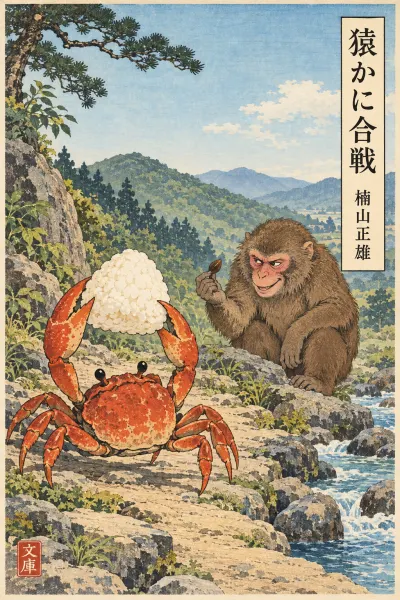
This is Kusuyama Masao's retelling of 猿かに合戦, one of Japan's best-known folktales. A crafty monkey cheats a crab out of a rice ball, then out of the persimmons from the tree the crab patiently grew. When the monkey's greed turns deadly, the crab's child finds unlikely allies: a chestnut, a bee, a piece of kelp and a mortar. Together they set out to make the monkey pay. The voice is that of a gentle storyteller reading aloud to children. The narration uses polite past tense (〜ました), and the story is full of sound and mimetic words such as むしゃむしゃ, ころころ and ちょきん. Chants and lines are repeated word for word, so they become familiar quickly. That makes the story rewarding for learners: once you understand a pattern, you meet it again and again. The challenge lies in the casual, sometimes old-fashioned dialogue, including forms like お泣きでない, 覚えたか and 〜ぬと. A handful of grammar patterns that are rare in textbooks also appear, which is why the text measures at about N2 despite its simple plot.
Contents
Easier versions
This story is also retold in simpler Japanese. Reading an easier version first makes the original much more approachable.
Before you read
- Learn the sound and mimetic words as vocabulary, not decoration. Words like むしゃむしゃ (munching greedily), ころころ (rolling), ぶん (a buzz or a quick swing) and ちょきん (a snip) often carry the action of a sentence by themselves.
- The repetitions help you. The crab's chant to the seed and the helpers' near-identical lines to the young crab come back almost unchanged. Work out the first instance carefully and the later ones will read easily.
- Watch for older or literary negatives and commands in the dialogue. 〜ぬと means 〜ないと, as in 'if you don't…'. お泣きでない is a soft 'don't cry'. 〜ておくれ is a familiar 'please do… for me'. 覚えたか is a threat along the lines of 'you'll remember this!'.
- Several grammar patterns recur and are worth reviewing first. 〜てやる means doing something to or for someone, often with an edge. いくら〜ても means 'no matter how much…'. 〜のではなかった means 'I shouldn't have…'. 〜と言わないばかり means 'as if to say…'. 〜たなり means 'just as it was, and then nothing more'. 〜きれない means 'can't fully…'.
- The last part takes place in a traditional Japanese house. Learning いろり (sunken hearth), 水がめ (water jar), 敷居 (threshold) and 鴨居 (lintel) beforehand will make the scene easier to picture.
Words to know
The most useful words from the notes across the story.
| Word | Meaning | JLPT |
|---|---|---|
| かたきかたき | enemy (esp. one who killed one's kin); the target of revengedictionary form: 敵かたきを討つ / かたきをとる = to avenge someone; かたき討ち = revenge. | N1 |
| もいでもぐ | to pick or pluck (fruit) with a twistdictionary form: もぐ | — |
| うなってうなる | to buzz, to hum, to growldictionary form: 唸るAny low, droning sound: insects, dogs, engines. | N3 |
| 灰はい | ash, ashes | N3 |
| だましてだます | to trick, to deceivedictionary form: 騙す | N2 |
| さっそくさっそく | right away, without delaydictionary form: 早速 | N2 |
| 間もなくまもなく | soon, before longHere 間 is read ま, not あいだ. | N2 |
| うらやましそうにうらやましい | enviousdictionary form: 羨ましい〜そうに means 'looking ...' and describes how someone appears. | N2 |
| ほうりましたほうる | to toss, to throwdictionary form: 放るA casual, careless kind of throw. | N2 |
| にくいにくい | hateful, detestabledictionary form: 憎いNot the suffix 〜にくい ("hard to ~"). | N2 |
| くたびれてくたびれる | to get tired, to be worn outdictionary form: くたびれるColloquial near-synonym of 疲れる. | N2 |
| 見せびらかしながらみせびらかす | to show off, to flauntdictionary form: 見せびらかすAlways negative in tone: showing something off in order to make others jealous. | N1 |
| しぶくってしぶい | astringent, puckery (like an unripe persimmon)dictionary form: 渋い〜くって is a colloquial form of 〜くて. 渋い also means 'tasteful, subdued' as in 渋い色. | N1 |
| 連れだってつれだつ | to go together, to go along with someonedictionary form: 連れ立つUsually in the て-form, used like an adverb: 連れ立って出かける. | — |
| 取りかえっことりかえっこ | a swap, a tradedictionary form: 取り替えっこ〜っこ is a childish suffix for doing something back and forth with someone, as in 取りかえっこ and 見せっこ. | — |
Plot summary
Show the full summary (contains spoilers)
A monkey persuades a crab to trade his rice ball for a persimmon seed and eats the rice ball in front of him. The crab plants the seed and threatens it until it grows into a tree full of fruit, but he cannot climb it. The monkey offers to pick the persimmons, eats the ripe ones himself and throws a hard green one at the crab, killing him. Then he runs off with the rest of the fruit. The crab's child comes home and weeps over its parent. A chestnut, a bee, a piece of kelp and a mortar each promise revenge. They find the monkey's house empty and hide inside. When the tired monkey returns, the chestnut burns him, the bee stings him, he slips on the kelp and the mortar falls on him. Finally the young crab clamps its pincers on the monkey's neck to avenge its parent.
About the author
Kusuyama Masao (1884–1950) was a Japanese writer, editor and translator who did much to shape children's literature in modern Japan. He studied at Waseda University and was also active in theatre, working as a critic and translator of Western drama. He is best remembered for his retellings of Japanese folk tales and legends for young readers. His retellings are written in clear, rhythmic Japanese meant to be read aloud.