 N3 · easy
Simplified retelling · JLPT N3
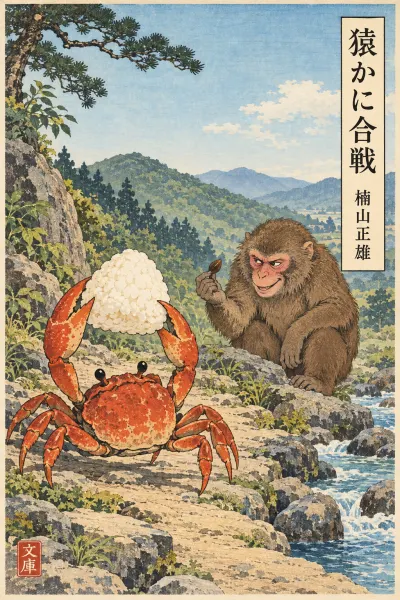
猿かに合戦 Saru ka ni Kassen in easy Japanese (N3)
This is our own simplified retelling of A Persimmon Seed for a Rice Ball, written for N3 learners and checked word by word against the N3 vocabulary list. A few story words and grammar patterns go beyond N3; the notes below give each one's level. It keeps the characters, events and ending of the original. When it feels easy, move on to the original text.
The story in brief
A monkey talks a crab into trading its rice ball for a persimmon seed. The seed grows into a tree, but when the persimmons ripen the monkey climbs it, eats the sweet fruit himself and kills the crab with a hard green one. The crab's child, helped by a chestnut, a bee, a strip of kelp and a mortar, ambushes the monkey in his house and takes revenge.
AI translation · independently checked
むかし、むかし、あるところに、さるとかにがいました。Long, long ago, in a certain place, there lived a monkey and a crab.
ある日、天気がよかったので、二人は一緒に遊びに出かけました。One day the weather was fine, so the two of them went out together to play.
途中で、さるはかきの種をひろいました。On the way, the monkey picked up a persimmon seed.
それから、川のそばで、かにはおにぎりをひろいました。Then, beside the river, the crab picked up a rice ball.
さるは、本当はおにぎりがとても欲しかったのです。The truth was, the monkey wanted that rice ball very much.
そこで、かにに言いました。So he said to the crab:
「このかきの種と、そのおにぎりを取りかえないか。」"How about swapping that rice ball for this persimmon seed?"
「でも、おにぎりのほうが大きいよ。」"But the rice ball's bigger."
「でも、種をうえれば木になって、おいしいかきがたくさんなるよ。」"Sure, but if you plant the seed, it'll grow into a tree, and lots of tasty persimmons will grow on it."
そう聞くと、かにも種が欲しくなりました。When the crab heard that, the crab wanted the seed too.
そして、とうとう取りかえてしまいました。And in the end, the crab went and made the swap.
さるはおにぎりをおいしそうに食べて、自分の家へ帰っていきました。The monkey munched the rice ball with great relish and went off home.
かにはすぐに種を庭にうえました。The crab planted the seed in the garden right away.
「早くめを出してください。出さないと、はさみで切りますよ。」"Hurry up and sprout, please. If you don't, I'll cut you with my claws!"
すると、かわいいめが出ました。And then a sweet little sprout came up.
かには毎日、めに言いました。Every day, the crab said to the sprout:
「早く大きな木になってください。ならないと、はさみで切りますよ。」"Hurry up and grow into a big tree, please. If you don't, I'll cut you with my claws!"
めはどんどん大きくなって、りっぱな木になりました。The sprout grew bigger and bigger, until it was a fine, splendid tree.
そして、花がさきました。And then it burst into flower.
「早くかきをつけてください。つけないと、はさみで切りますよ。」"Hurry up and grow persimmons, please. If you don't, I'll cut you with my claws!"
すると、木にはかきがたくさんなって、だんだん赤くなりました。And then lots of persimmons grew on the tree, and little by little they turned red.
かには手をのばしましたが、背がひくくて、とどきません。The crab stretched out a claw, but the crab was too short and couldn't reach them.
木に登ろうとしましたが、何度やっても、すべって登れませんでした。The crab tried to climb the tree, but no matter how many times the crab tried, the crab slipped and couldn't climb it.
ある日、さるが来て、赤いかきを見ました。One day the monkey came along and saw the red persimmons.
「さるさん、木に登って取ってくれませんか。お礼にかきを少しあげます。」"Mr. Monkey, won't you climb the tree and pick them for me? I'll give you a few persimmons to thank you."
「いいよ。待っていなさい。」"All right. You wait there."
さるはするする木に登りました。Up the tree the monkey went, scurry-scurry.
そして、赤いかきを取って、自分だけで食べはじめました。Then he picked a red persimmon and started eating all by himself.
「自分ばかり食べないで、わたしにも投げてください。」"Don't eat them all yourself! Throw some down to me too, please."
さるはわざと青いかきを取って、投げました。The monkey picked a green persimmon on purpose and threw it down.
食べてみると、とてもまずいかきでした。When the crab tried it, it tasted awful.
「これはまずいよ。あまいのをください。」"This one's awful! Give me a sweet one, please."
さるはまた青いかきを投げました。The monkey threw down another green persimmon.
「これもだめだ。本当にあまいのをください。」"This one's no good either. Please, give me a really sweet one."
さるはうるさいと思って、いちばんかたい青いかきを取りました。Thinking the crab was a nuisance, the monkey picked the hardest green persimmon of all.
そして、かにの頭に力いっぱい投げました。And he threw it at the crab's head with all his might.
かには体を強く打たれて、死んでしまいました。The crab's body was struck so hard that the crab died.
さるはあまいかきをおなかいっぱい食べました。The monkey ate sweet persimmons until his belly was full.
それから、かきをたくさん持って、逃げていきました。Then he took lots of persimmons and ran away.
そのあと、かにの子どもが遊びから帰ってきました。Afterwards, the crab's child came home from playing.
木のそばで、親が死んでいます。There beside the tree lay its parent, dead.
子どもはびっくりして、大きな声でなきました。The child was so shocked that it cried out loud.
見ると、赤いかきはなくなって、青いかきだけが残っていました。When it looked, the red persimmons were gone, and only the green ones were left.
「さるが殺して、かきを取っていったんだ。」"The monkey killed my parent and took the persimmons!"
そこへくりが来て、聞きました。Just then a chestnut came by and asked:
「かにさん、どうしてないているの。」"Little crab, why are you crying?"
「さるが親を殺しました。かたきをうちたいです。」"The monkey killed my parent. I want to get revenge."
「ひどいさるだ。わたしが手伝うから、なかないで。」"What a wicked monkey! I'll help you, so don't cry."
次に、はちが飛んできました。Next, a bee came flying along.
それから、こんぶとうすも来ました。Then a strip of kelp and a mortar came too.
みんな同じことを聞いて、同じように言いました。They all asked the same thing and said the same thing.
かにの子どもは、やっとなくのを止めました。At last the crab's child stopped crying.
そして、みんなで相談をはじめました。And they all began to make a plan together.
みんなは、かにの子どもと一緒に、さるの家へ行きました。Together with the crab's child, they all went to the monkey's house.
さるは遊びに出ていて、留守でした。The monkey had gone out to play, and nobody was home.
「ちょうどいい。家の中にかくれて待っていよう。」"Perfect. Let's hide inside the house and wait."
とうすが言いました。said the mortar.
くりはいろりの中に、はちは台所の水がめのうしろにかくれました。The chestnut hid in the hearth, and the bee hid behind the water jar in the kitchen.
こんぶは入口のところに長くねました。The kelp lay stretched out long across the doorway.
うすは入口の上の高いたなに登りました。The mortar climbed up onto the high shelf above the doorway.
夕方、さるは疲れて帰ってきました。In the evening, the monkey came home tired out.
いろりのそばに座って、He sat down by the hearth
「ああ、のどがかわいた。」"Ahh, I'm thirsty."
と言いました。and said that.
そのとき、いろりの中からくりが飛び出しました。Just then, the chestnut jumped out of the hearth.
そして、さるのはなに強く当たりました。And it hit the monkey hard on the nose.
「熱い。」"Hot!"
さるは台所へ走りました。The monkey ran to the kitchen.
水がめの水ではなを洗おうとすると、はちが飛び出して、さるの目の上をさしました。When he tried to wash his nose with water from the water jar, the bee flew out and stung him above the eye.
「痛い。」"Ouch!"
さるは外へ逃げようとしました。The monkey tried to run outside.
でも、入口でこんぶをふんで、すべって倒れました。But at the doorway he stepped on the kelp, slipped and fell over.
そこへ、たなの上からうすがおりてきて、さるの背中に乗りました。Then down came the mortar from the shelf, and landed on the monkey's back.
うすはとても重くて、さるは動けません。The mortar was very heavy, and the monkey couldn't move.
さるは苦しくて、手と足をばたばた動かしました。In agony, the monkey flailed his arms and legs, flap-flap-flap.
そのとき、庭のすみから、かにの子どもが出てきました。Just then, the crab's child came out from a corner of the garden.
「親のかたきだ。」"This is for my parent!"
かにの子どもははさみで、さるの首をちょきんと切りました。And with its claws, the crab's child cut off the monkey's head, snip!
Vocabulary
| Word | Meaning | JLPT |
|---|---|---|
| 途中とちゅう | on the way, partway途中で = on the way somewhere. | N4 |
| ひろいましたひろう | to pick up (something found)dictionary form: 拾うUsually written 拾う. | N4 |
| 取りかえないとりかえる | to swap, to exchangedictionary form: 取り替えるAとBを取り替える = swap A for B. | N4 |
| とうとうとうとう | finally, in the endOften after hesitation or a long process. | N4 |
| りっぱりっぱ | fine, splendid, impressivedictionary form: 立派な-adjective: りっぱな木. | N5 |
| とどきませんとどく | to reachdictionary form: 届くAlso used for letters and parcels arriving. | N3 |
| すべってすべる | to slip, to slidedictionary form: 滑る | N4 |
| わざとわざと | on purpose, deliberatelyUsually for something mean or unexpected. | N3 |
| かたきかたき | enemy one must avengedictionary form: 敵かたきをうつ = to take revenge; 親のかたき = the one who killed one's parent. | N1 |
| うすうす | mortar (heavy wooden or stone bowl for pounding rice)dictionary form: 臼 | — |
| 相談そうだん | discussion, talking over a plan相談する = to consult, talk something over. | N4 |
| 留守るす | being away from home留守でした = nobody was home. | N4 |
| いろりいろり | sunken hearth (fire pit in the floor of an old Japanese house)dictionary form: 囲炉裏 | — |
| 水がめみずがめ | water jardictionary form: 水瓶かめ becomes がめ in the compound. | — |
Grammar
〜ば N4 if ~ (then)
The ば-form states a condition that leads to a natural result. Here, planting the seed will lead to a tree full of persimmons.
種をうえれば木になって、おいしいかきがたくさんなるよ。
If you plant the seed, it'll grow into a tree, and lots of tasty persimmons will grow on it.
〜ないと N4 if you don't ~
The negative form plus と gives a condition with an automatic consequence. In the crab's chant it works as a playful threat.
出さないと、はさみで切りますよ。
If you don't, I'll cut you with my claws!
〜てしまう N4 to end up doing; to do completely (often with regret)
Adds a sense of finality or regret. 取りかえてしまいました suggests the crab gave in to the swap. 死んでしまいました stresses that the death is sad and final.
とうとう取りかえてしまいました。
In the end, the crab went and made the swap.
〜ようとする N3 to try to ~, to be about to ~
The volitional form plus とする describes an attempt, often one that fails or is interrupted. The crab tries to climb, and later the monkey tries to wash his nose and to run away.
木に登ろうとしましたが、何度やっても、すべって登れませんでした。
The crab tried to climb the tree, but no matter how many times the crab tried, the crab slipped and couldn't climb it.
Passive 〜られる N4 to be done to (something happening to the subject)
打たれる is the passive of 打つ. The sentence is told from the crab's side: the crab suffered the blow.
かには体を強く打たれて、死んでしまいました。
The crab's body was struck so hard that the crab died.
〜ないで N5 without doing ~; don't ~
The negative form plus で links a request not to do something with another request. 食べないで、…投げてください means 'don't eat them all, throw some instead.'
自分ばかり食べないで、わたしにも投げてください。
Don't eat them all yourself! Throw some down to me too, please.