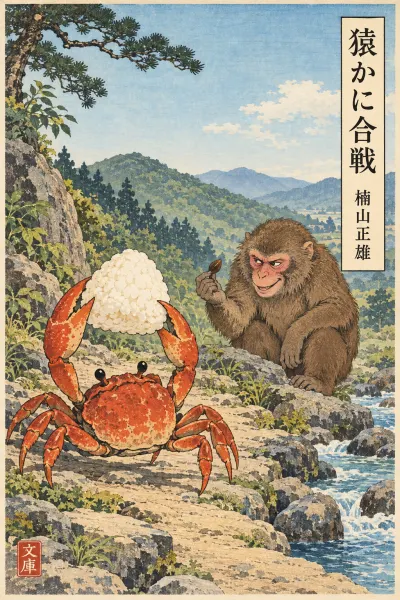
 N4 · easy
Simplified retelling · JLPT N4
猿かに合戦 Saru ka ni Kassen in easy Japanese (N4)
This is our own simplified retelling of A Persimmon Seed for a Rice Ball, written for N4 learners and checked word by word against the N4 vocabulary list. A few story words and grammar patterns go beyond N4; the notes below give each one's level. It keeps the characters, events and ending of the original. When it feels easy, move on to the N3 version or the original text.
The story in brief
A monkey talks a crab into trading its rice ball for a persimmon seed. The crab grows a fine tree, but the monkey climbs it, eats the ripe fruit and kills the crab by throwing a hard green persimmon. The crab's child, with help from a chestnut, a bee, a piece of kelp and a mortar, ambushes the monkey in its house and takes revenge.
AI translation · independently checked
むかし、むかし、あるところに、さるとかにがいました。Long, long ago, in a certain place, there lived a monkey and a crab.
ある日、天気がよかったので、さるとかにはいっしょに出かけました。One day the weather was fine, so the monkey and the crab went out together.
山の道で、さるはかきのたねを見つけました。On the mountain path, the monkey found a persimmon seed.
川のそばで、かにはおむすびを見つけました。By the river, the crab found a rice ball.
さるはおむすびが食べたくなりました。The monkey began to want to eat the rice ball.
「このたねと、そのおむすびをとりかえないか。」と、さるはかにに聞きました。"Why don't we swap this seed for that rice ball?" the monkey asked the crab.
「でも、おむすびのほうが大きいよ。」と、かには答えました。"But the rice ball's bigger," the crab answered.
「たねをうえると、木になって、おいしいかきがたくさんできるよ。」"If you plant the seed, it'll turn into a tree, and lots of tasty persimmons will grow on it!"
かにもたねが欲しくなって、おむすびとたねをとりかえました。Then the crab began to want the seed too, and swapped the rice ball for it.
さるはおむすびをおいしそうに食べて、家に帰りました。The monkey gobbled up the rice ball with great relish and went home.
かには、たねを家のにわにうえました。The crab planted the seed in the garden at home.
そして、毎日たねにむかって、「早く出て来い。出ないと、はさみで切るぞ。」と歌いました。And every day it faced the seed and sang, "Hurry up and come out! If you don't come out, I'll snip you with my pincers!"
すると、小さな木が出てきました。And then a little tree came up.
木はだんだん大きくなって、花がさいて、たくさんのかきができました。Little by little the tree grew bigger, its flowers bloomed, and lots of persimmons grew.
かきは赤くなりました。The persimmons turned red.
かには食べたかったのですが、せがひくいので、手が上までいきません。The crab wanted to eat them, but it was so short that its hands couldn't reach up to the top.
木にのぼろうとしましたが、何度のぼっても、おちてきます。It tried to climb the tree, but no matter how many times it climbed, it came tumbling down again.
かには毎日、かきを見ているだけでした。Every day, all the crab could do was look at the persimmons.
ある日、さるが来ました。One day, the monkey came along.
かには「さるさん、かきをとってくれないか。おれいに少しあげるよ。」とたのみました。The crab asked, "Monkey, won't you pick the persimmons for me? I'll give you a few to say thanks."
「いいよ。」さるは木にのぼりました。"Sure." The monkey climbed up the tree.
でも、さるは赤いかきを一つとって、「おいしい、おいしい。」と食べ始めました。But the monkey picked a red persimmon and started eating it, saying, "Yum, yum!"
「早く私にもくれよ。」とかにがたのむと、さるは青いかきをとって、なげました。When the crab begged, "Hurry up and give me some too!", the monkey picked a green persimmon and threw it down.
かには食べてみましたが、とてもまずいかきでした。The crab tried a bite, but it was a really nasty-tasting persimmon.
「これはまずいよ。あまいのをくれよ。」さるはまた青いかきをなげました。"This one tastes awful! Give me a sweet one!" The monkey threw down another green persimmon.
「これもだめだよ。」"This one's no good either!"
さるはうるさいと思いました。The monkey thought the crab was a nuisance.
そして、いちばん青くて、かたいかきをとって、かにのあたまにむかって、強くなげました。So it picked the greenest, hardest persimmon of all and threw it hard, straight at the crab's head.
かきはかにの体を強くうって、かには死にました。The persimmon struck the crab's body hard, and the crab died.
さるは赤いかきをおなかいっぱい食べて、たくさん持って、にげて行きました。The monkey ate red persimmons until its belly was full, took lots more with it, and ran away.
そこへ、かにの子どもが帰ってきました。Just then, the crab's children came home.
友だちと川であそんでいたのです。They had been playing in the river with their friends.
子がには、木の近くで死んでいる親を見て、びっくりして、なきました。When the little crabs saw their parent lying dead near the tree, they were shocked and burst into tears.
木には赤いかきがなくて、青いかきしかのこっていません。There were no red persimmons left on the tree — only green ones.
「さるがやったんだ。」"The monkey did this!"
すると、くりが来て、「かにさん、どうしてないているの。」と聞きました。Then a chestnut came along and asked, "Crab, why are you crying?"
子がには「さるが親を死なせました。かたきをとりたいです。」と答えました。The little crab answered, "The monkey killed my parent. I want revenge."
くりは「悪いさるだ。私が手つだうから、なかないで。」と答えました。The chestnut answered, "What a wicked monkey! I'll help you, so don't cry."
つぎに、はちが来て、同じことを聞きました。Next, a bee came and asked the same thing.
はちも「手つだうよ。」と答えました。The bee answered too, "I'll help!"
それから、こんぶも、うすも来て、「私たちも手つだうよ。」と答えました。After that, a piece of kelp and a mortar came as well, and answered, "We'll help too!"
子がにはなくのをやめました。The little crab stopped crying.
みんなは集まって、そうだんを始めました。They all gathered together and began to talk things over.
そうだんが終わると、みんなはさるの家へ出かけました。When they had finished talking, they all set off for the monkey's house.
さるは家にいませんでした。The monkey wasn't at home.
「ちょうどいい。家の中で待とう。」と、うすが話しました。"That's perfect. Let's wait inside the house," said the mortar.
くりは火の中に入りました。The chestnut got into the fire.
はちは水のそばにいました。The bee stayed by the water.
こんぶは入口の前に長くねました。The kelp lay stretched out long in front of the doorway.
うすは入口の上にのぼりました。The mortar climbed up above the doorway.
夕方、さるがつかれて帰ってきました。In the evening, the monkey came home, tired out.
火のそばにすわって、「ああ、のどがかわいた。」と、お茶を飲もうとしました。It sat down by the fire and said, "Ah, I'm thirsty," and was about to drink some tea.
すると、くりが火の中からとんで出て、さるのはなを強くうちました。Just then, the chestnut leaped out of the fire and hit the monkey hard on the nose.
「あつい!」さるは水のところへ走りました。"Hot!" The monkey ran over to the water.
すると、はちが出てきて、さるの目の上を強くさしました。Then the bee came out and stung the monkey hard just above the eye.
「いたい!」さるは外へにげようとしました。"Ouch!" The monkey tried to run outside.
でも、こんぶの上ですべって、たおれました。But it slipped on the kelp and fell over.
そこへ、うすが上からおちてきて、さるの上にのりました。Just then, the mortar dropped down from above and landed on top of the monkey.
うすはとても重くて、さるは動けません。The mortar was very heavy, and the monkey couldn't move.
そこへ子がにが来て、「親のかたきだ!」と、はさみでさるのくびを切りました。Then the little crab came over, cried, "This is for my parent!", and cut off the monkey's head with its pincers.
Vocabulary
| Word | Meaning | JLPT |
|---|---|---|
| とりかえましたとりかえる | to swap, to exchangedictionary form: 取り替えるAとBをとりかえる = swap A for B. | N4 |
| うえましたうえる | to plantdictionary form: 植えるUsed for seeds, trees and flowers. | N4 |
| おれいおれい | thanks; a thank-you giftdictionary form: お礼おれいに = as thanks, in return. | N4 |
| たのみましたたのむ | to ask (someone to do something), to requestdictionary form: 頼む | N5 |
| まずいまずい | bad-tasting, nasty (here the persimmon is unripe, so it is astringent, i.e. 渋い, rather than sweet)The opposite of おいしい. Unripe persimmons are very bitter. | N5 |
| なげましたなげる | to throwdictionary form: 投げる | N4 |
| にげてにげる | to run away, to escapedictionary form: 逃げる | N4 |
| かたきかたき | enemy; revengedictionary form: 敵かたきをとる = to take revenge for someone. 親のかたき = the one who killed one's parent. | N1 |
| うすうす | mortar (a heavy wooden or stone bowl for pounding rice)dictionary form: 臼Used for pounding rice into mochi; very heavy. | — |
| そうだんそうだん | discussion, talking things overdictionary form: 相談そうだんする = to discuss, to consult. | N4 |
| のどがかわいたのどがかわく | to be thirstydictionary form: 喉が渇くLiterally 'the throat gets dry'; usually said in the past form: のどがかわいた = I'm thirsty. | — |
| さしましたさす | to sting; to stabdictionary form: 刺す | N2 |
| すべってすべる | to slip, to slidedictionary form: 滑る | N4 |
| たおれましたたおれる | to fall over, to collapsedictionary form: 倒れる | N4 |
Grammar
〜たくなる N4 to come to want to do
The たい form becomes たく and combines with なる, showing a wish that arises. The monkey did not want the rice ball at first, but then started to want it.
さるはおむすびが食べたくなりました。
The monkey began to want to eat the rice ball.
〜と (natural result) N4 if / when ..., then ...
Dictionary form + と shows a result that always or naturally follows. Planting the seed automatically leads to a tree and fruit.
たねをうえると、木になって、おいしいかきがたくさんできるよ。
If you plant the seed, it'll turn into a tree, and lots of tasty persimmons will grow on it!
〜ようとする N4 to try to do; to be about to do
The volitional form + とする shows an attempt, often one that fails. Here the crab tries to climb but cannot.
木にのぼろうとしましたが、何度のぼっても、おちてきます。
It tried to climb the tree, but no matter how many times it climbed, it came tumbling down again.
何度〜ても N4 no matter how many times ...
The て form + も means 'even if'; with 何度 it means 'however many times'. The result stays the same each time.
何度のぼっても、おちてきます。
No matter how many times it climbed, it came tumbling down.
〜しか〜ない N4 only ... (nothing else)
しか always goes with a negative verb and stresses that nothing else is there. Only green persimmons are left, so the red ones are all gone.
青いかきしかのこっていません。
Only green persimmons are left.
Causative 〜させる N4 to make / cause someone to do
死ぬ becomes 死なせる, 'to cause to die'. It puts the blame on the monkey as the one who brought about the death.
さるが親を死なせました。
The monkey killed my parent.