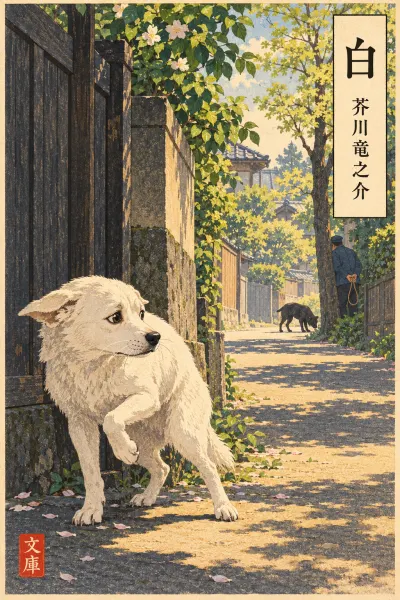
 N5 · easy
Simplified retelling · JLPT N5
白 Shiro in easy Japanese (N5)
This is our own simplified retelling of The Dog Called White, written for N5 learners and checked word by word against the N5 vocabulary list. A few story words and grammar patterns go beyond N5; the notes below give each one's level. It keeps the characters, events and ending of the original. When it feels easy, move on to the N4 version or the original text.
The story in brief
Shiro, a white dog, runs away in fear instead of helping his friend Kuro when a dogcatcher comes. When he gets home, his body has turned black, and the children he loves do not recognise him; the boy throws a stone at him and Shiro leaves. He saves a puppy called Napoleon from some children and becomes famous as a black dog who rescues people. One autumn night he returns to his kennel and tells the moon he regrets not helping Kuro. The next morning the children recognise him, and he sees in the girl's eyes that he is white again.
AI translation · independently checked
はるの日の午後です。It is a spring afternoon.
白といういぬが、しずかなみちをあるいていました。A dog called Shiro was walking along a quiet road.
みちのむこうに、いぬころしが一人いました。Further up the road, there was a dogcatcher.
くろいいぬをとろうとしています。He was trying to catch a black dog.
それはとなりのいえのくろでした。It was Kuro, from the house next door.
くろは白のいい友だちです。Kuro was Shiro's good friend.
白は「くろくん、あぶない!」といいたかったです。Shiro wanted to say, "Kuro, look out!"
でも、いぬころしが白を見ました。But the dogcatcher looked at Shiro.
白はとてもこわくなりました。Shiro became very frightened.
そして、くろをたすけないで、にげました。And he ran away without helping Kuro.
すぐに、くろの大きいこえを聞きました。Soon he heard Kuro's loud cry.
「たすけて!たすけて!」でも、白はとまりませんでした。"Help! Help!" But Shiro did not stop.
白はいえにかえりました。Shiro went home.
にわで、おじょうさんとぼっちゃんがあそんでいました。In the garden, the young miss and the young master were playing.
「おじょうさん、ぼっちゃん、今日いぬころしにあいました!」"Miss! Young master! Today I met a dogcatcher!"
でも、二人は白を見て、「どこのいぬ?」といいました。But the two of them looked at Shiro and said, "Whose dog is that?"
白はじぶんのあしを見ました。Shiro looked at his own legs.
あしも、おなかも、からだもみんなまっくろでした。His legs, his belly, his whole body were all pitch black.
白は大きいこえを出しました。Shiro barked loudly.
おじょうさんは「こわい!」といいました。The young miss said, "I'm scared!"
ぼっちゃんは白にいしをなげました。The young master threw a stone at Shiro.
「わたしは白ですよ!」"It's me, Shiro!"
でも、二人には分かりません。But the two of them could not understand.
白はいえを出ました。Shiro left the house.
白はまちをあるきました。Shiro walked through the town.
くろいからだを見たくありませんでした。He did not want to see his black body.
こうえんに入ると、「たすけて!」というこえを聞きました。When he went into a park, he heard a voice crying, "Help!"
白ははじめ、にげたいとおもいました。At first, Shiro felt like running away.
でも、白はもうにげませんでした。But Shiro did not run away anymore.
子どもたちが、小さいちゃいろのいぬをひいて、あそんでいました。Some children were dragging a little brown dog around and playing with it.
白はこわいいぬになって、大きいこえを出しました。Shiro turned fierce and barked loudly.
子どもたちはにげました。The children ran away.
白は小さいいぬといっしょに、そのいぬのいえまで行きました。Shiro went with the little dog all the way to its home.
それはきっさてんでした。It was a café.
「ぼくはナポレオンです。おじさんの名前は?」"I'm Napoleon. What's your name, mister?"
「白だよ。」"It's Shiro."
「白?でも、おじさんはくろいですね。」"Shiro? But you're black, mister."
「それでも白だよ。」"I'm still Shiro, all the same."
その後、くろいいぬのことが、たくさんしんぶんに出ました。After that, many stories about a black dog appeared in the newspapers.
くろいいぬは電車の前から男の子をたすけました。A black dog saved a boy from the front of a train.
かじの中から小さい子どもを出しました。It brought a small child out of a fire.
山でみちが分からなくなった学生たちを、まちまでつれて行きました。It led some students who had lost their way in the mountains down to a town.
まちに来たおおかみも、くろいいぬがとめました。When a wolf came into a town, it was a black dog that stopped it, too.
そのいぬは白でした。That dog was Shiro.
白はくろいじぶんがきらいでした。Shiro hated himself for being black.
だから、あぶないところへ行きました。That is why he went to dangerous places.
でも、しにませんでした。But he did not die.
あきのよる、白はつかれて、前のいえにかえりました。One autumn night, Shiro, worn out, came back to his old home.
いぬごやの前で、お月さまに話しました。In front of his kennel, he spoke to the moon.
「わたしはくろくんをたすけませんでした。だから、からだがくろくなりました。もう一度、おじょうさんとぼっちゃんにあいたいです。」"I did not help Kuro. That is why my body turned black. I want to see the young miss and the young master one more time."
そして、白はねました。And then Shiro went to sleep.
あさ、二人のこえで白はおきました。In the morning, Shiro woke up to the voices of the two children.
ぼっちゃんが大きいこえでいいました。The young master said in a loud voice,
「お父さん、お母さん!白がかえってきました!」"Father! Mother! Shiro has come back!"
おじょうさんは白のそばに来ました。The young miss came to Shiro's side.
白はおじょうさんのめを見ました。Shiro looked into the young miss's eyes.
めの中に、白いいぬがいました。In her eyes there was a white dog.
白はまた白いいぬになっていました。Shiro had become a white dog again.
「あら、白がないているわ。」"Oh, Shiro is crying."
ぼっちゃんはいいました。The young master said,
「ねえさんもないているよ。」"You're crying too, sis."
Vocabulary
| Word | Meaning | JLPT |
|---|---|---|
| いぬころしいぬころし | dogcatcherdictionary form: 犬殺しLiterally "dog-killer". This is an old word for a man who caught stray dogs. | — |
| となりとなり | next door; neighbouringdictionary form: 隣となりのいえ means "the house next door". | N5 |
| あぶないあぶない | dangerous; look out!dictionary form: 危ないSaid on its own, it works as a warning shout. | N5 |
| たすけないでたすける | to help; to savedictionary form: 助けるたすけて! means "Help!" | N3 |
| にげましたにげる | to run away; to escapedictionary form: 逃げる | N4 |
| おじょうさんおじょうさん | young miss (the daughter of the family)dictionary form: お嬢さんA polite word for someone else's daughter. Servants and pets in a story call the girl of the house this. | N4 |
| ぼっちゃんぼっちゃん | young master (the son of the family)dictionary form: 坊ちゃんA polite word for someone else's young son. | N2 |
| まっくろまっくろ | pitch black; completely blackdictionary form: 真っ黒まっ〜 adds "completely": まっしろ means "pure white". | N2 |
| なげましたなげる | to throwdictionary form: 投げるUse に for the target: 白にいしをなげる means "throw a stone at Shiro". | N4 |
| きっさてんきっさてん | café; coffee shopdictionary form: 喫茶店 | N5 |
| しんぶんしんぶん | newspaperdictionary form: 新聞しんぶんに出る means "to appear in the newspaper". | N5 |
| かじかじ | fire (a destructive fire, e.g. a house fire)dictionary form: 火事Use かじ for a fire that destroys buildings. Use 火 (ひ) for fire in general. | N4 |
| つかれてつかれる | to get tired; to be worn outdictionary form: 疲れる | N5 |
| いぬごやいぬごや | kennel; doghousedictionary form: 犬小屋いぬ + こや (hut). The こ becomes ご when the two words join. | — |
Grammar
〜ていました N5 was doing (an ongoing action in the past)
The て-form plus いました describes an action that was in progress at a past moment. It sets the scene as Shiro walks.
白といういぬが、しずかなみちをあるいていました。
A dog called Shiro was walking along a quiet road.
〜ようとする N3 to try to do; to be about to do
The volitional form (とろう) plus とする means someone is attempting an action that has not happened yet. Here the dogcatcher is in the middle of trying to catch Kuro.
くろいいぬをとろうとしています。
He was trying to catch a black dog.
〜たい / 〜たかった N5 want to do / wanted to do
Add たい to the verb stem to express a wish. たかった is its past form. Here it shows that Shiro wanted to warn Kuro but did not.
白は「くろくん、あぶない!」といいたかったです。
Shiro wanted to say, "Kuro, look out!"
い-adjective 〜く なる N5 to become (adjective)
Change the final い of an い-adjective to く and add なる to show a change of state. In this story it describes both Shiro's fear and his body turning black.
白はとてもこわくなりました。
Shiro became very frightened.
〜ないで N4 without doing
The ない-form plus で means doing the next action without doing the first one. Shiro runs away without helping his friend, and this is the key moment of the story.
くろをたすけないで、にげました。
Without helping Kuro, he ran away.
〜と (when) N4 when / as soon as (something happens)
A plain-form verb plus と links an action to what happens right after it. Often the second part is something the speaker discovers. When Shiro enters the park, he hears a cry.
こうえんに入ると、「たすけて!」というこえを聞きました。
When he went into a park, he heard a voice crying, "Help!"