Upper intermediate · JLPT N2
白Shiro — The Dog Called White
- JLPT N2
- 7,521 characters
- 6 parts
- about 63 minutes
- 3 easier versions
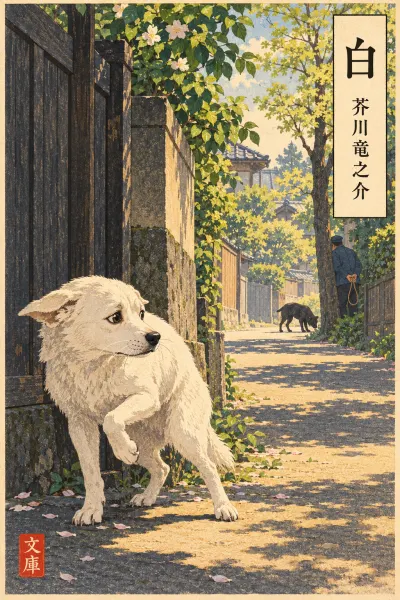
白 is a short fable-like tale by Akutagawa Ryūnosuke about a white dog named Shiro who, in a moment of fear, fails to warn his best friend Kuro about a dogcatcher. When he runs home, he finds that his own coat has turned completely black, and the children who loved him no longer know him. The story follows Shiro through the streets of Tōkyō as he lives with that shame and tries to become a different kind of dog. It is a story about cowardice, conscience and making amends, told for younger readers but not simplified for them. The narrator is warm and chatty, speaks in polite です/ます form and sometimes turns to the reader directly with asides like 御覧なさい. For learners, the gentle narrative voice is approachable, and the dog's-eye view keeps the vocabulary concrete. The difficulty comes from variety. Shiro shifts between polite speech and gruff, fatherly おれ speech, the grammar includes literary patterns such as 〜が早いか and 〜たなり, and one section is a series of stiff, semi-classical newspaper reports packed with place names and kanji compounds.
Contents
Easier versions
This story is also retold in simpler Japanese. Reading an easier version first makes the original much more approachable.
Before you read
- Notice who Shiro is talking to. With the children and the moon he speaks politely, but with the puppy Napoleon he uses plain, big-brotherly speech (おれ, おじさん). The puppy, by contrast, stays polite and eager, and that contrast shows their relationship.
- Treat Part 5 as a separate reading exercise. The newspaper reports use formal, semi-classical journalistic style and many proper nouns (田端, 軽井沢, 上高地, 名古屋, 小田原). Use the name list, and read each report for who, where and what the black dog did before working on the details.
- Learn the literary sequence patterns early, because they drive the action scenes. 〜が早いか means 'the moment that…', 〜たなり means 'did… and then stayed/remained so', and 〜たまま means 'while still in the state of…'.
- Watch for patterns that express Shiro's inner conflict and resolve: 〜まいと ('determined not to…'), 〜たさに ('out of a desire to…'), 〜さえ〜ば ('if only…'), and 〜どころか ('far from…'). These carry much of the story's emotional meaning.
- Track colour words and reflections. 白, 黒 and the moments when Shiro sees (or fears seeing) himself in glass, water or eyes are central to the story, so note every mirror-like surface the narrator mentions.
Words to know
The most useful words from the notes across the story.
| Word | Meaning | JLPT |
|---|---|---|
| 往来おうらい | street, roadOld-fashioned word for a street with traffic; literally 'going and coming'. | — |
| 罠わな | snare, trap罠にかける = to catch in a trap. | — |
| 野良犬のらいぬ | stray dog | — |
| 佇んでたたずむ | to stand still, to linger quietlydictionary form: 佇むA literary verb for standing quietly in one place, often with a wistful mood. | — |
| 御馳走ごちそう | a treat, fine food御馳走になる = to be treated to a meal; compare ごちそうさま after eating. | N4 |
| 夢中むちゅう | absorbed, frantic, carried away〜に夢中になる = to be completely absorbed in something. | N3 |
| 恐れましたおそれる | to fear, to be afraid ofdictionary form: 恐れるMore formal and written than 怖がる. | N3 |
| 唸ったうなる | to growl, to groandictionary form: 唸るNoun form 唸り声 (growl) appears later in the passage. | N3 |
| 縄なわ | rope, cordThis is the rope the puppy was tied with when Shiro rescued him. | N3 |
| 得意そうとくい | proud, pleased with oneselfdictionary form: 得意得意 can also mean 'strong point'; with そう it describes a proud, pleased look. | N3 |
| 救ったすくう | to save, to rescuedictionary form: 救う救い出す in the reports means 'to rescue and get out of danger'. | N3 |
| 覚悟かくご | readiness for the worst; resignation死を覚悟する means 'to be prepared to die'. | N3 |
| 狙ってねらう | to aim at, to targetdictionary form: 狙うAlso used for aiming at a goal; passive 狙われる = to be targeted. | N2 |
| 不相変あいかわらず | as before, as usualdictionary form: 相変わらずOld spelling; today written 相変わらず. | N2 |
| 図々しいずうずうしい | shameless, impudent, cheeky | N2 |
Plot summary
Show the full summary (contains spoilers)
One spring afternoon, Shiro sees a dogcatcher about to trap his friend Kuro, but he is too frightened to warn him and runs away. At home, the children do not recognise him: his body has turned black. They drive him off as a stray. Wandering Tōkyō and dreading his own reflection, Shiro hears children tormenting a puppy and, this time, charges in to save it. He walks the grateful puppy, Napoleon, home to a shabby café and parts from him with deep feeling. Newspapers then report a mysterious black dog that saves a boy from a train, kills a snake, guides lost students out of the Japan Alps, rescues a mayor's son from a fire and defeats an escaped wolf. Exhausted, Shiro returns to his old kennel at midnight. He tells the moon he only wishes to see his family once more. In the morning the children find him, Haruo cries that Shiro has come back, and in the girl's eyes Shiro sees himself white again.
About the author
Akutagawa Ryūnosuke (1892–1927) was one of the most important writers of modern Japanese short fiction. Born in Tokyo, he studied English literature at Tokyo Imperial University, and his early story 鼻 (The Nose) won praise from Natsume Sōseki. Many of his works retell older Japanese and Chinese tales with modern psychological insight, including 羅生門 (Rashōmon) and 藪の中 (In a Grove), which later inspired Kurosawa Akira's film Rashomon. He died by suicide at the age of 35. The Akutagawa Prize was named in his honour by his friend Kikuchi Kan.