Part 1 of 6 · JLPT N2
白(一) Shiro, part 1: Shiro Abandons His Friend
In this part
One spring afternoon, the white dog Shiro turns into a side street and sees a dogcatcher about to trap Kuro, the black dog next door and his best friend. When the dogcatcher glares at him, Shiro is too frightened to warn Kuro and runs away. Kuro's cries for help keep ringing in his ears as he flees.
AI translation · independently checked
ある春の午過ぎです。It was one spring afternoon.
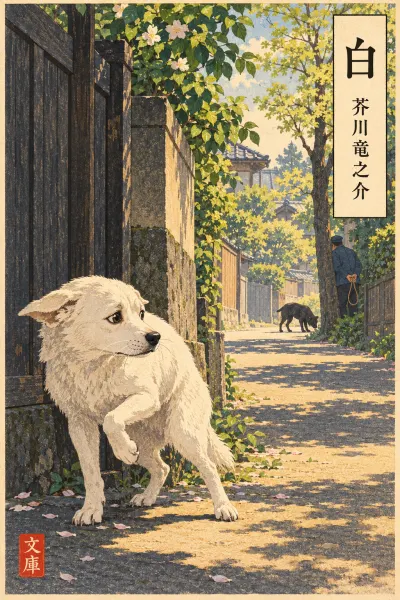
白と云う犬は土を嗅ぎ嗅ぎ、静かな往来を歩いていました。A dog called Shiro was walking along a quiet street, sniffing and sniffing at the ground.
狭い往来の両側にはずっと芽をふいた生垣が続き、そのまた生垣の間にはちらほら桜なども咲いています。On both sides of the narrow street, hedges that had put out new buds stretched on and on, and here and there between them cherry trees and other trees were in bloom.
白は生垣に沿いながら、ふとある横町へ曲りました。Shiro followed the hedges, and then, on a sudden whim, turned into a side street.
が、そちらへ曲ったと思うと、さもびっくりしたように、突然立ち止ってしまいました。But no sooner had he turned that way than he stopped short, as if something had given him a great fright.
それも無理はありません。And no wonder.
その横町の七八間先には印半纏を着た犬殺しが一人、罠を後に隠したまま、一匹の黒犬を狙っているのです。Some fifteen yards down that side street, a dogcatcher in a livery coat was hiding a snare behind his back and taking aim at a black dog.
しかも黒犬は何も知らずに、犬殺しの投げてくれたパンか何かを食べているのです。What was more, the black dog suspected nothing and was eating the bread, or whatever it was, that the dogcatcher had thrown to him.
けれども白が驚いたのはそのせいばかりではありません。Yet that was not the only reason Shiro was startled.
見知らぬ犬ならばともかくも、今犬殺しに狙われているのはお隣の飼犬の黒なのです。Had it been a dog he did not know, it might have been another matter, but the dog the dogcatcher was now aiming at was Kuro, the dog kept by the family next door.
毎朝顔を合せる度にお互の鼻の匂を嗅ぎ合う、大の仲よしの黒なのです。It was Kuro, his very best friend, whose nose he sniffed, and who sniffed his, every morning whenever they met.
白は思わず大声に「黒君! あぶない!」と叫ぼうとしました。Without thinking, Shiro was about to shout at the top of his voice, "Kuro! Look out!"
が、その拍子に犬殺しはじろりと白へ目をやりました。But at that very moment the dogcatcher shot Shiro a sharp glance.
「教えて見ろ! 貴様から先へ罠にかけるぞ。」――犬殺しの目にはありありとそう云う嚇しが浮んでいます。"Just try warning him! I'll snare you first." That was the threat written plainly in the dogcatcher's eyes.
白は余りの恐ろしさに、思わず吠えるのを忘れました。Shiro was so terrified that he forgot to bark.
いや、忘れたばかりではありません。No, it was not only that he forgot.
一刻もじっとしてはいられぬほど、臆病風が立ち出したのです。Cowardice came over him so strongly that he could not stay still for a single moment.
白は犬殺しに目を配りながら、じりじり後すざりを始めました。Keeping his eyes on the dogcatcher, Shiro began to back away, little by little.
そうしてまた生垣の蔭に犬殺しの姿が隠れるが早いか、可哀そうな黒を残したまま、一目散に逃げ出しました。Then, the instant the hedge hid the dogcatcher from view, he ran off as fast as his legs would carry him, leaving poor Kuro behind.
その途端に罠が飛んだのでしょう。The snare must have been thrown at that very moment.
続けさまにけたたましい黒の鳴き声が聞えました。Kuro's shrill cries rang out again and again.
しかし白は引き返すどころか、足を止めるけしきもありません。But far from turning back, Shiro showed no sign of even stopping.
ぬかるみを飛び越え、石ころを蹴散らし、往来どめの縄を擦り抜け、五味ための箱を引っくり返し、振り向きもせずに逃げ続けました。He leapt over puddles of mud, sent pebbles flying, slipped under the rope that closed off a road, knocked over a rubbish box, and kept on running without once looking back.
御覧なさい。Look at him!
坂を駈けおりるのを!See how he races down the slope!
そら、自動車に轢かれそうになりました!There, he was nearly run over by a car!
白はもう命の助かりたさに夢中になっているのかも知れません。Perhaps Shiro is already so desperate to save his own life that he can think of nothing else.
いや、白の耳の底にはいまだに黒の鳴き声が虻のように唸っているのです。No, deep in Shiro's ears, Kuro's cries are still buzzing like a horsefly.
「きゃあん。きゃあん。助けてくれえ! きゃあん。きゃあん。助けてくれえ!」"Kyaan! Kyaan! Help me! Kyaan! Kyaan! Help me!"
Vocabulary
| Word | Meaning | JLPT |
|---|---|---|
| 往来おうらい | street, roadOld-fashioned word for a street with traffic; literally 'going and coming'. | — |
| 生垣いけがき | hedgeA fence made of living plants (生 'living' + 垣 'fence'). | — |
| 横町よこちょう | side street, laneA small street branching off a main one. | — |
| 印半纏しるしばんてん | livery coat; short workman's jacket marked with a crest or nameA traditional happi-style coat worn by tradesmen, showing their employer's mark. | — |
| 犬殺しいぬころし | dogcatcherLiterally 'dog killer'; the period's harsh word for men who caught stray dogs. | — |
| 罠わな | snare, trap罠にかける = to catch in a trap. | — |
| 狙ってねらう | to aim at, to targetdictionary form: 狙うAlso used for aiming at a goal; passive 狙われる = to be targeted. | N2 |
| 貴様きさま | you (insulting)Originally respectful, now a very rude, aggressive 'you'. | — |
| 臆病風おくびょうかぜ | a fit of cowardiceLiterally 'wind of cowardice'; 臆病風が立つ / 臆病風に吹かれる = to lose one's nerve. | — |
| 後すざりあとずさり | moving backward, backing away (後すざり is a variant form of 後ずさり, from 退る しざる/すざる 'to move back')dictionary form: 後ずさりすざり is an older variant of ずさり. | — |
| 一目散いちもくさん | at full speed, headlongUsually 一目散に逃げる 'to run off as fast as one can'. | — |
| けたたましいけたたましい | shrill, piercing, alarmingly loudUsed for sudden startling sounds such as alarms or screams. | — |
| 夢中むちゅう | absorbed, frantic, carried away〜に夢中になる = to be completely absorbed in something. | N3 |
| 虻あぶ | horseflyA buzzing, biting fly; used here for a sound that keeps droning in the ear. | — |
Grammar
〜ばかりではない N3 not only ~
Says that what was just mentioned is not the whole story; something more follows. Here the danger to a dog is only part of the shock, and the next sentences give the bigger reason.
けれども白が驚いたのはそのせいばかりではありません。
Yet that was not the only reason Shiro was startled.
〜ならばともかく(も) N2 it would be one thing if ~, but
Sets aside one case as acceptable or different, in order to stress that the real case is more serious. A stranger dog would be another matter; Kuro is his friend.
見知らぬ犬ならばともかくも、今犬殺しに狙われているのはお隣の飼犬の黒なのです。
Had it been a dog he did not know, it might have been another matter, but the dog the dogcatcher was now aiming at was Kuro, the dog kept by the family next door.
〜が早いか N1 the moment ~, no sooner ~ than
Attached to the dictionary form of a verb, it shows that the next action follows immediately. As soon as the hedge hides the dogcatcher, Shiro bolts.
生垣の蔭に犬殺しの姿が隠れるが早いか、可哀そうな黒を残したまま、一目散に逃げ出しました。
The instant the hedge hid the dogcatcher from view, he ran off as fast as his legs would carry him, leaving poor Kuro behind.
〜たまま N4 leaving ~ as it is; while still ~
The た-form plus まま means a state continues unchanged while something else happens. Shiro runs off with Kuro still left behind.
可哀そうな黒を残したまま
leaving poor Kuro behind
〜どころか N2 far from ~; let alone ~
Rejects the expected idea and stresses that the reality is the opposite or even further from it. Shiro doesn't turn back; he doesn't even stop.
しかし白は引き返すどころか、足を止めるけしきもありません。
But far from turning back, Shiro showed no sign of even stopping.
〜たさに N1 out of the desire to ~
The たい-form turned into a noun (〜たさ) plus に gives the reason for an action: a strong wish. Here Shiro's wish to save his life drives his frantic running.
白はもう命の助かりたさに夢中になっているのかも知れません。
Perhaps Shiro is already so desperate to save his own life that he can think of nothing else.