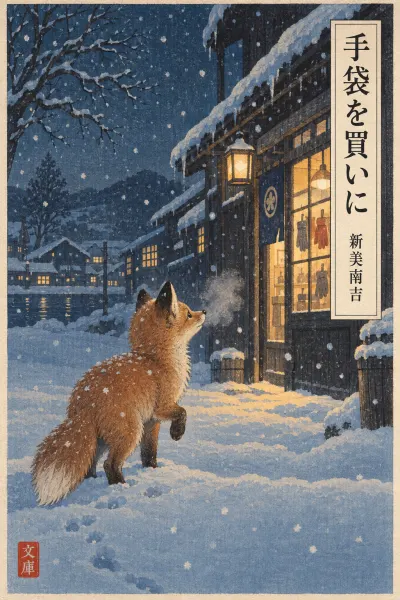
 N3 · easy
Simplified retelling · JLPT N3
手袋を買いに Tebukuro o Kai ni in easy Japanese (N3)
This is our own simplified retelling of Off to Buy Mittens, written for N3 learners and checked word by word against the N3 vocabulary list. A few story words and grammar patterns go beyond N3; the notes below give each one's level. It keeps the characters, events and ending of the original. When it feels easy, move on to the original text.
The story in brief
A little fox cub comes home with cold, red hands after playing in the snow, so his mother decides to buy him wool mittens in town. Afraid of people, she turns one of his paws into a human hand and sends him alone, but he shows the hatter his fox paw by mistake. The hatter sells him the mittens anyway, and when the cub says humans are not scary at all, his mother murmurs, wondering whether people really are good.
AI translation · independently checked
寒い冬が北から来て、きつねの親子が住んでいるもりにも来ました。Cold winter came from the north, and it came to the forest where a mother fox and her cub lived, too.
ある朝、子供のきつねがほらあなから出ようとしました。One morning, the little fox tried to go out of the burrow.
でも、「あっ」と大きな声を出して、目を手でおさえながら、お母さんのところへころがって来ました。But he cried "Oh!" in a loud voice, and holding his eyes with his paws, he came tumbling back to his mother.
「お母ちゃん、目に何かささった。早く取って。」"Mama, something stuck in my eyes. Take it out, quick."
お母さんきつねはびっくりして、子供の手をそっと取って見ました。The mother fox was startled, and she gently took his paws away and looked.
でも、目には何もささっていませんでした。But nothing was stuck in his eyes.
外へ出てみて、お母さんはやっと分かりました。When she went outside, the mother finally understood.
夜の間に、白い雪がたくさん降ったのです。During the night, a great deal of white snow had fallen.
雪の上に朝の光が当たって、とてもまぶしかったのです。The morning light was shining on the snow, and it was very dazzling.
雪を知らない子きつねは、その光を目に強く受けたので、何かささったと思ったのでした。The little fox did not know about snow, so when that light shone hard into his eyes, he thought something had stuck in them.
子きつねは外へ遊びに行きました。The little fox went outside to play.
やわらかい雪の上を走り回ると、雪がとんで、小さいにじが見えました。When he ran all around on the soft snow, the snow flew up, and small rainbows could be seen.
すると急に、後ろで「どたどた、ざーっ」とすごい音がしました。Then suddenly, behind him, there was a tremendous noise: thud, thud, whoosh!
白い雪が子きつねの上に落ちて来ました。White snow came falling down on top of the little fox.
子きつねはびっくりして、十メートルも向こうへ逃げました。The little fox was so startled that he ran a whole ten metres away.
ふりかえって見ましたが、何もいません。He turned around and looked, but there was nothing there.
木のえだから雪が落ちたのでした。It was only snow that had fallen from the branches of a tree.
しばらくして、子きつねはほらあなへ帰って来ました。After a while, the little fox came back to the burrow.
「お母ちゃん、お手々が冷たい。」"Mama, my little hands are cold."
子きつねはぬれて赤くなった両手を出しました。The little fox held out both his paws, wet and turned red.
お母さんはその手に「はーっ」と息をかけて、自分の手でやさしくつつみました。His mother blew on them, "haaa," and gently wrapped them in her own paws.
そして、「かわいい子の手にしもやけができたらかわいそうだ。夜になったら町へ行って、けいとの手袋を買ってあげよう」と思いました。And she thought, "It would be so sad if my darling child got chilblains on his hands. When night comes, I'll go to town and buy him some wool mittens."
暗い夜が来ました。Dark night came.
親子はほらあなを出ました。Mother and child left the burrow.
子きつねはお母さんのおなかの下に入って、丸い目であちこちを見ながら歩きました。The little fox walked tucked under his mother's belly, looking here and there with his round eyes.
しばらくすると、前の方にあかりが一つ見えました。After a while, they saw one light up ahead.
「お母ちゃん、ほしがあんなひくい所にも落ちているね。」"Mama, the stars fall down even in low places like that, don't they?"
「あれはほしじゃないのよ。町のあかりなのよ。」"That's not a star, dear. That's a light in the town."
そのあかりを見て、お母さんの足は止まってしまいました。When she saw that light, the mother's feet stopped still.
昔、友達のきつねと町へ行った時のことを思い出したのです。She remembered the time long ago when she had gone to town with a fox friend.
友達は、お母さんが止めるのも聞かないで、ある家のアヒルを盗もうとしました。Her friend would not listen when she tried to stop him, and he tried to steal a duck from a certain house.
それで農家の人に見つかって、追いかけられて、やっと逃げたのでした。Because of that, they were found by a farmer and chased, and they barely got away.
「お母ちゃん、早く行こうよ。」"Mama, let's go, hurry!"
でも、お母さんはどうしても足が前へ出ません。But no matter what she did, the mother's feet would not move forward.
仕方がないので、子きつねを一人で町へ行かせることにしました。There was nothing else to do, so she decided to let the little fox go into town by himself.
「坊や、手を片方出しなさい。」"Sweetie, hold out one of your hands."
お母さんはその手をしばらくにぎって、かわいい人間の子供の手に変えました。The mother held that hand for a while, and turned it into the lovely hand of a human child.
子きつねはその手を開いたりにぎったりして、ふしぎそうに見ました。The little fox opened and closed the hand, and looked at it in wonder.
「それは人間の手よ。町へ行ったら、まず丸い帽子のかんばんがある家を探しなさい。見つけたら、とをトントンとたたいて、『今晩は』と言うのよ。人間が少しとを開けるから、そこからこの人間の手を入れて、『この手にちょうどいい手袋をください』と言いなさい。決して、もう一つの手を出してはだめよ。」"That's a human hand. When you get to town, first look for a house with a sign shaped like a round hat. When you find it, knock on the door, tap tap, and say 'Good evening.' The human will open the door a little, so put this human hand in through the gap and say, 'Please give me some mittens that fit this hand just right.' You must never, ever hold out your other hand."
「どうして?」"Why?"
「人間は、相手がきつねだと分かると、手袋を売ってくれないの。それどころか、捕まえて、おりに入れてしまうのよ。人間は本当に怖いものなのよ。」"If humans find out you're a fox, they won't sell you mittens. Worse than that, they'll catch you and shut you up in a cage. Humans are truly frightening creatures."
お母さんは、持って来たお金を二つ、人間の手の方ににぎらせました。The mother put two of the coins she had brought into the human hand and had him hold them tight.
子きつねは町のあかりを見ながら、雪の野原を歩いて行きました。The little fox walked on across the snowy field, watching the lights of the town.
あかりは二つ、三つとふえて、十にもなりました。The lights grew to two, then three, and then as many as ten.
町に入ると、家はもうみんなとを閉めていました。When he came into the town, all the houses had already shut their doors.
高い窓から、あたたかそうな光が道の雪の上に落ちていました。From high windows, warm-looking light fell onto the snow in the street.
かんばんの上には小さな電気がついていました。Small electric lamps were lit above the signboards.
自転車のかんばんや、めがねのかんばんなど、いろいろありましたが、子きつねには何のかんばんか分かりません。There were all kinds of signs, a bicycle sign, a glasses sign and more, but the little fox could not tell what any of the signs were.
とうとう、黒い大きな帽子のかんばんが見つかりました。At last he found a sign with a big black hat.
子きつねは、教えられたとおり、とをたたきました。Just as he had been told, the little fox knocked on the door.
「今晩は。」"Good evening."
とが少し開いて、光が雪の上に長くのびました。The door opened a little, and the light stretched far out across the snow.
子きつねはその光がまぶしくて、びっくりして、間違えてきつねの手の方を入れてしまいました。The light was so dazzling that the little fox got a fright, and by mistake he put in his fox paw.
「このお手々にちょうどいい手袋ください。」"Please give me mittens that fit this little hand just right."
帽子屋さんは「おや」と思いました。The hatter thought, "Well, now!"
きつねの手です。It was a fox's paw.
「きっと木の葉をお金にして、買いに来たんだろう」と思いました。He thought, "I bet he's turned tree leaves into money and come to buy with them."
「先にお金をください。」"Give me the money first, please."
子きつねはお金を二つ渡しました。The little fox handed over the two coins.
帽子屋さんがお金を当ててみると、チンチンといい音がしました。When the hatter tapped the coins together, they made a nice clinking sound.
本当のお金です。It was real money.
帽子屋さんはたなから子供用のけいとの手袋を出して、子きつねに持たせてくれました。The hatter took a pair of children's wool mittens from the shelf and handed them to the little fox.
子きつねはお礼を言って、帰り始めました。The little fox said thank you and started back home.
「お母さんは人間は怖いと言ったけど、ちっとも怖くないや。」"Mama said humans are scary, but they're not scary at all!"
でも子きつねは、人間はどんなものか見てみたいと思いました。But the little fox thought he would like to see what humans were really like.
ある窓の下を通ると、やさしくて美しい声が聞こえました。As he passed under a certain window, he heard a gentle, beautiful voice.
「ねむれ ねむれ 母のむねに、ねむれ ねむれ 母の手に。」"Sleep now, sleep now, on your mother's breast; sleep now, sleep now, in your mother's arms."
きっと人間のお母さんの子守歌だ、と子きつねは思いました。That must be a human mother's lullaby, thought the little fox.
子きつねが眠る時も、お母さんきつねはあんなやさしい声で歌ってくれるからです。That was because when he went to sleep, his own mother sang to him in that same gentle voice.
次に、子供の声がしました。Next came a child's voice.
「お母ちゃん、こんな寒い夜は、もりの子きつねは寒い寒いと鳴いているだろうね。」"Mama, on a cold night like this, the little fox in the forest must be crying, 'I'm cold, I'm cold,' mustn't he?"
「もりの子きつねも、お母さんの歌を聞いて、ほらあなの中で眠ろうとしているでしょう。さあ、坊やも早く寝なさい。どっちが早く寝るかな。きっと坊やの方が早いですよ。」"The little fox in the forest is listening to his mama's song too, and trying to go to sleep in his burrow. Now then, you go to sleep quickly too. I wonder who'll fall asleep first. I bet it'll be you."
それを聞くと、子きつねは急にお母さんに会いたくなって、お母さんの待っている所へ走って行きました。When he heard that, the little fox suddenly wanted to see his mother, and he ran off to where she was waiting.
お母さんきつねは心配しながら、ずっと待っていました。The mother fox had been waiting all that time, full of worry.
子きつねが帰って来ると、あたたかいむねに抱いて、なきたいほど喜びました。When the little fox came back, she held him to her warm breast and was so happy she could have cried.
二人はもりへ帰って行きました。The two of them went back to the forest.
月が出て、きつねの毛が銀色に光りました。The moon came out, and the foxes' fur shone silver.
「お母ちゃん、人間はちっとも怖くないよ。」"Mama, humans aren't scary at all."
「どうして?」"Why do you say that?"
「間違えて本当の手を出しちゃったの。でも帽子屋さんは捕まえなかったよ。こんなにあたたかい手袋をくれたよ。」"I held out my real hand by mistake. But the hatter didn't catch me. He gave me these nice warm mittens."
子きつねは手袋をした両手をパンパンとたたいて見せました。The little fox clapped his mittened hands together, pat pat, to show her.
お母さんきつねは「まあ!」とびっくりしました。"My goodness!" said the mother fox in surprise.
そして、「本当に人間はいいものなのかしら。本当に人間はいいものなのかしら」と小さな声で言いました。And she said in a small voice, "Are humans really good, I wonder? Are humans really good?"
Vocabulary
| Word | Meaning | JLPT |
|---|---|---|
| ほらあなほらあな | burrow, den, cavedictionary form: 洞穴The foxes' home. Usually written 洞穴. | — |
| ささったささる | to get stuck in, to piercedictionary form: 刺さるIntransitive verb: something sticks into something. The transitive form 刺す means 'to stab'. | N2 |
| まぶしかったまぶしい | dazzling, too bright to look atdictionary form: 眩しいUsed for strong light such as sun on snow. It is usually written in hiragana. | N2 |
| しもやけしもやけ | chilblains, frostbite soresdictionary form: 霜焼けRed, itchy swelling of fingers and toes caused by cold. | — |
| けいとけいと | wool yarn, knitting wooldictionary form: 毛糸毛 'hair/fur' + 糸 'thread'. けいとの手袋 means knitted wool mittens. | N2 |
| かわいそうかわいそう | pitiful, poor thing, sad (for someone)dictionary form: 可哀想Do not confuse it with かわいい 'cute'. | N3 |
| 盗もうぬすむ | to stealdictionary form: 盗む盗もうとする means 'to try to steal'. | N4 |
| 追いかけられておいかける | to chase, to run afterdictionary form: 追いかけるIt is in the passive form here: 'were chased'. | N2 |
| 仕方がないしかたがない | it can't be helped, there's no other wayA very common set phrase. In speech it is often shortened to しょうがない. | — |
| 片方かたほう | one of a pair, one sideUsed for one hand, one shoe, one glove and so on. | — |
| かんばんかんばん | shop sign, signboarddictionary form: 看板The hat shop has a hat-shaped sign, so it is easy to find without reading. | N2 |
| 相手あいて | the other party, the person one is dealing withHere it means the customer: the one the shopkeeper is dealing with. | N3 |
| おりおり | cage (for animals)dictionary form: 檻 | N1 |
| 子守歌こもりうた | lullaby子守 means 'looking after a child'. It is also written 子守唄. | — |
Grammar
〜ようとする N3 to try to do; to be about to do
The volitional form plus とする describes an attempt or an action that is just starting. Often the action is interrupted or does not succeed, as when the cub tries to go out but is dazzled by the snow.
子供のきつねがほらあなから出ようとしました。
The little fox tried to go out of the burrow.
〜させることにする N3 to decide to make / let someone do
行かせる is the causative form of 行く ('make/let go'). Adding ことにする shows the speaker's decision, so the mother decides to let the cub go alone.
子きつねを一人で町へ行かせることにしました。
She decided to let the little fox go into town by himself.
〜たり〜たりする / 〜そうに N4 doing things like A and B; looking ~
〜たり〜たり lists actions that are repeated or done in turn: opening and closing. ふしぎそうに uses the stem + そう to mean 'looking puzzled', and it describes how he looked at his hand.
子きつねはその手を開いたりにぎったりして、ふしぎそうに見ました。
The little fox opened and closed the hand, and looked at it in wonder.
それどころか N2 on the contrary; far from that; even worse
This introduces something much stronger than what came before. Humans won't just refuse to sell the mittens, they will even catch the cub.
それどころか、捕まえて、おりに入れてしまうのよ。
Worse than that, they'll catch you and shut you up in a cage.
〜たとおり N3 just as ~; exactly the way ~
The past form plus とおり means doing something in the same way as described or instructed. Here it is combined with the passive 教えられた: 'just as he had been taught'.
子きつねは、教えられたとおり、とをたたきました。
Just as he had been told, the little fox knocked on the door.
〜てしまう N4 to end up doing (by mistake / with regret)
This shows that an action is complete and often that it was unintended or regrettable. In casual speech it becomes 〜ちゃう, as in 出しちゃった.
間違えてきつねの手の方を入れてしまいました。
By mistake he put in his fox paw.