Upper intermediate · JLPT N2
手袋を買いにTebukuro o Kai ni — Off to Buy Mittens
- JLPT N2
- 3,495 characters
- 3 parts
- about 29 minutes
- 2 easier versions
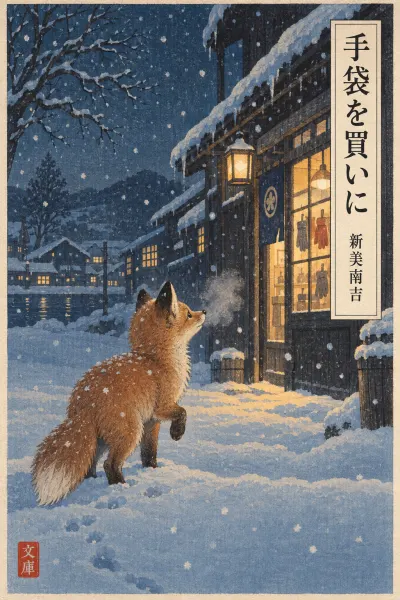
手袋を買いに is a short children's tale about a mother fox and her small cub on one snowy winter day and night. The cub sees snow for the first time and comes home with frozen paws, so his mother decides he needs mittens from the town. Fear of humans stops her at the edge of town, and the cub has to walk into the lit streets alone, carrying coins and one paw that has been changed into a human child's hand. The narration is gentle and warm, in polite -mashita form, and it lingers on sensations: dazzling snow, cold paws, lamplight on the snow, a song heard through a window. Dialogue is soft and childlike, with words such as 母ちゃん, お手々 and 坊. For a learner the story is rewarding because its vocabulary is concrete and its scenes are easy to picture. It is also challenging. It uses regional words such as ぬくとい, older spellings and terms such as 或, 仰有った, シャッポ and 白銅貨, and a great many sound words. The story is under 3,500 characters in three parts, so you can finish it in a few sittings.
Contents
Easier versions
This story is also retold in simpler Japanese. Reading an easier version first makes the original much more approachable.
Before you read
- Learn the family and child words before you start: 母ちゃん (Mama), 坊 (little one, used for the cub), お手々 (little hands), ねんね (sleep, in baby talk). They appear throughout the dialogue and set its tone.
- Expect many sound and mimetic words, often repeated: トントン (knocking), チンチン (a cold, stinging feeling, as in お手々がちんちんする), キラキラ (sparkling). Most of them describe how things feel or look, so reading them aloud helps you catch their meaning.
- Watch for giving and permission forms tied to the mother's care: 〜てやる and 〜させてやる (doing something for the cub, letting him do something), and the causative with ことになる (it ends up that she sends him). Also note the warnings in casual speech, 〜ちゃ駄目 and 〜ちゃいけない (you mustn't...).
- Several older or unusual items are easy to mistake. 或 means 'a certain', 仰有った is an old spelling of おっしゃった, 米 is used for metres, シャッポ means hat, and 白銅貨 are cupronickel coins. ぬくとい is a regional word meaning 'warm'.
- Notice 〜ほど and 〜ばかり. The narrator uses them for degree and emphasis, for example snow so bright it dazzles, or nothing but a certain sight. Also note それどころか (on the contrary; far from that), which marks a key turn in the cub's report about humans.
Words to know
The most useful words from the notes across the story.
| Word | Meaning | JLPT |
|---|---|---|
| 洞穴ほらあな | cave, burrow | — |
| 電燈でんとう | electric lampdictionary form: 電灯燈 is the older form of the kanji 灯. | N4 |
| 仰有ったおっしゃる | to say (honorific)dictionary form: 仰有るUsually written おっしゃる or 仰る today; 仰有る is an older spelling. | N4 |
| ちっともちっとも | (not) at all, (not) one bitUsed with a negative; casual and a little childlike. | N4 |
| 刺さったささる | to get stuck in, to piercedictionary form: 刺さるAn intransitive verb; the transitive form is 刺す, 'to stab'. | N2 |
| 眩しいまぶしい | dazzling, glaring | N2 |
| 風呂敷ふろしき | a cloth used to wrap and carry things | N2 |
| 看板かんばん | shop sign, signboard | N2 |
| 隙間すきま | gap, narrow opening | N2 |
| すなおにすなお | obediently, without fussdictionary form: 素直Describes someone who does what they are told, without suspicion or resistance. | N2 |
| 毛糸けいと | knitting wool, yarn | N2 |
| 通りかかるとおりかかる | to happen to pass byOften followed by と: 'just as he passed by…'. | N2 |
| 恋しくこいしい | missed, longed fordictionary form: 恋しいUsed for missing people, home or places you are far from, not only romantic love. | N2 |
| たまりましたたまる | to collect, to pooldictionary form: 溜まるHere the shadows 'pool' inside the footprints in the snow. | N2 |
| あきれましたあきれる | to be astonished, to be taken abackdictionary form: 呆れるOften a mix of surprise and disbelief. | N2 |
Plot summary
Show the full summary (contains spoilers)
Winter comes to the forest, and a fox cub is thrilled by his first snow. When he returns with cold paws, his mother decides to buy him mittens in town that night. Near the town she is too frightened to go on, because she remembers a narrow escape there. She turns one of his paws into a human child's hand. She tells him to knock at the hat shop and hold out only that hand, and warns that humans catch foxes. Dazzled by the shop's light, the cub pushes in his real fox paw instead. The hat-maker checks that the coins are real and sells him children's woollen mittens. On his way back the cub hears a human mother singing her child to sleep and runs home to his own mother. As they walk back under the moon, he says humans weren't frightening at all. His mother wonders aloud whether humans might really be good.
About the author
Niimi Nankichi was a Japanese writer of children's stories, poems and songs from Handa in Aichi Prefecture. The countryside of that area is widely thought to lie behind the village and hills of Gongitsune. He began writing as a young man. Gongitsune appeared in the children's magazine Akai Tori (The Red Bird), edited by Suzuki Miekichi. Niimi later worked as a teacher at a girls' school while continuing to write. His health was poor, and he died of tuberculosis while still in his twenties. Many of his works were published and became widely known only after his death. Besides Gongitsune, he is especially remembered for Tebukuro wo Kai ni (Buying Mittens).