 N5 · easy
Simplified retelling · JLPT N5
手袋を買いに Tebukuro o Kai ni in easy Japanese (N5)
This is our own simplified retelling of Off to Buy Mittens, written for N5 learners and checked word by word against the N5 vocabulary list. A few story words and grammar patterns go beyond N5; the notes below give each one's level. It keeps the characters, events and ending of the original. When it feels easy, move on to the original text.
The story in brief
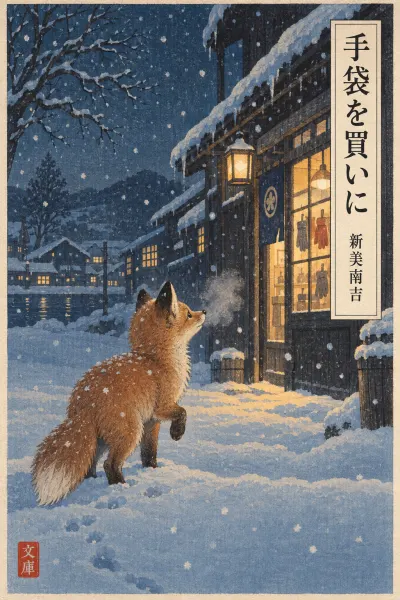
After seeing snow for the first time, a little fox cub comes home with cold hands, and his mother decides to buy him mittens in town. She is afraid of people, so she turns one of his paws into a human hand and sends him alone, but at the shop he holds out his fox paw by mistake. The shopkeeper sells him mittens anyway, and when the cub tells his mother that people are not scary, she wonders whether people really are good.
AI translation · independently checked
さむいふゆが来ました。The cold winter came.
もりのあなに、きつねのお母さんと子どもがすんでいました。A mother fox and her little one lived in a burrow in the forest.
ある朝、子どもがあなから出ました。One morning, the little fox came out of the burrow.
「お母さん、目がいたい!」"Mama, my eyes hurt!"
お母さんが見ると、目はだいじょうぶでした。When his mother looked, his eyes were just fine.
きのうのよる、白いゆきがたくさんふりました。The night before, lots of white snow had fallen.
天気がよくて、ゆきがとてもあかるかったのです。The weather was fine, and the snow was very bright.
子どもは、ゆきをしりませんでした。The little fox had never known snow.
子どもは、ゆきの上であそびました。The little fox played on the snow.
すると、後ろの木の上から、ゆきがたくさんふりました。Then lots of snow came falling down from the tree behind him.
子どもははしって、とおくへ行きました。The little fox ran far away.
でも、何もいませんでした。But there was nothing there.
あなにかえると、子どもはいいました。When he got back to the burrow, the little fox said:
「お母さん、てがつめたいよ。」"Mama, my hands are cold!"
お母さんは、子どもの小さいてをもちました。His mother held the little fox's small hands.
そして、「よるになったら、まちへ行って、てぶくろをかいましょう」といいました。Then she said, "When night comes, let's go to town and buy you some mittens."
よるになりました。Night came.
お母さんと子どもは、あなを出ました。The mother and her little one left the burrow.
すこし行くと、前にあかるいものが一つありました。When they had gone a little way, there was something bright up ahead.
「お母さん、ほしがあんなにひくいところにあるよ。」"Mama, there's a star down so low!"
「あれはほしじゃないの。まちの電気よ。」"That's not a star, dear. It's the lights of the town."
お母さんの足はとまりました。The mother's feet stopped.
前に、友だちのきつねとまちへ行きました。Once before, she had gone to town with a fox friend.
友だちは、人のいえのとりをとりました。Her friend had taken a bird from someone's house.
人が大きなこえを出しました。Someone had shouted loudly.
二人ははしってにげました。The two of them had run away.
とてもこわかったです。It had been very frightening.
お母さんは、まちへ行きたくありませんでした。The mother did not want to go to town.
それで、子どもが一人で行きます。So the little fox would go by himself.
お母さんは、子どものてを一つもちました。The mother held one of the little fox's hands.
すると、そのては、かわいい人の子どものてになりました。Then that hand turned into the sweet hand of a human child.
「これは人のてよ。まるいぼうしのかんばんがあるみせに行ってね。ドアの前で『こんばんは』といってね。ドアがすこしあいたら、この人のてを入れて、『このてにいいてぶくろをください』といってね。こっちのきつねのては、出さないでね。」"This is a human hand. Go to the shop with the sign of a round hat, all right? In front of the door, say 'Good evening.' When the door opens a little, put this human hand in and say, 'Please give me some nice mittens for this hand.' And don't put out this fox hand, all right?"
「どうして?」"Why?"
「人は、きつねにはてぶくろをうらないの。きつねをつかまえるのよ。人はこわいのよ。」"People won't sell mittens to foxes. They catch foxes. People are scary."
お母さんは、人のてにお金を二つ入れました。The mother put two coins into the human hand.
子どもは、まちへ行きました。The little fox went to the town.
電気は二つ、三つ、十になりました。The lights became two, then three, then ten.
あかいのや、きいろいのや、あおいのがありました。There were red ones, yellow ones and blue ones.
まちのいえは、みんなドアがしまっていました。All the houses in the town had their doors shut.
子どもは、かんばんを見ながらあるきました。The little fox walked along, looking at the signs.
そして、くろいぼうしのかんばんのみせにつきました。And he came to a shop with the sign of a black hat.
「こんばんは。」"Good evening."
ドアがすこしあきました。The door opened a little.
中はとてもあかるかったです。Inside, it was very bright.
子どもは、ちがうほうのてを入れました。The little fox put in the wrong hand.
きつねのてです。It was his fox hand.
「このてに、いいてぶくろをください。」"Please give me some nice mittens for this hand."
みせの人は、きつねのてだとわかりました。The shopkeeper could tell it was a fox's hand.
「先にお金をください。」"Please give me the money first."
子どもは、お金を二つわたしました。The little fox handed over the two coins.
ほんとうのお金でした。It was real money.
みせの人は、子どものてぶくろを出して、子どもにわたしました。The shopkeeper took out some children's mittens and handed them to the little fox.
子どもは「ありがとう」といって、かえりました。The little fox said "Thank you" and went back.
「人はこわくないよ。」"People aren't scary!"
まどのちかくで、きれいなこえがしました。Near a window, he heard a lovely voice.
人のお母さんが、うたをうたっていました。A human mother was singing a song.
「ねましょう、ねましょう……」"Go to sleep, go to sleep..."
それから、人の子どものこえがしました。After that, he heard the voice of a human child.
「お母さん、こんなさむいよる、もりのきつねの子どもは、さむいとないているでしょうね。」"Mama, on such a cold night, the little fox in the forest must be crying because he's cold, don't you think?"
「もりのきつねの子どもも、お母さんのうたを聞いて、ねているでしょう。あなたも早くねましょう。」"The little fox child in the forest is probably listening to his mother's song and going to sleep too. Let's get you to sleep soon as well."
それを聞いて、子どもはお母さんにあいたくなりました。When he heard that, the little fox wanted to see his mother.
そして、はしってかえりました。And he ran all the way back.
お母さんは、さむい中で、長い時間まっていました。His mother had waited a long time out in the cold.
子どもが来ると、「よかった、よかった」といいました。When the little fox came, she said, "Oh, good, good."
二人は、もりへかえりました。The two of them went back to the forest.
「お母さん、人はこわくないよ。ちがうほうのて、きつねのてを出したの。でも、みせの人は何もしなかったよ。こんなにあたたかいてぶくろをうったよ。」"Mama, people aren't scary. I put out the wrong hand, my fox hand. But the shop man didn't do anything. He sold me these mittens, and they're so warm!"
子どもは、てぶくろを見せました。The little fox showed her the mittens.
お母さんは「えっ」といいました。His mother said, "Oh!"
そして、小さいこえでいいました。Then she said in a small voice:
「ほんとうに、人はいいのでしょうか。ほんとうに、人はいいのでしょうか。」"Are people really good, I wonder? Are people really good, I wonder?"
Vocabulary
| Word | Meaning | JLPT |
|---|---|---|
| あなあな | hole; burrow, dendictionary form: 穴Here it is the foxes' home under the ground. | N3 |
| すんですむ | to live (in a place)dictionary form: 住むUsed with に: もりのあなにすむ, 'live in a burrow in the forest'. | N5 |
| ふりましたふる | to fall (rain, snow)dictionary form: 降るゆきがふる = it snows; あめがふる = it rains. | N5 |
| あかるかったあかるい | bright, lightdictionary form: 明るいOpposite: くらい (dark). | N5 |
| つめたいつめたい | cold (to the touch)dictionary form: 冷たいUsed for things you touch, like hands or water. For weather, use さむい. | N5 |
| てぶくろてぶくろ | mittens, glovesdictionary form: 手袋From て (hand) + ふくろ (bag); ふ becomes ぶ in the compound. | N4 |
| にげましたにげる | to run away, to escapedictionary form: 逃げる | N4 |
| ぼうしぼうし | hat, capdictionary form: 帽子 | N5 |
| かんばんかんばん | shop sign, signboarddictionary form: 看板Shops once used picture signs, like a hat for a hat shop. | N2 |
| うらないうる | to selldictionary form: 売るOpposite: かう (to buy). うらない is the negative form. | N5 |
| つかまえるつかまえる | to catch, to capturedictionary form: 捕まえる | N4 |
| しまってしまる | to be shut, to closedictionary form: 閉まるドアがしまる (the door closes) vs. ドアがあく (the door opens). | N5 |
| ちがうちがう | to differ; to be wrong (ちがうほう = the other one)dictionary form: 違うちがうほうのて = 'the other (wrong) hand'. | N5 |
| わたしましたわたす | to hand over, to givedictionary form: 渡すThe receiver takes に: 子どもにわたす. | N5 |
Grammar
〜たら N4 when / after (something happens)
Add ら to the past (た) form to say 'when this happens, then...'. Here the mother says they will go shopping once night comes.
よるになったら、まちへ行って、てぶくろをかいましょう
When night comes, let's go to town and buy some mittens.
〜ましょう N5 let's (do)
The verb stem + ましょう is a polite way to suggest doing something together. It also appears in the lullaby ねましょう, 'let's sleep'.
てぶくろをかいましょう
Let's buy some mittens.
〜ないで(ね) N5 please don't (do)
The ない form + で asks someone not to do something. It is a short, casual form of 〜ないでください, and ね makes it soft and caring.
こっちのきつねのては、出さないでね。
And don't put out this fox hand, all right?
〜ながら N4 while (doing)
Verb stem + ながら shows two actions done at the same time by the same person. The cub walks and looks at the signs at once.
子どもは、かんばんを見ながらあるきました。
The little fox walked along, looking at the signs.
〜でしょう N5 probably; I suppose
でしょう shows a guess about something the speaker cannot see. The child imagines the fox cub crying in the forest.
もりのきつねの子どもは、さむいとないているでしょうね。
The little fox in the forest must be crying because he's cold, don't you think?
〜たくなる N4 to come to want to (do)
〜たい (want to) changes to たく + なる (become) to show a new wish. After hearing the song, the cub suddenly wants to see his mother.
子どもはお母さんにあいたくなりました。
The little fox wanted to see his mother.