Part 1 of 8 · JLPT N3
透明猫 Tōmei Neko, part 1: A Voice in the Grass
In this part
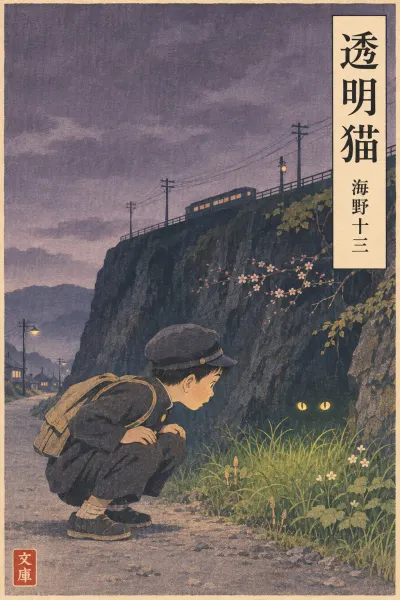
Each evening Seiji walks along a road below a cliff to take dinner to his father, a guard at the radio station. On the way home one gloomy spring evening, he hears a cat mewing right in front of him, but he can't see any cat. Wondering whether it is the ghost of his dead cat Mii, he spots two glowing eyes floating above the grass and bravely reaches out to grab them.
AI translation · independently checked
崖下の道The Road Below the Cliff
いつも通りなれた崖下を歩いていた青二だった。Seiji was walking along the foot of the cliff, a way he always took and knew by heart.
崖の上にはいい住宅がならんでいた。Up on top of the cliff stood a row of fine houses.
赤い屋根の洋館もすくなくない。Quite a few of them were Western-style houses with red roofs.
崖下の道の、崖と反対の方は、雑草のはえしげった低い堤が下の方へおちこんでいて、その向うに、まっ黒にこげた枕木利用の垣がある。On the other side of the road, away from the cliff, a low bank thick with weeds sloped down, and beyond it ran a fence made from old railway sleepers, charred pitch-black.
その中にはレールがあって、汽車が走っている。Behind the fence lay the rails, and trains ran along them.
青二は、この道を毎日のように往復する。Seiji went up and down this road almost every day.
それは放送局に働いている父親のために、夕食のべんとうをとどけるためだった。He did it to take a packed supper to his father, who worked at the radio station.
したがって、青二の通るのは夕方にかぎっていた。So Seiji only ever came this way in the evening.
その日も青二は、べんとうを放送局の裏口の受付にとどけ、守衛の父親から鉛筆を一本おだちんにもらい、それをポケットにいれて、崖下の道を引っかえしていったのである。That day, too, Seiji had delivered the packed supper to the reception desk at the back entrance of the radio station, received a pencil as a reward from his father, who was a guard there, put it in his pocket, and set off back along the road below the cliff.
あたりはもう、うすぐらくなっていた。It was already growing dark all around.
まだ春は浅く、そしてその日は曇っていて、西空に密雲がたれこみ、日が早く暮れかけていた。Spring had barely begun, and that day was cloudy; thick clouds hung low in the western sky, and night was falling early.
青二は、すきな歌を、かたっぱしから口笛で吹いて、いい気持で歩いていった。Seiji whistled one favourite song after another, walking along in high spirits.
そのとき、道ばたで、「にゃーお」と、猫のなき声がした。Just then, from the side of the road, came a cat's cry: "Meow!"
青二は猫が大好きだった。Seiji loved cats.
この間まで、青二の家にもミイという猫がいたが、それは近所の犬の群れにかこまれて、むざんにもかみ殺されてしまった。Until not long ago, Seiji's family had had a cat too, called Mii, but she had been surrounded by a pack of neighbourhood dogs and cruelly bitten to death.
青二はそのとき、わあわあと泣いたものだ。Seiji had cried and cried when that happened.
ミイが殺されてから、青二の家には猫がいない。Since Mii was killed, there had been no cat in Seiji's house.
「にゃーお」また猫は、道ばたで鳴いた。"Meow!" The cat cried again from the roadside.
崖下の草むらの中だった。It came from the clump of grass at the foot of the cliff.
青二は口笛を吹くのをやめて、猫の鳴き声のする方へ近づいた。Seiji stopped whistling and went towards the place where the mewing was coming from.
が、猫の姿は見えなかった。But there was no cat to be seen.
どこへにげこんだのだろうと思っていると、また「にゃーお」と猫はないた。Just as he was wondering where it had run off to hide, the cat went "Meow!" again.
青二はぎくりとした。Seiji gave a start.
というのは、猫のないたのは彼が草むらの方へ顔をつきだしているそのすぐ鼻の先ともいっていいほどの近くだったからである。That was because the cat had cried so close by that you could almost say it was right under the nose he was poking towards the grass.
しかも、猫の姿は見えなかった。And yet there was no cat to be seen.
青二は、うしろへ身をひいて、顔色をかえた。Seiji drew back, and his face changed colour.
ふしぎなこともあればあるものだ。What a strange thing to happen!
たしかに猫のなき声がするのに姿が見えないのである。He could clearly hear a cat mewing, yet he couldn't see it.
「にゃーおん」猫はまたないた。"Meeow!" the cat cried again.
青二は、ぶるっとふるえた。Seiji shivered all over.
彼は、あることを思いついたのだ。A certain idea had come into his head.
(これはひょっとすると、死んだミイのたましいがあらわれたのではないだろうか)(Could this be the ghost of Mii, come back from the dead?)
死人のたましいが出てくる話は、いくどもきいたことがある。He had heard plenty of stories about the ghosts of dead people appearing.
しかし死んだ猫のたましいが出てきた話は、あまりきいたことがなかった。But he had hardly ever heard a story about the ghost of a dead cat appearing.
でも、今はそうとしか考えようがないのだった。Still, right now he couldn't think of any other explanation.
「おいミイかい」"Hey, is that you, Mii?"
青二は、思いきって、ふるえる声で、そういって、声をかけた。Seiji plucked up his courage and called out in a trembling voice.
「にゃーお」返事が、同じところからきこえた。"Meow!" The answer came from the very same spot.
「あっ!」青二は、おどろきの声をあげて、その場にすくんでしまった。"Oh!" Seiji cried out in surprise and froze where he stood.
というわけは、彼はそのとき、草の上に二つの光るものがういているのを見つけたからである。For at that moment he had noticed two shining things floating above the grass.
それはなんだか、えたいの知れないものだった。They were something he couldn't make head or tail of.
ただぴかぴかと光って、行儀よく二つがならんでいた。They simply glittered and glowed, sitting neatly side by side.
大きさはラムネのガラス玉を四つ五つあわせたぐらいあって、全体はうす青く、そしてまん中のところが黄色で、そのまた中心のところが黒かった。Each was about as big as four or five marbles from a soda bottle put together; overall they were pale blue, the middle part was yellow, and the very centre of that was black.
(目玉のようだが、いったいなんだろう)(They look like eyeballs, but what on earth are they?)
とたんに、また「にゃーおん」とあまえるような声がきこえた。At that very moment he heard another "Meeow!", sweet and coaxing.
たしかにその二つの玉のすぐそばから声が出たようである。The voice certainly seemed to come from just beside those two balls.
青二は、こわいはこわいが、その光った二つの正体を見きわめないではいられなかった。Scared as he was, Seiji couldn't help wanting to find out what those two shining things really were.
そこで、彼は勇気を出して、草むらの中へふみこむと、両手でその玉をぎゅっとつかもうと――。So he summoned his courage, stepped into the grass, and reached out with both hands to grab the balls tight, when—
Vocabulary
| Word | Meaning | JLPT |
|---|---|---|
| 崖下がけした | the foot of a cliff崖 (cliff) + 下 (below). | — |
| 通りなれたとおりなれる | to be used to passing along (a route)dictionary form: 通りなれるVerb stem + なれる (慣れる) = to be used to doing something. | — |
| 洋館ようかん | Western-style houseNot to be confused with the sweet 羊羹 (ようかん). | — |
| 枕木まくらぎ | railway sleeper (tie)Literally 'pillow wood'; old sleepers were often reused for fences. | — |
| 往復おうふく | going there and back; a round tripUsed as a する verb here. | N2 |
| おだちんおだちん | small reward for doing an erranddictionary form: お駄賃Typically given to children for helping out. | — |
| 守衛しゅえい | security guard, gatekeeper | N1 |
| かたっぱしからかたっぱしから | one after another, every single onedictionary form: 片っ端からColloquial, emphatic form of 片端から. | — |
| むざんむざん | cruel, pitifuldictionary form: 無残むざんにも adds the feeling 'how cruelly'. | — |
| ぎくりとぎくりと | with a start, with a jolt of alarm (ぎくり; used with と, often as ぎくりとする)Onomatopoeic adverb for sudden fright. | — |
| たましいたましい | soul, spirit (here: ghost)dictionary form: 魂 | N1 |
| えたいの知れないえたいのしれない | mysterious, impossible to identifydictionary form: 得体の知れないSet phrase: something whose true nature is unknown. | — |
| 正体しょうたい | true identity, what something really is | — |
| 見きわめみきわめる | to find out for certain, to get to the bottom ofdictionary form: 見極める | — |
Grammar
〜かける N3 to be starting to ~, to be about to ~
Attached to a verb stem, かける shows an action that has begun but is not finished. 暮れかけていた means the day was in the process of growing dark.
日が早く暮れかけていた
night was falling early
〜たものだ N3 used to ~ / did ~ (looking back)
Past tense + ものだ recalls a past experience with feeling. Here it emphasises how hard Seiji cried back then.
青二はそのとき、わあわあと泣いたものだ。
Seiji had cried and cried when that happened.
〜もあればあるものだ N1 such a thing really does happen (expressing surprise)
A set exclamation repeating ある with ば: 'if there are such things, there are'. It expresses amazement that something so unusual can actually happen.
ふしぎなこともあればあるものだ。
What a strange thing to happen!
〜としか〜ようがない N2 there is no way to ~ other than as ~
しか with a negative means 'only'; verb stem + ようがない means 'there is no way to'. Together: he could think of it in no other way.
でも、今はそうとしか考えようがないのだった。
Still, right now he couldn't think of any other explanation.
AはAが N2 it is certainly A, but…
Repeating an adjective around は and が admits a fact before turning to something stronger. Seiji admits he is scared, but curiosity wins.
青二は、こわいはこわいが
Scared as he was, Seiji…
〜ないではいられない N2 can't help ~ing
Negative form + ではいられない shows an urge one cannot resist. Seiji simply had to find out what the glowing things were.
その光った二つの正体を見きわめないではいられなかった。
He couldn't help wanting to find out what those two shining things really were.