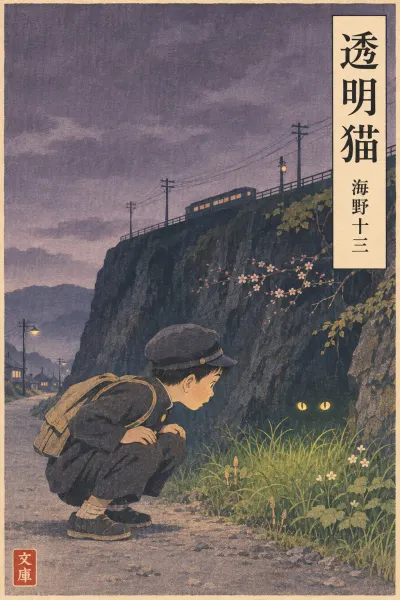
Part 2 of 8 · JLPT N3
透明猫 Tōmei Neko, part 2: An Invisible Cat Comes Home
In this part
Groping in the grass, Seiji discovers that the two floating balls are the eyes of a cat he cannot see, with its front legs tied together by a thin rubber band. Burning with curiosity, he carries the warm, sleepy creature home and slips upstairs without telling his mother, afraid she would make him throw it away. While he wonders where to hide it, his mother calls him down to dinner.
AI translation · independently checked
「うわっ」青二は、いそいで手を引くと、その場にとびあがった。"Whoa!" Seiji snatched his hand back and jumped where he stood.
玉をつかむ前に、掌が、ごそごそとする毛のようなものにふれたからであった。Before he could grab the balls, his palm had brushed against something rough and furry.
よっぽどそのへんでやめて、逃げだそうと思ったけれどもともと青二は、ものずきなたちだったから、ふみとどまった。He seriously thought of quitting right there and running away, but Seiji had always been the curious sort, so he stood his ground.
そしてもう一度、その二つの玉の方へ両手をもっていった。Then he reached out both hands once more toward the two balls.
「あ、――」ふしぎな手ざわりを、青二は、感じた。"Ah—" Seiji felt something strange under his fingers.
毛の密生した動物の頭と思われるものに、ふれたからであった。He had touched what seemed to be the head of an animal covered in thick fur.
ふしぎな発見A Strange Discovery
「……猫の頭のようだが、しかしそんなものは見えないではないか」なんという気持ちのわるいことだろう、と青二は思った。"…It feels like a cat's head, but I can't see anything of the kind!" How creepy can you get, Seiji thought.
しかしこのとき彼は、さっきとはちがって、もうよほど落ちつきをとりもどしていた。This time, though, unlike a moment ago, he had already got back a good deal of his nerve.
もう一度その毛深い動物の頭にさわり、それから、おそるおそる下の方へなでていった。He touched the furry animal's head again, and then, very cautiously, stroked his way downward.
全くおどろいた。He was absolutely astonished.
たしかに、猫と思われるからだがあった。There was certainly a body there, a body that seemed to be a cat's.
しっぽもあって、ぴんぴんうごいていた。It had a tail, too, and the tail was twitching briskly.
足のうらには、たしか猫のものにちがいない土ふまずもあるし、爪もついていた。On the soles of its feet were the little pads that could only belong to a cat, and it had claws as well.
しかしそれは全く見えないのであった。And yet it was completely invisible.
青二は、いよいよおどろいたが、もっとしらべをつづけた。Seiji was more amazed than ever, but he went on investigating.
青二の目に見える二つの玉は、どうやらこの猫の目玉であるらしく思われる。The two balls Seiji could see, it seemed, were most likely this cat's eyes.
それから新発見があった。Then came a new discovery.
見えない猫の二本の前足が、細いゴムのバンドで結んであることだった。The invisible cat's two front legs were tied together with a thin rubber band.
そのゴムのバンドは、草むらの中にあって、よくよく見ないと、青二の目には、はいらない場所であった。The rubber band lay down in the grass, in a spot where Seiji would never have noticed it unless he looked very, very closely.
こわいよりも、今や青二は、好奇心にわき立った。Seiji was no longer scared; now he was bubbling over with curiosity.
青二は、そのあやしい猫のような動物を抱きあげた。Seiji picked up the mysterious cat-like animal in his arms.
たしかに猫ぐらいの重さが感じられた。Sure enough, it felt about as heavy as a cat.
青二は、それをしっかりと抱いて、道へ出た。Holding it tight, Seiji came out onto the road.
そして、自分の家の方へ歩き出した。Then he set off toward home.
その動物は、おとなしかった。The animal was quiet and gentle.
もうなきはしなかった。It did not cry any more.
青二のふところへ、もぐりこむようにして、からだをまげた。It curled itself up as if burrowing into the front of Seiji's coat.
動物の温か味が青二の方へつたわって来た。Seiji could feel the animal's warmth seeping into him.
動物はねむり始めたらしい。It seemed the animal had begun to fall asleep.
「いったいこれはなにかしらん。猫のたましいにしては、すこし変だし……」"What on earth can this be? It's a bit odd for a cat's ghost…"
青二には、このあやしい動物の正体を、はっきりいいあてることができなかった。Seiji could not say for certain what this mysterious animal really was.
やがて青二は、家にかえりついた。Before long, Seiji reached home.
青二は「ただ今」といって、すぐ二階へあがった。Seiji said, "I'm home," and went straight upstairs.
青二は、途中で拾ってきたあやしい猫みたいな動物のことを、母親に話をしようかと思ったが、いやいやそうでない、そんなあやしいものを拾って来たことを、お母さんが知ったら、どんなにおどろくかしれない。Seiji thought of telling his mother about the strange cat-like animal he had picked up on the way, but no, no, that would never do—if Mother found out he had brought home something so strange, there was no telling how shocked she would be.
そして早くそのようなものは捨てておしまいといわれるだろう。And she would surely tell him, "Hurry up and throw that thing away."
それではせっかくこわい目をして拾ってきたのに、つまらない事になってしまう。Then, after all the fright he had gone through to bring it home, everything would be spoiled.
そう思って青二は、その怪しい動物を抱いたまますぐ二階の自分の部屋にあがってしまったのである。That was why Seiji had gone straight upstairs to his own room, still holding the mysterious animal.
二階へあがったものの、青二は、ちょっと困ってしまった。But once he was upstairs, Seiji found himself in a bit of a fix.
このあやしい動物をどこへおいたらいいかということだ。Where on earth was he going to put this mysterious animal?
そのままおいておけば、きっと出ていってしまうだろう。If he just left it as it was, it would be sure to wander off.
逃げられたんでは、いやだ。He didn't want it to get away.
戸棚に入れようか。Should he put it in the cupboard?
いや、猫はふすまを破ることなんか平気だから、戸棚では安心ならない。No—cats think nothing of tearing through paper sliding doors, so the cupboard wouldn't be safe.
「青二や。なにをしておいでだい。ご飯ですよ。早くおりていらっしゃい」"Seiji, dear! What are you doing up there? Dinner's ready. Come on down now."
はしご段の下から、母親が二階へ声をかけた。His mother called up to him from the foot of the stairs.
「はーい。今行くよ」"Coming! I'll be right there."
Vocabulary
| Word | Meaning | JLPT |
|---|---|---|
| 掌てのひら | palm of the handAlso written 手のひら. Read しょう in compounds such as 掌握 (grasp, control). | N1 |
| ものずきものずき | curious, fond of odd thingsdictionary form: 物好きたち here means 'nature, temperament' (質), so ものずきなたち is 'a curious disposition'. | N1 |
| ふみとどまったふみとどまる | to stand one's ground, stay putdictionary form: 踏みとどまるLiterally 'to plant one's feet and stay'. | — |
| 手ざわりてざわり | feel, texture (to the touch)dictionary form: 手触り | — |
| 密生みっせい | to grow thicklydictionary form: 密生する密 = dense, 生 = grow. Used of fur, hair and plants. | — |
| おそるおそるおそるおそる | timidly, cautiouslydictionary form: 恐る恐る | — |
| 土ふまずつちふまず | arch of the foot; here, the pads of a pawdictionary form: 土踏まずLiterally 'the part that doesn't step on the ground'. | — |
| 好奇心こうきしん | curiosity | — |
| わき立ったわきたつ | to seethe, bubble over (with excitement)dictionary form: 沸き立つOriginally used of boiling water. | — |
| ふところふところ | the front fold of one's clothes, bosomdictionary form: 懐The space between chest and kimono or coat, where things are tucked. | — |
| もぐりこむもぐりこむ | to burrow into, crawl intodictionary form: 潜り込む | — |
| 正体しょうたい | true identity, what something really is | — |
| せっかくせっかく | with so much trouble; all that effort (only to…)Often followed by のに: the effort is about to be wasted. | N2 |
| ふすまふすま | paper-covered sliding doordictionary form: 襖Japanese sliding panels of paper over a wooden frame, used for rooms and cupboards. | N2 |
Grammar
〜ではないか N3 but surely…!, isn't it…!
A rhetorical negative question used to express surprise or to point out something obvious. Here Seiji exclaims that he plainly cannot see anything.
しかしそんなものは見えないではないか
but I can't see anything of the kind!
〜にちがいない N3 must be, there is no doubt that
Expresses strong certainty based on evidence. The paw pads can only be a cat's.
たしか猫のものにちがいない土ふまずもあるし
there were pads that could only belong to a cat
〜にしては N3 for a…, considering it is…
Means that something does not match what you would expect from X. Seiji thinks the creature is too odd to be a cat's ghost.
猫のたましいにしては、すこし変だし
it's a bit odd for a cat's ghost
どんなに〜かしれない N1 there's no telling how (much)…
どんなに〜かしれない: 'there's no telling how (much)…'. It comes from 〜か知れない ('it cannot be known'), which is the base form rather than a shortening of かもしれない. It is used with どんなに or どれだけ to stress an extreme degree. Here: 'there was no telling how shocked she would be'.
お母さんが知ったら、どんなにおどろくかしれない
if Mother found out, there was no telling how shocked she would be
〜ておしまい N3 go and do…, get it done (soft command)
おしまい is a shortened imperative of しまう (from おしまいなさい). It is a motherly way of telling a child to finish something off, here to throw the thing away.
早くそのようなものは捨てておしまい
Hurry up and throw that thing away
〜たものの N2 although, but even so
Attaches to a past-tense verb. It states that one thing was done, but the expected result did not follow. Seiji got upstairs, but then he was stuck.
二階へあがったものの、青二は、ちょっと困ってしまった。
But once he was upstairs, Seiji found himself in a bit of a fix.