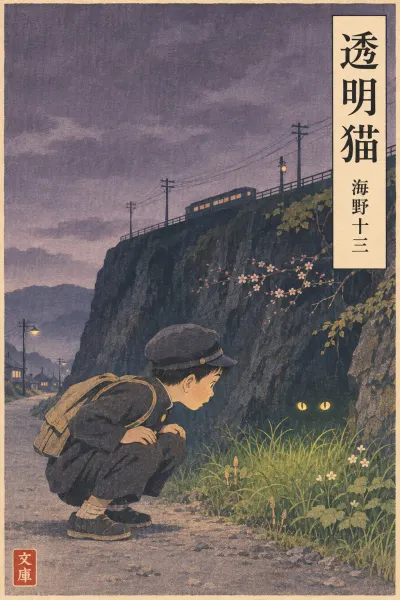
Part 3 of 8 · JLPT N3
透明猫 Tōmei Neko, part 3: A Fish Bone and a Pale Face
In this part
Seiji ties up the invisible animal, eats supper with his mother, and sneaks a fish bone upstairs. As the creature eats, he watches the bone travel down its throat and realises it really is a transparent cat. He notices its eyes now look faint, and the next morning his mother says his own face looks pale and blurry, though he laughs it off.
AI translation · independently checked
さあ、どうしようかと、青二は困ってしまった。Now what am I going to do? thought Seiji, completely at a loss.
が、困ったときには、よく名案がうかぶものである。But when you are at a loss, a good idea will often pop into your head.
青二は、机のひきだしをひっぱりだして、ひもを探した。Seiji pulled out the drawer of his desk and looked for some string.
赤と青のだんだらの、荷物をくくるひもがあった。There was a piece of red-and-blue striped string, the kind used for tying up parcels.
それを出すと彼はあやしい動物の後足二本を、そのひもでいっしょにぐるぐるしばってしまった。He took it out and wound it round and round the strange animal's two hind legs, tying them tightly together.
こうすれば、このあやしい動物は、前足も後足も二本ずつしばられているんだから、もう歩くことができない。That way, with both its front legs and its hind legs tied in pairs, the strange animal wouldn't be able to walk any more.
歩くことができなければ、この部屋から、出てゆくこともない。And if it couldn't walk, it couldn't get out of the room either.
よしよし、これなら大丈夫と、青二はそれがすむと、机の上にそっとおいて、はしご段を下へおりていった。"Good, good, that ought to do it," thought Seiji, and when he had finished, he set it gently on top of the desk and went down the ladder-like stairs.
夕飯のおぜんを、母親とかこんで、いつものように食べた。He sat down to supper at the little table with his mother and ate just as he always did.
母親は、放送局にはかわったことがなかったかと聞いた。His mother asked whether anything unusual had happened at the broadcasting station.
青二は、なにもかわったことがなく、お父さんは鉛筆を一本くれたと、答えた。Seiji answered that nothing unusual had happened, and that his father had given him a pencil.
食事がすんだ。Supper was over.
母親が台所の方へいっているひまに、青二は皿の上からたべのこりの魚の骨をそっと掌へうつした。While his mother was off in the kitchen, Seiji quietly slid the leftover fish bones from his plate into the palm of his hand.
そして急に立って、二階へとんとんとあがっていった。Then he suddenly stood up and went thump-thump-thump up the stairs to the second floor.
「青二、お待ちよ、りんごを一つ、あげるから……」"Seiji, wait a minute, I'll give you an apple..."
母親が声をかけたが、青二は、His mother called after him, but Seiji just said,
「うん。あとでもらうから、今はいいよ」"Yeah. I'll have it later, I don't want it now,"
と、いいすてて二階へあがった。tossing the words over his shoulder as he went upstairs.
すぐ机の前へとんでいった。He rushed straight over to his desk.
机の上には、見おぼえのある赤と青とのだんだらのひもと、ゴムのバンドがあった。On the desk lay the red-and-blue striped string he knew so well, and the rubber band.
気味のわるい二つの目玉らしいものも、そこにあった。And there, too, were what seemed to be two eerie eyeballs.
「にゃーお。う、う、う」"Mia-ow. Mrr, mrr, mrr."
「これがほしいんだろう。さあ、おたべ」"This is what you want, isn't it? Here you are, eat up."
青二は、魚の骨を、光る目玉の下へおいてやった。Seiji put the fish bones down just below the glowing eyes.
すると、かりかりと骨をかむ音がした。At once there came a crunch-crunch sound of bones being chewed.
骨がくだけて、机の上からすこしもちあがった。The bones broke into pieces and rose a little way above the desk.
そしてそれはやがて線のようにつながって、だんだんと上にあがり、それから横にのびていった。Then, before long, the pieces joined up into something like a line, climbed gradually upward, and then stretched out sideways.
「き、気持がわるいなあ」"Ugh, th-that's creepy!"
青二は、ぞっとした。A shiver ran down Seiji's spine.
魚の骨が、動物の口へはいってくだかれ、それから食道をとおって、胃ぶくろの方へ行くらしい。It seemed the fish bones went into the animal's mouth, were crunched up, and then passed down its gullet towards its stomach.
それが透いてみえるのだった。And he could see it all, right through the animal.
「ふーん。たしかにこれは見えない猫だ。透明猫だ。なぜこんなふしぎな動物が生きているんだろうか」"Well, well. This really is an invisible cat. A transparent cat! How on earth can such a strange animal be alive?"
青二は、おそろしくもなったが、またこの見えない猫が貴重なものに思われてきて、膝の上にのせてしきりになでてやった。Seiji felt frightened, but at the same time the invisible cat began to seem very precious to him, so he put it on his lap and stroked it again and again.
そのうちに、二つの目玉が動かなくなった。After a while, the two eyeballs stopped moving.
透明猫は、膝の上でねむりはじめたらしい。It looked as if the transparent cat had fallen asleep on his lap.
しかしそのとき、青二がふしぎに思ったのは、拾ったときはたいへんはっきり見えていた目玉が、今はぼんやりとしか見えないことだった。But what struck Seiji as odd just then was that the eyes, which had been so very clear when he picked the cat up, could now be seen only faintly.
おそろしき事件A Terrible Happening
あくる日、青二はいつものように五時に起きた。The next day, Seiji got up at five o'clock as usual.
父親は、まだねていた。His father was still asleep.
放送局から夜おそく帰ってくるので、父は朝おそく起きるならわしだった。Because he came home late at night from the broadcasting station, his father was in the habit of getting up late in the morning.
だからその朝も、青二は母親といっしょに朝のおぜんについた。So that morning, too, Seiji sat down to breakfast with his mother.
茶の間は、台所のとなりで、光線があまりはいらない部屋だった。The living room was next to the kitchen and didn't get much light.
「どうしたの、青二。お前の顔は、へんだね。気分でもわるいのかい」"What's the matter, Seiji? Your face looks strange. Aren't you feeling well?"
母親が心配そうにきいた。his mother asked anxiously.
青二は、べつに気分もわるくなかった。Seiji didn't feel the least bit unwell.
だからそのとおり答えた。So that was what he told her.
「でもね、青二。どうもへんだよ。なんだかお前の顔は、かげがうすいよ。ぼんやりしているよ」"Even so, Seiji, something's not right. Somehow your face looks so pale and thin, as if it were fading. It looks all blurry."
そういわれても、青二は本気にしなかった。But even when she said so, Seiji didn't take it seriously.
「お母さんは、あんなことをいっているよ。お母さんの目の方が、今日はどうかしているんでしょう。目がかすんでいるんじゃない」"Listen to what you're saying, Mother! It's your eyes that are acting up today, I bet. Aren't they just a bit misty?"
Vocabulary
| Word | Meaning | JLPT |
|---|---|---|
| 名案めいあん | good idea, bright idea名 here means 'excellent', as in 名作 (masterpiece). | — |
| だんだらだんだら | (in) bands of alternating colours, stripedOld-fashioned; often だんだら模様 or だんだら染め. | — |
| くくるくくる | to tie up, to bundledictionary form: 括るUsed for tying things together into a bundle. | — |
| しばってしばる | to tie, to binddictionary form: 縛るStronger than 結ぶ: tying something so it can't move. | N2 |
| はしご段はしごだん | steep stairs, ladder-like staircasedictionary form: 梯子段Old word for the narrow, steep stairs in traditional houses. | — |
| おぜんおぜん | small dining table; a meal set on itdictionary form: お膳おぜんをかこむ / おぜんにつく = sit down to a meal together. | — |
| 掌てのひら | palm of the handAlso written 手のひら. | N1 |
| ぞっとしたぞっとする | to shudder, to get the shiversdictionary form: ぞっとするFrom fear or disgust. | — |
| 透いてすく | to be see-through; 透いてみえる = to show throughdictionary form: 透くSame kanji as 透明 (transparent). | — |
| 貴重きちょう | precious, valuable | N3 |
| しきりにしきりに | repeatedly, again and again | N3 |
| ならわしならわし | habit, customdictionary form: 習わしSomewhat literary; 〜のがならわしだ = it is (someone's) custom to… | — |
| かげがうすいかげがうすい | to look faint and sickly; (lit.) one's shadow is thindictionary form: 影が薄いIdiom for someone who looks weak or near death; here it is also eerily literal. | — |
| かすんでかすむ | to be blurry, misty (of eyes or a view)dictionary form: 霞む | N1 |
Grammar
〜ものである N2 it is the nature of things that…; tends to…
Attached to a plain-form verb, ものである states a general truth about how things usually are. The narrator uses it to make a general remark about life.
困ったときには、よく名案がうかぶものである。
When you are at a loss, a good idea will often pop into your head.
〜ずつ N4 … each, … at a time
ずつ after a number shows the same amount for each item. Here both the front legs and the hind legs are tied in pairs of two.
前足も後足も二本ずつしばられているんだから
since both its front legs and its hind legs are tied in pairs
〜らしい N4 it seems that…, apparently
らしい after a plain form shows a conclusion drawn from what one can observe. Seiji guesses the bones are heading for the stomach from what he sees.
胃ぶくろの方へ行くらしい。
It seemed they went towards its stomach.
〜てくる (change) N3 to gradually come to…
〜てくる after a verb of change shows a feeling or state that develops over time. 思われてきて means the cat gradually began to seem precious to him.
この見えない猫が貴重なものに思われてきて
the invisible cat began to seem very precious to him
〜しか〜ない N4 only…
しか followed by a negative verb means 'nothing but' or 'only'. ぼんやりとしか見えない means the eyes can be seen only faintly, with a sense that this is less than expected.
今はぼんやりとしか見えないことだった
was that they could now be seen only faintly
〜でも〜のかい N3 … or something?
でも after a noun softens a suggestion by offering it as one example ('something like…'). The ending のかい is a gentle, familiar question form.
気分でもわるいのかい
Aren't you feeling well, or something?