Part 8 of 8 · JLPT N3
透明猫 Tōmei Neko, part 8: The Mystery Solved at Last
In this part
Invisibility spreads through the city by touch, and people grow frightened. Then Dr Hanegi comes forward: he made the cat transparent with a special mould, and he has a medicine that kills it. Everyone is cured, Seiji goes home to his overjoyed mother, and Roku-san mends his ways.
AI translation · independently checked
その間に、全市の透明人間は、ますますかずがふえていった。Meanwhile, the number of invisible people all over the city kept growing and growing.
透明になった者が誰かのからだにさわると、かならずその人のからだがやがてもうろうとなって透明化することが分った。It was found that whenever someone who had turned transparent touched another person's body, that person's body would soon grow hazy and become transparent too.
つまり伝染性があるのだ。In other words, it was catching.
大きな恐怖がひろがっていった。A great terror spread far and wide.
だが、このさわぎは、事件発生後七日目に急に解決することとなった。But on the seventh day after it all began, the uproar was suddenly settled.
というのは、はじめの「透明猫」をつくった羽根木博士という学者が、その筋へ名乗り出たからである。That was because the scientist who had made the first "transparent cat", a man called Dr Hanegi, came forward to the authorities.
博士の研究は、肉体の透明化にあった。The doctor's research was about making living bodies transparent.
からだを、空気と同じ反射率、屈折率をもたせることにあった。His aim was to give a body the same reflectivity and the same refractive index as air.
博士は、かびの一種が、そういうことに強い働きのあることを発見し、自分の研究室でそのかびを培養しては、いろいろな虫やモルモットや猫に植えていたのである。He had discovered that a certain kind of mould had a powerful effect of just that sort, and he had been growing the mould in his laboratory and planting it into all kinds of insects, guinea pigs and cats.
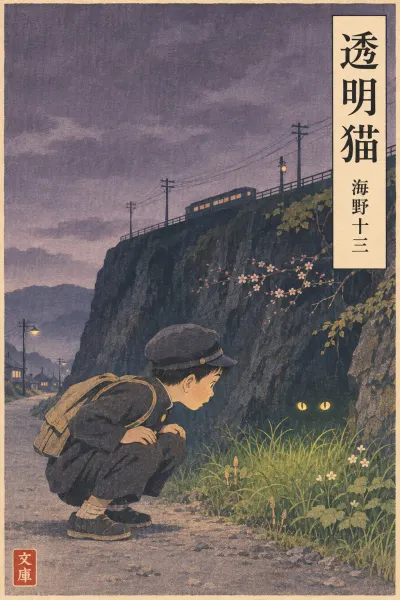
例の猫も、前足と後足とをそれぞれしばり、かびを植えた直後だったが、その後足のひもがとけたので、研究室から外へにげだし、崖の下へおちた。The cat in our story had had its front legs and back legs tied up, and the mould had only just been planted in it, but the cord on its back legs came loose, so it ran away out of the laboratory and fell down below the cliff.
そのとき青二が通りかかって猫を拾ったわけだ。And that was when Seiji happened to come by and picked the cat up.
しかし青二は猫にさわったので、青二もまた透明になった。But because Seiji had touched the cat, Seiji turned transparent too.
見世物小屋でこの猫にさわった連中も、みな同じことだった。It was just the same for all the people who had touched the cat at the sideshow tent.
博士は、そのかびを殺す薬を用意していたので、それを注射することによって、透明人間たちはみんなもとの不透明にもどることが出来た。The doctor had prepared a medicine that killed the mould, and by injecting it, all the invisible people were able to go back to being solid and seeable, just as they had been before.
青二も今はうれしく自分の家へもどることができた。Seiji, too, could now happily return to his own home.
六さんも心を改め、もうけをほんとうに山わけにした。Roku-san turned over a new leaf as well, and this time he really did split the takings fifty-fifty.
青二のお母さんも、青二がもどってきたので大よろこびであった。Seiji's mother was overjoyed to have Seiji back home again.
のこる問題は、羽根木博士の研究のことであるが、博士は今まで発見していなかったこの研究の結果を、どういう方面に活かして使おうかと、今、考え中だそうである。The one question left was what to do about Dr Hanegi's research, and they say the doctor is now thinking hard about how he might put the results of this research, something never discovered before, to good use.
Vocabulary
| Word | Meaning | JLPT |
|---|---|---|
| 透明とうめい | transparent; invisible不透明 (ふとうめい), used later in the passage, is the opposite: 'not transparent, opaque'. | N2 |
| もうろうもうろう | hazy, dim, blurreddictionary form: 朦朧Usually written in kana. It also describes a foggy, half-conscious state of mind (意識がもうろうとする). | — |
| 伝染性でんせんせい | contagiousness; being infectious伝染 means 'infection, contagion', and the suffix 性 means '-ness, quality'. | — |
| 恐怖きょうふ | fear, terror | N3 |
| 解決かいけつ | solution, settlement (of a problem or case) | N3 |
| 名乗り出たなのりでる | to come forward and identify oneselfdictionary form: 名乗り出る名乗る means 'to give one's name' and 出る means 'to come out'. その筋 is an old-fashioned way of saying 'the authorities concerned'. | — |
| 屈折率くっせつりつ | refractive indexThe suffix 率 means 'rate, ratio', as in 反射率 'reflectivity'. | — |
| かびかび | mould, mildewdictionary form: 黴Normally written in kana. | — |
| 培養ばいよう | culturing, growing (microbes etc.) | — |
| 植えてうえる | to plant; here, to implant or inoculatedictionary form: 植えるIts basic meaning is planting trees or seeds. Here it is used for putting mould into an animal. | N4 |
| 見世物小屋みせものごや | sideshow tent, freak-show booth見世物 means 'a show or spectacle'. 小屋 is a hut or booth, and it becomes ごや through rendaku (sound change). | — |
| 注射ちゅうしゃ | injection注射する means 'to inject' or 'to give a shot'. | N4 |
| 心を改めこころをあらためる | to reform, to turn over a new leafdictionary form: 心を改める | — |
| 山わけやまわけ | splitting equally, going halvesdictionary form: 山分けIt comes from dividing a heap (山) into equal piles. もうけ means 'profit, takings'. | — |
Grammar
〜ていく N4 change continuing onward
Attached to verbs of change, 〜ていく shows a process that keeps moving forward from now on. Here the number of invisible people keeps on increasing.
全市の透明人間は、ますますかずがふえていった。
The number of invisible people all over the city kept growing and growing.
〜ことが分かる N4 it becomes clear that …
こと turns the clause before it into a noun, so the whole clause becomes the fact that was discovered. The past form 分かった means 'it was found out that …'.
その人のからだがやがてもうろうとなって透明化することが分った。
It was found that that person's body would soon grow hazy and become transparent.
〜こととなる N3 it turns out that …; it comes about that …
This is a more formal, written version of 〜ことになる. It presents an outcome as something that came about through circumstances rather than through someone's decision.
このさわぎは、事件発生後七日目に急に解決することとなった。
On the seventh day after it all began, the uproar was suddenly settled.
というのは〜からである N3 that is because …
It opens a sentence that explains the reason for what was just said. The ending からである marks the reason in a written style.
というのは、はじめの「透明猫」をつくった羽根木博士という学者が、その筋へ名乗り出たからである。
That was because the scientist who had made the first "transparent cat", a man called Dr Hanegi, came forward to the authorities.
〜ては N3 repeated action: do A and then B, over and over
The pattern Vては followed by another verb describes a cycle of actions that is repeated. The doctor kept growing the mould and then implanting it, again and again.
自分の研究室でそのかびを培養しては、いろいろな虫やモルモットや猫に植えていたのである。
He had been growing the mould in his laboratory and planting it into all kinds of insects, guinea pigs and cats.
〜そうである N4 I hear that …; they say …
Added to a plain-form sentence, そうだ / そうである reports information heard from others. The narrator uses it to pass on news about the doctor's current plans.
今、考え中だそうである。
They say he is now thinking it over.