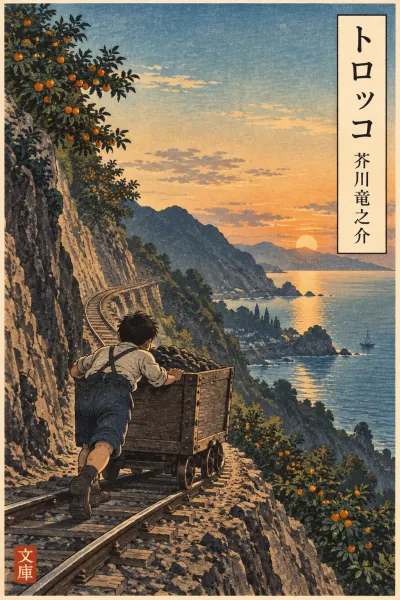
Part 1 of 3 · JLPT N2
トロッコ Torokko, part 1: A Forbidden Ride on the Rail Cart
In this part
When Ryōhei is eight, work begins on a light railway near his village, and he longs to ride the rail carts that carry earth down the slope. One February evening he and two younger boys push a cart uphill and ride it down, until a tall labourer in a straw hat shouts at them and they run away. About ten days later Ryōhei watches two young workers pushing a cart and feels they might be friendly, so he runs over to them.
AI translation · independently checked
小田原熱海間に、軽便鉄道敷設の工事が始まったのは、良平の八つの年だった。It was the year Ryōhei turned eight that work began on laying a light railway between Odawara and Atami.
良平は毎日村外れへ、その工事を見物に行った。Every day Ryōhei went to the edge of the village to watch the construction.
工事を――といったところが、唯トロッコで土を運搬する――それが面白さに見に行ったのである。Though we may say he watched the construction, it was only the earth being carried in rail carts that he found so interesting and went to see.
トロッコの上には土工が二人、土を積んだ後に佇んでいる。On the cart two labourers stood motionless behind the heaped-up earth.
トロッコは山を下るのだから、人手を借りずに走って来る。Because the cart was going down the mountain, it came running along without anyone pushing it.
煽るように車台が動いたり、土工の袢天の裾がひらついたり、細い線路がしなったり――良平はそんなけしきを眺めながら、土工になりたいと思う事がある。The cart's frame rocked and heaved as it went, the hems of the labourers' short coats flapped, and the thin rails bent; watching such scenes, Ryōhei sometimes wished he could become a labourer himself.
せめては一度でも土工と一しょに、トロッコへ乗りたいと思う事もある。At the very least, he sometimes wished he could ride a rail cart with the labourers, even just once.
トロッコは村外れの平地へ来ると、自然と其処に止まってしまう。When a cart reached the flat ground at the edge of the village, it came to a stop there on its own.
と同時に土工たちは、身軽にトロッコを飛び降りるが早いか、その線路の終点へ車の土をぶちまける。At the same moment the labourers would nimbly jump down from the cart and immediately tip the earth out of it at the end of the line.
それから今度はトロッコを押し押し、もと来た山の方へ登り始める。Then, this time pushing and pushing the cart, they would start back up towards the mountain they had come from.
良平はその時乗れないまでも、押す事さえ出来たらと思うのである。Ryōhei would think then that even if he could not ride it, if only he could at least push it.
或夕方、――それは二月の初旬だった。One evening, early in February,
良平は二つ下の弟や、弟と同じ年の隣の子供と、トロッコの置いてある村外れへ行った。Ryōhei went to the edge of the village where the rail carts were kept, together with his brother, who was two years younger, and the neighbours' child, who was the same age as his brother.
トロッコは泥だらけになったまま、薄明るい中に並んでいる。The carts stood in a row in the dim light, still covered in mud.
が、その外は何処を見ても、土工たちの姿は見えなかった。But apart from that, wherever they looked, there was no sign of the labourers.
三人の子供は恐る恐る、一番端にあるトロッコを押した。Timidly, the three children pushed the cart at the very end.
トロッコは三人の力が揃うと、突然ごろりと車輪をまわした。When the strength of the three came together, the cart's wheels suddenly turned with a rumble.
良平はこの音にひやりとした。The sound gave Ryōhei a chill of fright.
しかし二度目の車輪の音は、もう彼を驚かさなかった。But the second rumble of the wheels no longer startled him.
ごろり、ごろり、――トロッコはそう云う音と共に、三人の手に押されながら、そろそろ線路を登って行った。Rumble, rumble: with that sound, pushed by the three children's hands, the cart slowly climbed up the rails.
その内にかれこれ十間程来ると、線路の勾配が急になり出した。Before long, when they had come some sixty feet or so, the slope of the line began to grow steep.
トロッコも三人の力では、いくら押しても動かなくなった。No matter how hard the three of them pushed, the cart would no longer move.
どうかすれば車と一しょに、押し戻されそうにもなる事がある。At times they were even close to being pushed back down along with it.
良平はもう好いと思ったから、年下の二人に合図をした。Ryōhei judged that this was far enough, and he signalled to the two younger boys.
「さあ、乗ろう!」"Now, let's get on!"
彼等は一度に手をはなすと、トロッコの上へ飛び乗った。They let go all at once and jumped up onto the cart.
トロッコは最初徐ろに、それから見る見る勢よく、一息に線路を下り出した。At first the cart moved slowly, then, gathering speed before their eyes, it rushed down the rails in one go.
その途端につき当りの風景は、忽ち両側へ分かれるように、ずんずん目の前へ展開して来る。At that instant the scene ahead seemed to split and fall away to either side, and it came unfolding rapidly before his eyes.
顔に当る薄暮の風、足の下に躍るトロッコの動揺、――良平は殆ど有頂天になった。The dusk wind striking his face, the rocking of the cart dancing beneath his feet: Ryōhei was almost beside himself with joy.
しかしトロッコは二三分の後、もうもとの終点に止まっていた。But two or three minutes later, the cart had already stopped at the end of the line where it had started.
「さあ、もう一度押すじゃあ」"Come on, let's push it again!"
良平は年下の二人と一しょに、又トロッコを押し上げにかかった。Together with the two younger boys, Ryōhei set about pushing the cart back up again.
が、まだ車輪も動かない内に、突然彼等の後には、誰かの足音が聞え出した。But before the wheels had even begun to turn, they suddenly heard someone's footsteps behind them.
のみならずそれは聞え出したと思うと、急にこう云う怒鳴り声に変った。What was more, no sooner had the footsteps become audible than they turned into an angry shout.
「この野郎! 誰に断ってトロに触った?」"You little brats! Who said you could touch that cart?"
其処には古い印袢天に、季節外れの麦藁帽をかぶった、背の高い土工が佇んでいる。There stood a tall labourer in an old work coat marked with a crest, wearing a straw hat though it was out of season.
――そう云う姿が目にはいった時、良平は年下の二人と一しょに、もう五六間逃げ出していた。By the time that figure caught his eye, Ryōhei and the two younger boys had already run thirty feet or more away.
――それぎり良平は使の帰りに、人気のない工事場のトロッコを見ても、二度と乗って見ようと思った事はない。After that, even when Ryōhei saw a cart at the deserted construction site on his way home from an errand, he never once thought of trying to ride it again.
唯その時の土工の姿は、今でも良平の頭の何処かに、はっきりした記憶を残している。Only the figure of that labourer still remains as a clear memory somewhere in Ryōhei's head, even now.
薄明りの中に仄めいた、小さい黄色の麦藁帽、――しかしその記憶さえも、年毎に色彩は薄れるらしい。A small yellow straw hat glimmering faintly in the dim light; yet it seems that even that memory fades in colour with every year.
その後十日余りたってから、良平は又たった一人、午過ぎの工事場に佇みながら、トロッコの来るのを眺めていた。A little more than ten days later, Ryōhei was once again standing all alone at the construction site in the early afternoon, watching for the carts to come.
すると土を積んだトロッコの外に、枕木を積んだトロッコが一輛、これは本線になる筈の、太い線路を登って来た。Then, besides the carts loaded with earth, one cart loaded with sleepers came climbing up the thick rails that were to become the main line.
このトロッコを押しているのは、二人とも若い男だった。The two men pushing this cart were both young.
良平は彼等を見た時から、何だか親しみ易いような気がした。From the moment he saw them, Ryōhei somehow felt they would be easy to get along with.
「この人たちならば叱られない」――彼はそう思いながら、トロッコの側へ駈けて行った。"These men won't scold me": thinking so, he ran over to the side of the cart.
Vocabulary
| Word | Meaning | JLPT |
|---|---|---|
| 軽便鉄道けいべんてつどう | light railway (narrow-gauge line)Historical term for small, cheaply built railways common in the Meiji and Taishō eras. | — |
| 見物けんぶつ | watching, sightseeing〜を見物に行く = go to watch something as a spectacle. | N4 |
| 土工どこう | labourer doing earthwork, navvy | — |
| 佇んでたたずむ | to stand still, lingerdictionary form: 佇むLiterary verb; recurs throughout the story. | — |
| しなったりしなう | to bend, flex (springily)dictionary form: 撓う | — |
| ぶちまけるぶちまける | to dump out, tip out all at onceRough, vigorous verb; also 'to blurt out (feelings)'. | — |
| 終点しゅうてん | end of the line, terminus | N2 |
| 恐る恐るおそるおそる | timidly, fearfully | — |
| 勾配こうばい | slope, gradient | — |
| 間けん | ken (old unit of length, about 1.8 m)Read けん as a unit of length; here combined with numbers as じっけん, ごろっけん. | — |
| 有頂天うちょうてん | ecstatic, beside oneself with joyUsually 有頂天になる. | — |
| 印袢天しるしばんてん | workman's short coat bearing a crest or company markdictionary form: 印半纏袢天 is an older spelling of 半纏. | — |
| 人気ひとけ | sign of people, presence of people人気のない = deserted; not にんき (popularity) here. | N3 |
| 枕木まくらぎ | railway sleeper, crosstieLiterally 'pillow wood'. | — |
Grammar
〜が早いか N1 as soon as, no sooner … than
Attached to a dictionary-form verb, it shows the next action follows instantly. The labourers dump the earth the moment they jump down.
身軽にトロッコを飛び降りるが早いか、その線路の終点へ車の土をぶちまける
no sooner had they nimbly jumped down from the cart than they dumped the earth at the end of the line
〜ないまでも N1 even if not …, at least
Concedes that a larger wish is out of reach and settles for something smaller. Paired here with さえ〜たら ('if only … at least').
乗れないまでも、押す事さえ出来たらと思うのである
he would think that even if he could not ride it, if only he could at least push it
〜事がある N4 sometimes …, there are times when …
After a dictionary-form verb it describes something that happens occasionally, here Ryōhei's recurring wishes.
土工になりたいと思う事がある
sometimes he wished he could become a labourer
〜たと思うと N2 no sooner had … than; just as …
Marks a sudden change that follows immediately after the first event. The footsteps turn into a shout at once.
それは聞え出したと思うと、急にこう云う怒鳴り声に変った
no sooner had they become audible than they suddenly turned into an angry shout
〜にかかる N2 to set about doing, start on
Verb stem + にかかる means beginning a task in earnest. Here it is 押し上げにかかった, 'set about pushing up'.
又トロッコを押し上げにかかった
set about pushing the cart back up again
〜そうになる N3 to come close to …, almost …
Verb stem + そうになる means something nearly happens. Here the children are almost pushed back down by the cart.
押し戻されそうにもなる事がある
at times they were even close to being pushed back