Part 3 of 3 · JLPT N2
トロッコ Torokko, part 3: The Long Run Home in the Dark
In this part
The labourers suddenly tell Ryōhei to go home alone because they are staying the night further down the line. Terrified but determined not to cry, he runs the long road back as night falls, throwing away his sweets, sandals and jacket, and bursts into sobs only when he reaches his own door. Years later, as a tired proofreader in Tokyo, he still sometimes recalls that dim, broken path for no clear reason.
AI translation · independently checked
ところが土工たちは出て来ると、車の上の枕木に手をかけながら、無造作に彼にこう云った。But when the labourers came out, they put their hands on the sleepers loaded on the cart and said to him, quite offhandedly:
「われはもう帰んな。おれたちは今日は向う泊りだから」"You go on home now. We're stopping the night over there today."
「あんまり帰りが遅くなるとわれの家でも心配するずら」"If you're back too late, your folks'll be worrying."
良平は一瞬間呆気にとられた。For a moment Ryōhei was struck dumb.
もうかれこれ暗くなる事、去年の暮母と岩村まで来たが、今日の途はその三四倍ある事、それを今からたった一人、歩いて帰らなければならない事、――そう云う事が一時にわかったのである。That it would soon be getting dark; that although he had walked as far as Iwamura with his mother at the end of last year, today's road was three or four times as long; that he would now have to walk all the way back entirely on his own: all of this dawned on him at once.
良平は殆ど泣きそうになった。Ryōhei was very nearly in tears.
が、泣いても仕方がないと思った。But he thought that crying would do no good.
泣いている場合ではないとも思った。He also thought that this was no time for crying.
彼は若い二人の土工に、取って附けたような御時宜をすると、どんどん線路伝いに走り出した。He gave the two young labourers an awkward, hasty bow, then set off at a run along the tracks.
良平は少時無我夢中に線路の側を走り続けた。For a while Ryōhei ran on beside the rails, blind to everything else.
その内に懐の菓子包みが、邪魔になる事に気がついたから、それを路側へ抛り出す次手に、板草履も其処へ脱ぎ捨ててしまった。Before long he noticed that the packet of sweets in the front of his kimono was getting in his way, so he flung it to the roadside, and while he was at it he kicked off his wooden sandals there as well.
すると薄い足袋の裏へじかに小石が食いこんだが、足だけは遙かに軽くなった。Then the pebbles dug straight into the thin soles of his tabi socks, but his feet felt far lighter.
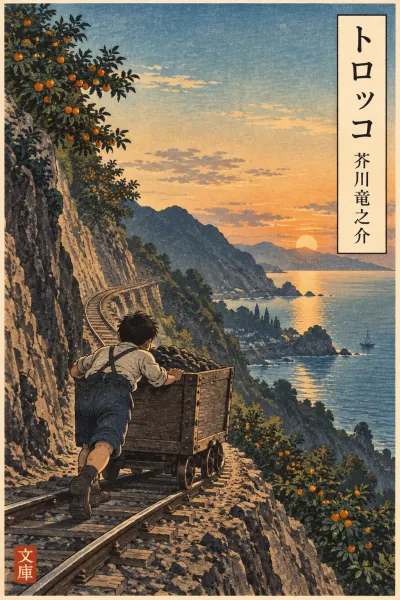
彼は左に海を感じながら、急な坂路を駈け登った。With the sea on his left, he raced up the steep slope.
時時涙がこみ上げて来ると、自然に顔が歪んで来る。Every now and then tears welled up, and his face would twist of its own accord.
――それは無理に我慢しても、鼻だけは絶えずくうくう鳴った。Even when he forced himself to hold them back, his nose kept snuffling and whimpering.
竹藪の側を駈け抜けると、夕焼けのした日金山の空も、もう火照りが消えかかっていた。By the time he had dashed past the bamboo thicket, the glow in the sunset sky over Higanesan was already fading.
良平は、愈気が気でなかった。Ryōhei grew more and more frantic.
往きと返りと変るせいか、景色の違うのも不安だった。Perhaps because going and coming back are different, the unfamiliar look of the scenery frightened him too.
すると今度は着物までも、汗の濡れ通ったのが気になったから、やはり必死に駈け続けたなり、羽織を路側へ脱いで捨てた。Next it began to bother him that even his kimono was soaked through with sweat, so, still running desperately, he pulled off his haori jacket and threw it to the roadside.
蜜柑畑へ来る頃には、あたりは暗くなる一方だった。By the time he reached the mandarin orchards, everything around him was growing darker and darker.
「命さえ助かれば――」良平はそう思いながら、辷ってもつまずいても走って行った。"If only I can stay alive…" With that thought in his mind, Ryōhei ran on, slipping and stumbling.
やっと遠い夕闇の中に、村外れの工事場が見えた時、良平は一思いに泣きたくなった。When at last he saw the construction site at the edge of the village far off in the dusk, Ryōhei wanted to burst out crying all at once.
しかしその時もべそはかいたが、とうとう泣かずに駈け続けた。But even then, though his face puckered, he kept running without crying after all.
彼の村へはいって見ると、もう両側の家家には、電燈の光がさし合っていた。When he came into his village, the electric lights in the houses on both sides were already shining out across the street.
良平はその電燈の光に、頭から汗の湯気の立つのが、彼自身にもはっきりわかった。In that light Ryōhei could see clearly for himself the steam of his sweat rising from his head.
井戸端に水を汲んでいる女衆や、畑から帰って来る男衆は、良平が喘ぎ喘ぎ走るのを見ては、「おいどうしたね?」などと声をかけた。The women drawing water at the well and the men coming home from the fields called out things like "Hey, what's the matter?" when they saw him running along, gasping and panting.
が、彼は無言のまま、雑貨屋だの床屋だの、明るい家の前を走り過ぎた。But he ran past without a word, past the general store, the barber's and the other brightly lit houses.
彼の家の門口へ駈けこんだ時、良平はとうとう大声に、わっと泣き出さずにはいられなかった。When he dashed in through the gate of his own house, Ryōhei could no longer keep from bursting into loud wails.
その泣き声は彼の周囲へ、一時に父や母を集まらせた。At the sound of his crying, his father and mother came rushing to him at once.
殊に母は何とか云いながら、良平の体を抱えるようにした。His mother in particular, saying something or other, tried to take him in her arms.
が、良平は手足をもがきながら、啜り上げ啜り上げ泣き続けた。But Ryōhei, thrashing his arms and legs, went on crying and sobbing and sobbing.
その声が余り激しかったせいか、近所の女衆も三四人、薄暗い門口へ集って来た。Perhaps because he was crying so hard, three or four women from the neighbourhood also gathered at the dim gateway.
父母は勿論その人たちは、口口に彼の泣く訣を尋ねた。His parents, and of course these women too, all asked him why he was crying.
しかし彼は何と云われても泣き立てるより外に仕方がなかった。But whatever they said to him, there was nothing he could do but go on wailing.
あの遠い路を駈け通して来た、今までの心細さをふり返ると、いくら大声に泣き続けても、足りない気もちに迫られながら、…………As he looked back on the helpless loneliness he had felt all the way along that long road, he was gripped by the feeling that no amount of loud crying would ever be enough…
良平は二十六の年、妻子と一しょに東京へ出て来た。When he was twenty-six, Ryōhei moved to Tokyo with his wife and child.
今では或雑誌社の二階に、校正の朱筆を握っている。Now, in an upstairs room of a certain magazine publisher, he grips a proofreader's red brush.
が、彼はどうかすると、全然何の理由もないのに、その時の彼を思い出す事がある。Yet at times, for no reason at all, he finds himself remembering the boy he was then.
全然何の理由もないのに?For no reason at all?
――塵労に疲れた彼の前には今でもやはりその時のように、薄暗い藪や坂のある路が、細細と一すじ断続している。Before him, worn out by the drudgery of the world, there still stretches, just as it did then, a single thin road through dim thickets and up slopes, broken off here and there and going on again.
……………
Vocabulary
| Word | Meaning | JLPT |
|---|---|---|
| 土工どこう | labourer (on earthworks or construction)Older word for a navvy; today 作業員 is more common. | — |
| 無造作むぞうさ | casual, offhand, without a second thoughtUsed with に as an adverb: 無造作に言う. | — |
| 呆気にとられたあっけにとられる | to be dumbfounded, taken abackdictionary form: 呆気にとられるSet phrase; 呆気 is rarely used on its own. | — |
| 懐ふところ | the fold at the front of a kimono, used as a pocketAlso figuratively 'one's wallet' or 'bosom'. | — |
| 足袋たび | tabi, split-toed Japanese socksWorn with sandals; the big toe is separated from the others. | N2 |
| 羽織はおり | haori, a short jacket worn over a kimono | — |
| 必死ひっし | desperate, frantic, with all one's mightLiterally 'certain death'; 必死に走る = to run for dear life. | N3 |
| 夕闇ゆうやみ | dusk, evening darkness | — |
| べそべそをかく | to pucker up one's face, be on the verge of tearsdictionary form: べそをかくUsed mostly of children. | — |
| 喘ぎあえぐ | to pant, gasp for breathdictionary form: 喘ぐRepeated 喘ぎ喘ぎ = 'gasping and gasping', continuously. | — |
| 啜り上げすすりあげる | to sob, sniffle while cryingdictionary form: 啜り上げる | — |
| 心細さこころぼそい | helpless loneliness, forlornnessdictionary form: 心細い〜さ turns an adjective into a noun. | N1 |
| 校正こうせい | proofreading | — |
| 塵労じんろう | worldly toil, the weariness of everyday caresLiterary, Buddhist-tinged word: 'dust' (塵) of the world plus 'labour' (労). | — |
Grammar
〜ている場合ではない N2 this is no time to ~
〜ている場合ではない ('this is no time to ~'): attached to the progressive 〜ている form of a verb, it says the situation is too urgent for that action to be appropriate. Ryōhei tells himself he cannot afford to cry.
泣いている場合ではないとも思った。
He also thought that this was no time for crying.
気が気でない N1 to be beside oneself with worry
A fixed idiom describing anxiety so strong one cannot stay calm. 愈 (いよいよ) adds 'more and more'.
良平は、愈気が気でなかった。
Ryōhei grew more and more frantic.
〜たなり N1 while still ~, keeping on ~
Literary なり after the た-form means the first state continues while something else happens. Here he keeps running while he throws off his jacket.
やはり必死に駈け続けたなり、羽織を路側へ脱いで捨てた。
Still running desperately, he pulled off his haori jacket and threw it to the roadside.
〜一方だ N2 to keep on ~ing, to do nothing but ~
After a dictionary-form verb of change, it describes a trend moving steadily in one direction, usually a worsening one.
あたりは暗くなる一方だった。
Everything around him was growing darker and darker.
〜ずにはいられない N2 cannot help ~ing
Negative ず plus には plus いられない: the speaker is unable to hold back from the action. Ryōhei could no longer stop himself from crying.
良平はとうとう大声に、わっと泣き出さずにはいられなかった。
Ryōhei could no longer keep from bursting into loud wails.
〜より外に仕方がない N2 there is nothing to do but ~
より外 (ほか) means 'other than'; with 仕方がない it says the only possible option is the verb before it. It is close to modern 〜しかない.
しかし彼は何と云われても泣き立てるより外に仕方がなかった。
But whatever they said to him, there was nothing he could do but go on wailing.