Upper intermediate · JLPT N2
トロッコTorokko — The Rail Cart
- JLPT N2
- 4,325 characters
- 3 parts
- about 36 minutes
- 3 easier versions
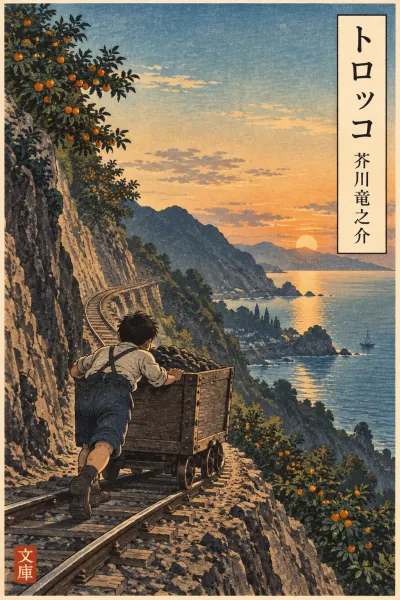
トロッコ is a short story told almost entirely from the viewpoint of an eight-year-old boy. Ryōhei lives in a village near the construction site of a light railway between Odawara and Atami, and he is fascinated by the small open carts the labourers push along the narrow rails. What starts as a child's wish to push, and above all ride, one of these carts becomes a single long afternoon that takes him farther from home than he meant to go. The narration is plain and understated, but it stays close to Ryōhei's changing feelings: excitement, pride, growing unease, and something harder to name. A brief closing section jumps forward to his adult life and turns the whole episode into a memory. For learners, the story is short and has a clear, linear plot. Its setting is concrete: rails, slopes, orange groves, the sea, the evening sky. The challenges are older spellings, the workers' rough regional speech, and long descriptive sentences that link actions and sensations together. It rewards slow, careful reading.
Contents
Easier versions
This story is also retold in simpler Japanese. Reading an easier version first makes the original much more approachable.
Before you read
- Learn the older spellings before you start. 云う is 言う, and 難有う is ありがとう. When a kanji compound looks unfamiliar, try reading it aloud; the word is often an everyday one.
- The labourers speak rough regional dialect. われ means 'you' (not 'I'), 帰んな is a blunt 帰りな ('go home'), and endings like ずら work roughly like だろう. Their lines are short, so focus on who is speaking and what they want.
- Pre-learn the core vocabulary: トロッコ, 線路 (rails), 土工 (labourer), 押す (push), 乗る (ride), 坂 (slope), 蜜柑畑 (orange grove), 茶店 (tea house). These words carry most of the action.
- Long sentences often chain actions and sensations with te-forms and と/すると. Break them at each verb and ask what Ryōhei does, sees, or feels in each piece. His emotions are usually shown through his actions rather than stated.
- Watch for the sudden time jump near the end, where the story moves to Ryōhei as an adult. The tone shifts from immediate experience to reflection, and the final image connects back to the road he ran along as a child.
Words to know
The most useful words from the notes across the story.
| Word | Meaning | JLPT |
|---|---|---|
| 土工どこう | labourer doing earthwork, navvy | — |
| 勾配こうばい | slope, gradient | — |
| 羽織はおり | short coat worn over a kimono | — |
| 見物けんぶつ | watching, sightseeing〜を見物に行く = go to watch something as a spectacle. | N4 |
| 人気ひとけ | sign of people, presence of people人気のない = deserted; not にんき (popularity) here. | N3 |
| 必死ひっし | desperate, frantic, with all one's mightLiterally 'certain death'; 必死に走る = to run for dear life. | N3 |
| 終点しゅうてん | end of the line, terminus | N2 |
| 足袋たび | tabi, split-toed Japanese socksWorn with sandals; the big toe is separated from the others. | N2 |
| 冷淡れいたん | cold, indifferent, unfriendly冷 'cold' + 淡 'faint, thin'; 冷淡さ is the noun 'coldness'. | N1 |
| 心細さこころぼそい | helpless loneliness, forlornnessdictionary form: 心細い〜さ turns an adjective into a noun. | N1 |
| 軽便鉄道けいべんてつどう | light railway (narrow-gauge line)Historical term for small, cheaply built railways common in the Meiji and Taishō eras. | — |
| 佇んでたたずむ | to stand still, lingerdictionary form: 佇むLiterary verb; recurs throughout the story. | — |
| しなったりしなう | to bend, flex (springily)dictionary form: 撓う | — |
| ぶちまけるぶちまける | to dump out, tip out all at onceRough, vigorous verb; also 'to blurt out (feelings)'. | — |
| 恐る恐るおそるおそる | timidly, fearfully | — |
Plot summary
Show the full summary (contains spoilers)
Eight-year-old Ryōhei watches labourers carting earth for the new Odawara–Atami railway and longs to ride a cart. One evening he and two younger boys push an empty cart and ride it downhill, but a worker shouts at them and they run away. Some days later he asks two young labourers if he can help push. They agree, and he happily pushes and rides with them far beyond the village, past orange groves and within sight of the sea. As the distance grows, he becomes uneasy. At a tea house they give him some sweets, and then they casually tell him to go home, because they are staying the night there. Terrified, Ryōhei runs back alone along the rails as darkness falls, shedding his sweets and sandals. At home he bursts into tears and cannot be comforted. Years later, working as a proofreader in Tokyo, he still sometimes recalls that dim road for no clear reason.
About the author
Akutagawa Ryūnosuke (1892–1927) was one of the most important writers of modern Japanese short fiction. Born in Tokyo, he studied English literature at Tokyo Imperial University, and his early story 鼻 (The Nose) won praise from Natsume Sōseki. Many of his works retell older Japanese and Chinese tales with modern psychological insight, including 羅生門 (Rashōmon) and 藪の中 (In a Grove), which later inspired Kurosawa Akira's film Rashomon. He died by suicide at the age of 35. The Akutagawa Prize was named in his honour by his friend Kikuchi Kan.