Part 2 of 3 · JLPT N2
トロッコ Torokko, part 2: Pushing Farther and Farther from Home
In this part
Ryōhei asks two young labourers if he can help push their cart, and they happily let him. He enjoys pushing uphill and riding down, but as the line winds past orange groves, woods and a view of the sea, he realises he has come much too far. While the men stop at roadside tea shops, he grows anxious about getting home before dark.
AI translation · independently checked
「おじさん。押してやろうか?」"Mister. Want me to help push?"
その中の一人、――縞のシャツを着ている男は、俯向きにトロッコを押したまま、思った通り快い返事をした。One of them, a man in a striped shirt, kept pushing the cart with his head bent low and gave a friendly answer, just as Ryōhei had expected.
「おお、押してくよう」"Yeah, go on and push."
良平は二人の間にはいると、力一杯押し始めた。Ryōhei squeezed in between the two of them and began to push with all his strength.
「われは中中力があるな」"You're pretty strong, you are."
他の一人、――耳に巻煙草を挟んだ男も、こう良平を褒めてくれた。The other man, the one with a cigarette tucked behind his ear, praised Ryōhei like this too.
その内に線路の勾配は、だんだん楽になり始めた。Before long, the slope of the track gradually began to ease.
「もう押さなくとも好い」――良平は今にも云われるかと内心気がかりでならなかった。"You don't need to push any more." Inwardly Ryōhei could not stop worrying that they would say this to him at any moment.
が、若い二人の土工は、前よりも腰を起したぎり、黙黙と車を押し続けていた。But the two young labourers only straightened their backs more than before and went on pushing the cart in silence.
良平はとうとうこらえ切れずに、怯ず怯ずこんな事を尋ねて見た。At last Ryōhei could not hold back any longer, and timidly he asked them this.
「何時までも押していて好い?」"Can I keep on pushing for as long as I like?"
「好いとも」"Sure you can."
二人は同時に返事をした。The two of them answered at the same time.
良平は「優しい人たちだ」と思った。"They're kind people," Ryōhei thought.
五六町余り押し続けたら、線路はもう一度急勾配になった。After they had pushed on for a little more than six or seven hundred yards, the track grew steep once again.
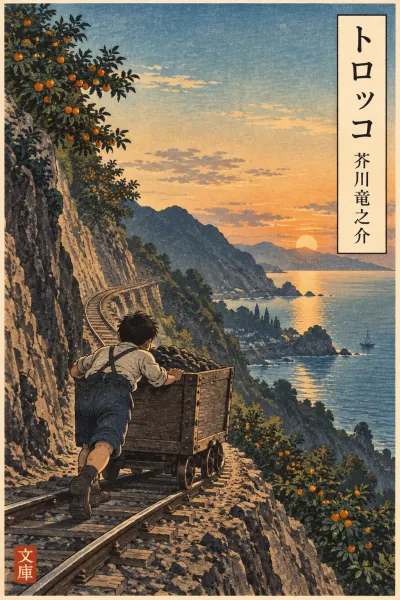
其処には両側の蜜柑畑に、黄色い実がいくつも日を受けている。There, in the orange groves on both sides, many yellow fruits were catching the sun.
「登り路の方が好い、何時までも押させてくれるから」――良平はそんな事を考えながら、全身でトロッコを押すようにした。"Uphill is better, because they let me keep pushing as long as I like." Thinking this, Ryōhei set his whole body to pushing the cart.
蜜柑畑の間を登りつめると、急に線路は下りになった。When they reached the top of the rise between the orange groves, the track suddenly turned downhill.
縞のシャツを着ている男は、良平に「やい、乗れ」と云った。The man in the striped shirt said to Ryōhei, "Hey, hop on."
良平は直に飛び乗った。Ryōhei jumped on at once.
トロッコは三人が乗り移ると同時に、蜜柑畑の匀を煽りながら、ひた辷りに線路を走り出した。The moment the three of them had climbed aboard, the cart began to run down the track in one long glide, stirring up the scent of the orange groves.
「押すよりも乗る方がずっと好い」――良平は羽織に風を孕ませながら、当り前の事を考えた。"Riding is much better than pushing." With the wind filling out his short coat, Ryōhei thought this obvious thought.
「行きに押す所が多ければ、帰りに又乗る所が多い」――そうもまた考えたりした。"If there's a lot of pushing on the way out, then there'll be a lot of riding on the way back." He thought this, too.
竹藪のある所へ来ると、トロッコは静かに走るのを止めた。When they came to a place with a bamboo thicket, the cart quietly stopped running.
三人は又前のように、重いトロッコを押し始めた。The three of them began to push the heavy cart again, as before.
竹藪は何時か雑木林になった。At some point the bamboo thicket gave way to a wood of mixed trees.
爪先上りの所所には、赤錆の線路も見えない程、落葉のたまっている場所もあった。Here and there on the gentle upward slope, fallen leaves had piled up so thickly that even the rusty rails could not be seen.
その路をやっと登り切ったら、今度は高い崖の向うに、広広と薄ら寒い海が開けた。When at last they had climbed all the way up that path, this time a wide, chilly-looking sea opened out beyond a high cliff.
と同時に良平の頭には、余り遠く来過ぎた事が、急にはっきりと感じられた。And at the same moment, it suddenly struck Ryōhei, quite clearly, that he had come much too far.
三人は又トロッコへ乗った。The three of them got onto the cart again.
車は海を右にしながら、雑木の枝の下を走って行った。With the sea on its right, the cart ran on beneath the branches of the trees.
しかし良平はさっきのように、面白い気もちにはなれなかった。But Ryōhei could no longer feel the fun he had felt a little while earlier.
「もう帰ってくれれば好い」――彼はそうも念じて見た。"I wish they'd turn back now." He even silently prayed for this.
が、行く所まで行きつかなければ、トロッコも彼等も帰れない事は、勿論彼にもわかり切っていた。But of course he knew perfectly well that neither the cart nor the men could go back until they had got to where they were going.
その次に車の止まったのは、切崩した山を背負っている、藁屋根の茶店の前だった。The next place the cart stopped was in front of a thatched tea shop, backed by a hillside that had been cut away.
二人の土工はその店へはいると、乳呑児をおぶった上さんを相手に、悠悠と茶などを飲み始めた。The two labourers went into the shop and, chatting with the woman who ran it, a baby strapped to her back, began to drink tea and so on at their leisure.
良平は独りいらいらしながら、トロッコのまわりをまわって見た。Ryōhei, alone and fretting, walked round and round the cart.
トロッコには頑丈な車台の板に、跳ねかえった泥が乾いていた。On the sturdy boards of the cart's frame, splashed mud had dried.
少時の後茶店を出て来しなに、巻煙草を耳に挟んだ男は、(その時はもう挟んでいなかったが)トロッコの側にいる良平に新聞紙に包んだ駄菓子をくれた。A little later, as he was coming out of the tea shop, the man who had had a cigarette behind his ear (though by then it was no longer there) gave Ryōhei, who was standing beside the cart, some cheap sweets wrapped in newspaper.
良平は冷淡に「難有う」と云った。Ryōhei said "Thank you" coldly.
が、直に冷淡にしては、相手にすまないと思い直した。But he immediately thought better of it, feeling that being cold would be unfair to the man.
彼はその冷淡さを取り繕うように、包み菓子の一つを口へ入れた。As if to smooth over his coldness, he put one of the wrapped sweets into his mouth.
菓子には新聞紙にあったらしい、石油の匀がしみついていた。The sweets had soaked up a smell of kerosene, which seemed to have come from the newspaper.
三人はトロッコを押しながら緩い傾斜を登って行った。Pushing the cart, the three of them climbed a gentle slope.
良平は車に手をかけていても、心は外の事を考えていた。Though Ryōhei kept his hands on the cart, his mind was on other things.
その坂を向うへ下り切ると、又同じような茶店があった。When they had gone all the way down the far side of that slope, there was another tea shop just like the first.
土工たちがその中へはいった後、良平はトロッコに腰をかけながら、帰る事ばかり気にしていた。After the labourers had gone inside, Ryōhei sat on the cart, thinking of nothing but getting home.
茶店の前には花のさいた梅に、西日の光が消えかかっている。In front of the tea shop, the light of the setting sun was fading on a plum tree in bloom.
「もう日が暮れる」――彼はそう考えると、ぼんやり腰かけてもいられなかった。"It's getting dark already." When he thought this, he could not just sit there idly.
トロッコの車輪を蹴って見たり、一人では動かないのを承知しながらうんうんそれを押して見たり、――そんな事に気もちを紛らせていた。He kicked at the cart's wheels, and he strained and grunted to push it even though he knew it would not move for him alone; with things like this he tried to distract himself.
Vocabulary
| Word | Meaning | JLPT |
|---|---|---|
| 勾配こうばい | slope, gradient (of a track or road)急勾配 in a later sentence means a steep slope. | — |
| 気がかりきがかり | worry, anxiety, something weighing on one's mind | — |
| 土工どこう | labourer, navvy (construction or earthwork worker)Old-fashioned; modern Japanese would more often say 作業員. | — |
| 黙黙ともくもくと | silently, without a word (while working)dictionary form: 黙々とUsually written 黙々と today; 々 repeats the previous kanji. | — |
| 煽りあおる | to stir up, to fan (a smell, flames, wind)dictionary form: 煽る | — |
| 羽織はおり | short coat worn over a kimono | — |
| 孕ませはらむ | to fill out (with wind), to swelldictionary form: 孕むLiterally 'to be pregnant with'; used of sails or clothes swelling with wind. | — |
| 念じてねんじる | to wish or pray silentlydictionary form: 念じる | — |
| 茶店ちゃみせ | roadside tea shop, rest stop | — |
| 悠悠とゆうゆうと | leisurely, unhurriedlydictionary form: 悠々と | — |
| 駄菓子だがし | cheap sweets, penny candy | — |
| 冷淡れいたん | cold, indifferent, unfriendly冷 'cold' + 淡 'faint, thin'; 冷淡さ is the noun 'coldness'. | N1 |
| 取り繕うとりつくろう | to smooth over, to patch up (an awkward impression) | — |
| 紛らせてまぎらせる | to distract (one's feelings), to divertdictionary form: 紛らせる気を紛らす / 気持ちを紛らせる = to take one's mind off something. | — |
Grammar
〜てならない / 〜でならない N2 can't help feeling ~; extremely ~
Attached to words for feelings, it shows an emotion so strong that it cannot be controlled. Here 気がかり + でならなかった means he could not stop worrying.
良平は今にも云われるかと内心気がかりでならなかった。
Inwardly Ryōhei could not stop worrying that they would say this to him at any moment.
〜切れずに N3 unable to ~ completely; without managing to ~
切れる after a verb stem means 'to be able to do fully'; the negative 〜切れず(に) is a written form of 〜切れないで. こらえ切れずに = unable to hold back any longer.
良平はとうとうこらえ切れずに、怯ず怯ずこんな事を尋ねて見た。
At last Ryōhei could not hold back any longer, and timidly he asked them this.
〜ば、〜 N4 if ~, then ~
The ば-conditional sets a condition and its natural result. Here the adjective 多い becomes 多ければ: 'if there is a lot of pushing on the way out'.
行きに押す所が多ければ、帰りに又乗る所が多い
If there's a lot of pushing on the way out, then there'll be a lot of riding on the way back.
〜しなに N1 just as ~, on the way ~
A literary suffix attached to a verb stem, meaning 'at the moment of doing' or 'while on the way'. 出て来しなに = just as he was coming out.
少時の後茶店を出て来しなに
A little later, as he was coming out of the tea shop
〜かかる N2 to be about to ~, to begin to ~
After a verb stem, かかる shows an action that is just starting or on the point of happening. 消えかかっている = the light is on the point of fading.
茶店の前には花のさいた梅に、西日の光が消えかかっている。
In front of the tea shop, the light of the setting sun was fading on a plum tree in bloom.
〜てもいられない N2 can't just keep on ~
Shows that the situation won't allow someone to go on doing something. ぼんやり腰かけてもいられなかった = he could not just sit there idly.
彼はそう考えると、ぼんやり腰かけてもいられなかった。
When he thought this, he could not just sit there idly.