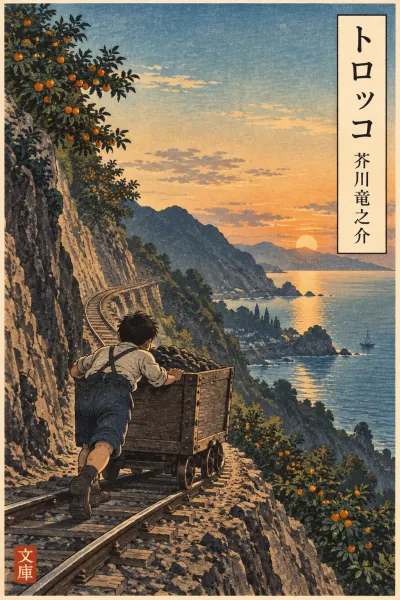
 N3 · easy
Simplified retelling · JLPT N3
トロッコ Torokko in easy Japanese (N3)
This is our own simplified retelling of The Rail Cart, written for N3 learners and checked word by word against the N3 vocabulary list. A few story words and grammar patterns go beyond N3; the notes below give each one's level. It keeps the characters, events and ending of the original. When it feels easy, move on to the original text.
The story in brief
Eight-year-old Ryōhei longs to ride the carts at a railway construction site, and one day two young labourers let him help push one far into the hills. At dusk they tell him to go home alone, and he runs the long, frightening way back, bursting into tears when he finally reaches home. Years later, as a tired adult in Tokyo, he still sometimes remembers that dark, narrow road.
AI translation · independently checked
良平が八歳のとき、むらの近くで、せんろを作る工事が始まりました。When Ryōhei was eight, work began near his village on building a railway line.
良平は毎日、その工事を見に行きました。Every day Ryōhei went to watch the construction.
いちばんおもしろかったのは、トロッコです。What he found most interesting of all were the rail carts.
トロッコは土をのせて、山からさかを下りて来ます。Loaded with earth, the carts came rolling down the slope from the hills.
上には男の人が二人乗っています。Two men rode on top of each one.
良平は「一度でいいから、トロッコに乗りたい」と思いました。Ryōhei thought, "I want to ride a cart, even if it's just once."
「押すだけでもいい」とも思いました。He also thought, "Even just pushing one would be fine."
ある夕方、良平は弟と、となりの家の子と三人で工事の場所へ行きました。One evening, Ryōhei went to the construction site with his little brother and the boy from next door, the three of them together.
働く人はだれもいませんでした。There were no workers anywhere.
三人はトロッコを押してみました。The three of them tried pushing a cart.
トロッコはごろごろと音を立てて、せんろを登って行きました。The cart rumbled and clattered as it climbed up the track.
道が急になると、もう動かなくなりました。When the slope grew steep, it would not move any further.
「さあ、乗ろう!」"Right, let's get on!"
三人はトロッコに飛び乗りました。The three of them jumped onto the cart.
トロッコはだんだん速くなり、さかを下りました。The cart gradually picked up speed and ran down the slope.
風が顔に当たって、良平はとてもうれしくなりました。The wind struck his face, and Ryōhei felt wonderfully happy.
もう一度押そうとしたとき、後ろから大きな声が聞こえました。Just as they were about to push it once more, a loud voice came from behind them.
「こら!だれがトロッコにさわっていいと言った?」"Hey! Who said you could touch that cart?"
むぎわらぼうしをかぶった、背の高い男の人でした。It was a tall man wearing a straw hat.
三人はすぐににげました。The three of them ran away at once.
それから良平は、二度とトロッコに乗ろうと思いませんでした。After that, Ryōhei never again thought of riding a cart.
十日ぐらいたって、良平はまた一人で工事の場所にいました。About ten days later, Ryōhei was at the construction site again, this time alone.
すると、若い男の人が二人、トロッコを押して来ました。Then two young men came along, pushing a cart.
「この人たちならしかられない」と良平は思いました。"These men won't tell me off," Ryōhei thought.
「おじさん、押してあげようか。」"Mister, shall I help you push?"
「おお、押してくれ。」Yeah, give us a push.
良平は二人の間に入って、力いっぱい押しました。Ryōhei squeezed in between the two of them and pushed with all his strength.
「おまえは力があるな」と一人がほめてくれました。"You're a strong one, aren't you," one of them said in praise.
道が楽になっても、二人は何も言わずに押し続けました。Even when the going became easy, the two men kept on pushing without a word.
良平は心配になって聞きました。Ryōhei grew uneasy and asked,
「いつまでも押していていい?」"Can I keep pushing as long as I like?"
「いいとも。」"Sure you can."
良平は「優しい人たちだ」と思いました。Ryōhei thought, "They're kind men."
みかんばたけの間を登ると、今度は下りになりました。After climbing between the mandarin orchards, the track now began to slope downhill.
「乗れ」と言われて、良平はすぐ飛び乗りました。When they told him, "Get on," Ryōhei jumped aboard at once.
「押すより乗るほうがずっといい」と良平は思いました。"Riding is much better than pushing," Ryōhei thought.
トロッコはたけやぶの前で止まり、三人はまた押しました。The cart stopped in front of a bamboo grove, and the three of them pushed again.
はやしを通って高い所に来ると、向こうに広い海が見えました。When they passed through a wood and came to a high place, the wide sea came into view in the distance.
そのとき良平は、遠くへ来すぎたことに気がつきました。At that moment Ryōhei realised he had come much too far.
トロッコはまた走りましたが、良平はもう楽しくありませんでした。The cart ran on again, but Ryōhei no longer enjoyed it.
「早く帰ってくれればいいのに」と思いました。"I wish they'd hurry up and go back," he thought.
二人は茶店に入って、ゆっくりお茶を飲みました。The two men went into a teahouse and took their time drinking tea.
良平は外で一人で待っていました。Ryōhei waited outside by himself.
出て来た男の人が、新聞紙につつんだおかしをくれました。One of the men came out and gave him some sweets wrapped in newspaper.
そのおかしは、へんなにおいがしました。The sweets had a strange smell.
次の茶店の前で待っているうちに、日がくれてきました。While he was waiting in front of the next teahouse, the sun began to go down.
良平は帰ることばかり考えていました。Ryōhei could think of nothing but going home.
すると、二人が出て来て言いました。Then the two men came out and said,
「おまえはもう帰りな。おれたちは今日は向こうにとまるから。」"You'd better head home now. We're staying the night over there today."
「帰りがおそくなると、家の人が心配するぞ。」"If you're back late, your folks'll be worried."
良平はびっくりしました。Ryōhei was stunned.
もうすぐ暗くなります。It would soon be dark.
帰り道はとても長いです。The way home was very long.
それを一人で歩いて帰らなければなりません。He would have to walk all that way back alone.
良平はなきそうになりましたが、ないても仕方がないと思いました。Ryōhei was on the verge of tears, but he thought that crying would do no good.
二人に頭を下げると、せんろにそって走り出しました。He bowed his head to the two men and started running along the track.
走っているうちに、おかしがじゃまになったので、道にすてました。As he ran, the sweets got in his way, so he threw them away by the road.
ぞうりもぬいですてました。He took off his straw sandals and threw those away too.
足の下に石が当たって痛かったですが、足はかるくなりました。The stones under his feet hurt, but his feet felt lighter.
なみだが何度も出ましたが、良平は走り続けました。Tears came again and again, but Ryōhei kept on running.
あせで着物がぬれたので、はおりもぬいですてました。His kimono was soaked with sweat, so he took off his haori jacket and threw that away as well.
帰りは景色が違って見えて、こわかったです。On the way back, the scenery looked different, and it frightened him.
「命さえ助かれば」と思いながら、良平はころんでも走りました。Thinking, "If only I can get out of this alive," Ryōhei ran on, even when he fell.
遠くに工事の場所が見えたとき、良平はなきたくなりました。When he saw the construction site in the distance, Ryōhei wanted to cry.
でも、なかないで走りました。But he ran on without crying.
むらに入ると、家々にはもう電気がついていました。When he entered the village, the lights were already on in the houses.
「どうしたんだ」と声をかける人もいましたが、良平は何も言わずに走りました。Some people called out, "What's the matter?" but Ryōhei ran on without saying anything.
自分の家に着いたとき、良平はとうとう大きな声でなき出しました。When he reached his own house, Ryōhei at last burst out crying at the top of his voice.
父と母がすぐに来ました。His father and mother came at once.
母は良平の体を抱きました。His mother held Ryōhei in her arms.
近所の人も集まって来て、なくわけを聞きました。The neighbours gathered too and asked why he was crying.
でも、良平はなき続けることしかできませんでした。But all Ryōhei could do was keep on crying.
あの長い道を一人で走ったこわさとさびしさを思うと、いくらないても足りない気がしたのです。When he thought of the fear and loneliness of running that long road by himself, he felt that no amount of crying would ever be enough.
良平は二十六歳のとき、妻と子供といっしょに東京へ来ました。When Ryōhei was twenty-six, he came to Tokyo with his wife and child.
今はざっしの会社で働いています。Now he works at a magazine company.
仕事に疲れたとき、良平は時々、理由もなく、あの日のことを思い出します。When he is tired from work, Ryōhei sometimes remembers that day, for no reason at all.
今でも良平の前には、あのときのように、暗くてほそい道が一本、続いているのです。Even now, just as it did back then, a single dark, narrow road stretches on before him.
Vocabulary
| Word | Meaning | JLPT |
|---|---|---|
| 工事こうじ | construction work工事の場所 = the construction site. | N2 |
| トロッコとろっこ | small rail cart pushed along narrow tracksFrom English 'truck'; used on building sites and in mines. | — |
| ごろごろごろごろ | rumbling, rolling (sound)Onomatopoeia for something heavy rolling; also thunder. | — |
| 急きゅう | steep (of a slope)Usually 'sudden', but with 道 or さか it means 'steep'. | N4 |
| しかられないしかる | to scold, tell offdictionary form: 叱るHere passive negative: 'I won't be scolded'. | N3 |
| ほめてほめる | to praisedictionary form: 褒めるOpposite of 叱る. | N4 |
| 下りくだり | downhill stretch, descentPairs with 上り (のぼり), 'uphill'. | N3 |
| 茶店ちゃみせ | roadside teahouseA small rest stop serving tea and snacks to travellers. | — |
| くれてくれる | (of the day) to grow darkdictionary form: 暮れる日がくれる = the sun sets. Not the giving verb くれる. | N4 |
| じゃまじゃま | hindrance, nuisancedictionary form: 邪魔じゃまになる = to get in the way. | N4 |
| ぞうりぞうり | straw sandalsdictionary form: 草履Traditional flat thonged footwear. | N2 |
| はおりはおり | haori, a short jacket worn over a kimonodictionary form: 羽織No exact English equivalent; a loose, hip-length coat. | — |
| 助かればたすかる | to be saved, survivedictionary form: 助かる命が助かる = to escape with one's life. | N2 |
| わけわけ | reasondictionary form: 訳なくわけ = the reason (he was) crying. | N4 |
Grammar
〜(よ)うとしたとき N3 just as (someone) was about to do
Volitional form + とする shows an attempt or the moment just before an action. With とき it marks the point where something interrupts.
もう一度押そうとしたとき、後ろから大きな声が聞こえました。
Just as they were about to push it once more, a loud voice came from behind them.
〜ばいいのに N3 I wish ~; if only ~
Conditional ば + いいのに expresses a wish that something would happen, with a feeling of frustration that it isn't happening.
「早く帰ってくれればいいのに」と思いました。
"I wish they'd hurry up and go back," he thought.
〜ているうちに N3 while ~ (something changes)
Marks a period during which a change happens naturally, often without the person noticing. Here the sun goes down while he waits.
次の茶店の前で待っているうちに、日がくれてきました。
While he was waiting in front of the next teahouse, the sun began to go down.
〜そうになる N3 to be on the verge of ~
Verb stem + そうになる means something almost happens. なきそうになる = nearly cry.
良平はなきそうになりましたが、ないても仕方がないと思いました。
Ryōhei was on the verge of tears, but he thought that crying would do no good.
〜さえ〜ば N2 if only ~; as long as ~
さえ with a ば-conditional says that one condition is all that matters. Ryōhei cares only about surviving.
「命さえ助かれば」と思いながら
Thinking, "If only I can get out of this alive"
〜ことしかできない N3 can do nothing but ~
しか + negative means 'only'. Combined with ことができない, it means the only thing possible was this one action.
良平はなき続けることしかできませんでした。
All Ryōhei could do was keep on crying.