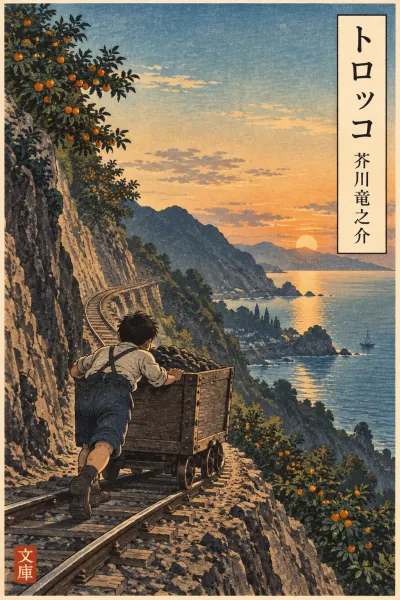
 N4 · easy
Simplified retelling · JLPT N4
トロッコ Torokko in easy Japanese (N4)
This is our own simplified retelling of The Rail Cart, written for N4 learners and checked word by word against the N4 vocabulary list. A few story words and grammar patterns go beyond N4; the notes below give each one's level. It keeps the characters, events and ending of the original. When it feels easy, move on to the N3 version or the original text.
The story in brief
Eight-year-old Ryōhei longs to ride the rail carts at a nearby railway construction site. After being scared off by a worker, he later gets two young workers to let him push, and rides with them far from his village. At dusk they tell him to go home alone, and he runs the long way back in fear, bursting into tears only when he reaches home. Years later in Tokyo, the memory of that dark road still comes back to him.
AI translation · independently checked
りょうへいが八つの年に、村の近くで新しいせんろの工事が始まりました。The year Ryōhei was eight, work on a new railway line began near his village.
りょうへいは毎日、その工事を見に行きました。Every day, Ryōhei went to watch the construction.
いちばん見たかったのは、トロッコです。What he wanted to see most of all were the rail carts.
トロッコには、工事の男が二人のっています。Two construction workers were riding on the cart.
トロッコは土をのせて、山から走って来ます。Loaded with earth, the carts came running down from the hills.
りょうへいは「ぼくもトロッコにのりたい。押してみたい」と思いました。Ryōhei thought, "I want to ride a cart too. I want to try pushing one."
二月のある夕方、りょうへいは弟と、となりの子供と三人で、トロッコのところへ行きました。One evening in February, Ryōhei went to the carts with his little brother and the boy from next door, the three of them together.
工事の人は一人もいません。There was not a single worker around.
三人で押すと、トロッコが動きました。When the three of them pushed, the cart moved.
三人はトロッコを押して、せんろを少しのぼりました。The three boys pushed the cart a little way up the track.
それから、みんなでトロッコにのりました。Then they all climbed onto the cart.
トロッコは下の方へ、はやく走り出しました。The cart began to run fast, down the slope.
風がかおにふいて、りょうへいはとてもうれしくなりました。The wind blew against his face, and Ryōhei felt very happy.
もう一度押そうとすると、後ろから大きなこえが聞こえました。When they were about to push it once more, a loud voice came from behind them.
「だれがトロッコにさわった!」せの高い工事の男が立っていました。"Who touched that cart?!" A tall construction worker was standing there.
三人はびっくりして、にげました。The three boys were startled and ran away.
それから、りょうへいはもうトロッコにのりたいと思いませんでした。After that, Ryōhei no longer wanted to ride the carts.
十日ぐらい後、りょうへいは一人で工事場へ行きました。About ten days later, Ryōhei went to the construction site on his own.
わかい男が二人、トロッコを押していました。Two young men were pushing a cart.
「この人たちはおこらないだろう」と思って、りょうへいは聞きました。Thinking, "These men probably won't get angry," Ryōhei asked them.
「おじさん、押してもいい?」"Mister, can I push?"
「ああ、押してくれ。」"Yeah, go on, push."
りょうへいは一生けんめい押しました。Ryōhei pushed with all his might.
「強いな」と男はほめてくれました。"You're strong, huh," one of the men said, praising him.
「いつまでも押していい?」と聞くと、二人は「いいよ」と答えました。When he asked, "Can I keep pushing as long as I like?" the two of them answered, "Sure."
りょうへいは「やさしい人たちだ」と思いました。Ryōhei thought, "They're kind men."
みかんの木の間をのぼると、道は下の方へつづいていました。When they had climbed up between the mandarin orange trees, the path ran on downhill.
男が「のれ」と声をかけました。"Hop on," one of the men called to him.
三人がのると、トロッコははやく走りました。When the three of them got on, the cart ran fast.
「押すより、のる方がいい」とりょうへいは思いました。"Riding is better than pushing," Ryōhei thought.
また押して、山をのぼりました。They pushed again and climbed the hill.
高いところから、広くてさむそうな海が見えました。From the high ground, they could see the sea, wide and cold-looking.
りょうへいは急に「とおくまで来すぎた」と思いました。Suddenly Ryōhei thought, "I've come too far."
もう楽しくありません。It was no longer fun.
「早く帰りたい」と思いました。"I want to go home soon," he thought.
トロッコは小さい店の前で止まりました。The cart stopped in front of a small shop.
二人は店に入って、お茶を飲みました。The two men went into the shop and drank tea.
りょうへいは一人で待っていました。Ryōhei waited alone.
男の一人が、新聞でつつんだおかしをくれました。One of the men gave him some sweets wrapped in newspaper.
また少し行くと、同じような店がありました。When they had gone a little further, there was another shop just like the first.
空はもう赤くなっていました。The sky had already turned red.
「もうすぐ夜になる」と思って、りょうへいはとてもしんぱいになりました。Thinking, "It'll be night soon," Ryōhei grew very worried.
店から出て来た二人は、りょうへいに話しました。The two men came out of the shop and spoke to Ryōhei.
「もう帰りなさい。ぼくたちは今日、向こうにとまるから。」"Time for you to head home. We're staying the night over there today."
「帰りがおそいと、家の人がしんぱいするよ。」"If you're back late, your folks'll worry."
りょうへいはびっくりしました。Ryōhei was stunned.
もうすぐくらくなります。It would soon be dark.
帰る道はとても長いです。The road home was very long.
一人で歩いて帰らなければなりません。He would have to walk back all by himself.
りょうへいはなきそうになりました。Ryōhei was on the verge of tears.
でも、ないても仕方がないと思いました。But he thought that crying would do no good.
りょうへいは二人にあいさつをして、せんろのよこを走り出しました。Ryōhei said goodbye to the two men and started running alongside the track.
じゃまになったので、おかしを道にすてました。The sweets were getting in his way, so he threw them onto the road.
ぞうりもすてました。He threw away his straw sandals too.
足はいしでいたかったですが、軽くなりました。The stones hurt his feet, but he felt lighter.
あせでぬれた上着もすてました。He threw away his jacket too, which was soaked with sweat.
みかんの木のところへ来ると、もうくらくなっていました。By the time he reached the mandarin orange trees, it was already dark.
りょうへいは「死にたくない」と思いながら、走りつづけました。Thinking, "I don't want to die," Ryōhei kept on running.
村の工事場が見えると、なきたくなりました。When he caught sight of the construction site by his village, he felt like crying.
でも、なかないで走りました。But he ran on without crying.
村に入ると、家には電気がついていました。When he entered the village, the lights were on in the houses.
村の人が「どうしたの?」と聞きましたが、りょうへいは何も答えないで走りました。People in the village asked, "What's the matter?" but Ryōhei ran past without answering anything.
家のもんに入ると、りょうへいは大きなこえでなき出しました。As soon as he stepped through the gate of his house, Ryōhei burst out crying loudly.
お父さんとお母さんが来ました。His father and mother came.
となりの家の人も集まりました。The people from next door gathered too.
みんな「どうしてないているの?」と聞きました。Everyone asked, "Why are you crying?"
でも、りょうへいはなきつづけるほかありませんでした。But Ryōhei could do nothing but go on crying.
とおい道を一人で走って来た、そのこわさとさびしさを思い出すと、いくらないても足りませんでした。When he remembered the fear and loneliness of running that long road by himself, no amount of crying was enough.
りょうへいは二十六の年に、家族と一しょに東京へ来ました。The year he was twenty-six, Ryōhei came to Tokyo with his family.
今はざっしの会社ではたらいています。Now he works at a magazine company.
でも時々、何のりゆうもないのに、あの日のことを思い出します。Yet sometimes, for no reason at all, he remembers that day.
つかれたりょうへいの前には、今も、あの日のようなくらい道が、細く長くつづいているのです。Even now, before the weary Ryōhei, a dark road like the one on that day stretches on, thin and long.
Vocabulary
| Word | Meaning | JLPT |
|---|---|---|
| 工事こうじ | construction work工事場 (こうじば) is a construction site. | N2 |
| せんろせんろ | railway track, railsdictionary form: 線路Kanji 線 'line' + 路 'road'. | N2 |
| 押しておす | to pushdictionary form: 押すOpposite of 引く (ひく) 'to pull'. | N5 |
| 夕方ゆうがた | evening, late afternoon | N5 |
| にげましたにげる | to run away, to fleedictionary form: 逃げる | N4 |
| ほめてほめる | to praise (here ほめてくれました: the man praised Ryōhei, which is framed as a kindness toward Ryōhei from the narrator's viewpoint)dictionary form: 褒めるほめてくれる: someone praises you (a kindness to the speaker's side). | N4 |
| つづいてつづく | to continue, to stretch ondictionary form: 続くUsed for roads and tracks that go on and on. | N4 |
| 声をかけましたこえをかける | to call out to someone, to speak to someonedictionary form: 声をかける | — |
| しんぱいしんぱい | worry, anxietydictionary form: 心配心配になる 'to become worried'; 心配する 'to worry'. | N4 |
| 仕方がないしかたがない | it can't be helped; there's no point〜ても仕方がない: 'there's no use in doing ~'. | — |
| じゃまじゃま | in the way, a nuisancedictionary form: 邪魔じゃまになる 'to get in the way'. | N4 |
| すてましたすてる | to throw awaydictionary form: 捨てる | N4 |
| ぞうりぞうり | zōri, straw sandalsdictionary form: 草履Traditional Japanese sandals made of straw, held by a thong between the toes; there is no exact English equivalent. | N2 |
| 上着うわぎ | jacket, outer garment | N5 |
Grammar
〜てみたい N4 want to try doing ~
The て-form + みる means 'try doing and see'. Adding たい makes it 'want to try'. Ryōhei has never pushed a cart and wants to try it.
ぼくもトロッコにのりたい。押してみたい
I want to ride a cart too. I want to try pushing one.
〜ようとすると N3 just as (someone) was about to ~
The volitional form (押そう) + とする means 'try to / be about to do'. With と, it shows that something else happened at that moment and interrupted the action.
もう一度押そうとすると、後ろから大きなこえが聞こえました。
When they were about to push it once more, a loud voice came from behind them.
〜すぎる N4 to do ~ too much
The verb stem + すぎる means 'too much'. 来すぎた = 'came too far'; it shows Ryōhei's sudden worry.
りょうへいは急に「とおくまで来すぎた」と思いました。
Suddenly Ryōhei thought, "I've come too far."
〜なければなりません N4 must ~, have to ~
Take the negative form of the verb (e.g. 帰らない), drop the final い and add ければ, then add なりません: 帰らなければなりません = must go home / have to go home. It expresses obligation: Ryōhei has no choice but to walk home alone.
一人で歩いて帰らなければなりません。
He would have to walk back all by himself.
〜そうになる N3 to almost ~, to be on the verge of ~
The verb stem + そうになる means something nearly happens but does not. Ryōhei almost cries but holds back.
りょうへいはなきそうになりました。
Ryōhei was on the verge of tears.
〜ほかない N3 can do nothing but ~
The dictionary form + ほかない (here ほかありませんでした) means there is no other choice. Ryōhei cannot explain his feelings; he can only keep crying.
りょうへいはなきつづけるほかありませんでした。
Ryōhei could do nothing but go on crying.