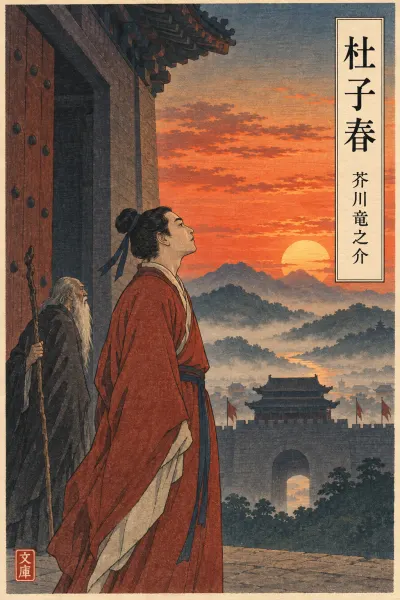
 N4 · easy
Simplified retelling · JLPT N4
杜子春 Toshishun in easy Japanese (N4)
This is our own simplified retelling of Toshishun and the Hermit of Mount Gabi, written for N4 learners and checked word by word against the N4 vocabulary list. A few story words and grammar patterns go beyond N4; the notes below give each one's level. It keeps the characters, events and ending of the original. When it feels easy, move on to the N3 version or the original text.
The story in brief
Toshishun, a poor young man at the west gate of a great city, is twice made rich when a mysterious old man tells him where to find buried money, and twice loses it all as his fair-weather friends leave him. He asks to become the old man's pupil, and the hermit takes him to a mountain where he must stay silent through every terror, even death and the tortures of Hell. When he sees his dead parents beaten and hears his mother's loving voice, he cries out. He is glad to have failed, promises to live an honest life, and the hermit gives him a house surrounded by peach blossoms.
AI translation · independently checked
春の夕方です。It was a spring evening.
大きな町の西のもんの下に、わかい男が一人立っていました。Beneath the west gate of a great city, a young man stood all alone.
名前はトシシュンです。His name was Toshishun.
トシシュンは、前はお金持ちの子どもでした。Toshishun had once been the son of a rich family.
でも、今はお金がぜんぜんありません。But now he had no money at all.
ねるところもありません。He had no place to sleep, either.
「おなかもすいたし、とまるところもない。川に入って死んだほうがいいかもしれない。」"I'm hungry, and I have nowhere to stay. Perhaps I would be better off throwing myself into the river and dying."
すると、一人のおじいさんが来て、聞きました。Just then an old man came up and asked him a question.
「お前は何を考えているのだ。」"What are you thinking about?"
「今夜ねるところがないので、こまっています。」"I have nowhere to sleep tonight, so I don't know what to do."
「では、いいことを教えよう。夕日の中に立ちなさい。かげのあたまのところを、夜にさがしなさい。車いっぱいのお金があるよ。」"Then I'll tell you something good. Stand in the evening sun. At night, search the spot where the head of your shadow falls. There is a whole cartload of money there."
トシシュンが見ると、おじいさんはもういませんでした。When Toshishun looked, the old man was already gone.
その夜さがすと、本当にお金がたくさん出てきました。That night he searched the spot, and a great deal of money really did come out of the ground.
トシシュンは町でいちばんのお金持ちになりました。Toshishun became the richest man in the city.
大きな家を買って、高い物をたくさん買いました。He bought a large house, and he bought many expensive things.
前はあいさつもしなかった友だちが、毎日あそびに来ました。Friends who had never even greeted him before came to visit him every day.
トシシュンは毎日パーティーをしました。Toshishun held a party every day.
でも、三年後、お金はなくなりました。But three years later, the money was gone.
友だちはもう来ません。His friends no longer came.
あいさつもしません。They would not even greet him.
水一ぱいも、くれる人はいませんでした。There was no one who would give him so much as a cup of water.
トシシュンは、また西のもんの下に立っていました。Once again Toshishun was standing beneath the west gate.
すると、またあのおじいさんが来ました。And once again that old man came along.
今度は、かげの体の真ん中のところでした。This time the spot was where the middle of his shadow's body fell.
トシシュンはまたお金持ちになりました。Toshishun became rich once more.
でも、また三年後に、お金はなくなりました。But three years later, the money was gone again.
またおじいさんが来ました。Again the old man came.
おじいさんが話し始めると、トシシュンは言いました。As the old man began to speak, Toshishun said:
「お金はもういりません。人はみんなつめたいです。お金があると、みんなやさしいです。でも、お金がなくなると、だれもあいさつしません。あなたはせんにんでしょう。私をあなたの生徒にしてください。」"I don't want money any more. People are all cold-hearted. When you have money, everyone is kind. But when your money is gone, no one will even greet you. You are a hermit sage, aren't you? Please take me as your pupil."
おじいさんはわらいました。The old man laughed.
「そうだ。私はせんにんだ。いいだろう。いっしょに来なさい。」"That's right. I am a hermit. Very well. Come with me."
おじいさんは木のえだをひろって、トシシュンといっしょにのりました。The old man picked up a branch from a tree and climbed onto it together with Toshishun.
えだは空をとんで、高い山へ行きました。The branch flew through the sky and went to a high mountain.
山の上はとてもしずかで、ほしが大きくひかっていました。At the top of the mountain all was very quiet, and the stars shone big and bright.
おじいさんはトシシュンを大きないしの上にすわらせて、言いました。The old man sat Toshishun down on a large rock and said:
「私はちょっと出かける。ここで待っていなさい。こわいものがたくさん来る。でも、けっして声を出すな。一つでも言葉を話したら、せんにんにはなれないよ。」"I'm going out for a while. Wait here. Many frightening things will come. But on no account make a sound. If you speak even a single word, you won't be able to become a hermit."
「だいじょうぶです。死んでも、話しません。」"I'll be all right. Even if I die, I won't speak."
おじいさんがいなくなると、空から声が聞こえました。When the old man had gone, a voice was heard from the sky.
「そこにいるのはだれだ。」トシシュンは答えませんでした。"Who is there?" Toshishun did not answer.
すると、大きなとらと白いへびが来ました。Then a huge tiger and a white snake came.
でも、トシシュンは動きませんでした。But Toshishun did not move.
とらとへびはきえました。The tiger and the snake vanished.
つぎに、強い風がふいて、雨がたくさんふりました。Next, a strong wind blew and heavy rain fell.
空がひかって、大きな音がしました。Lightning flashed across the sky, and there was a tremendous crash.
でも、トシシュンは何も言いませんでした。But Toshishun said nothing.
それから、とても強そうな大きな男が来ました。After that, a huge, very strong-looking man came.
「答えなければ、お前は死ぬぞ。」トシシュンは答えませんでした。"If you do not answer, you shall die!" Toshishun did not answer.
男はおこって、トシシュンを死なせました。The man grew angry and put Toshishun to death.
トシシュンはじごくへ行きました。Toshishun went to Hell.
じごくには、おにがたくさんいました。In Hell there were many demons.
えんまさまが聞きました。King Enma questioned him.
「お前はなぜ山の上にすわっていたのだ。」トシシュンは答えませんでした。"Why were you sitting on top of that mountain?" Toshishun did not answer.
おにたちは、トシシュンをいろいろなひどいところへつれて行きました。The demons took Toshishun to all kinds of dreadful places.
とてもいたかったです。It was terribly painful.
でも、トシシュンは何も言いませんでした。But Toshishun said nothing.
えんまさまは言いました。King Enma spoke.
「この男のお父さんとお母さんをつれてこい。」おにが二ひきのうまをつれてきました。"Bring this man's father and mother here!" The demons brought two horses.
よく見ると、それは死んだお父さんとお母さんでした。When he looked closely, he saw that they were his dead father and mother.
「答えなければ、このうまたちを打つぞ。」トシシュンは答えませんでした。"If you do not answer, these horses shall be beaten!" Toshishun did not answer.
おにたちは、うまをたくさん打ちました。The demons beat the horses again and again.
うまはちを出して、たおれました。The horses bled and fell down.
トシシュンは下をむいて、おじいさんの言葉を思い出していました。Toshishun looked down and kept recalling the old man's words.
すると、とてもよわい声が聞こえました。Then he heard a very faint voice.
「心配しないで。私たちはどうなってもいいのよ。お前がよければ、それでいいの。言いたくないことは、言わなくてもいいよ。」"Don't worry. It doesn't matter what happens to us. As long as you are all right, that's all we want. You don't have to say anything you don't wish to say."
お母さんの声でした。It was his mother's voice.
お母さんは、おにに打たれても、おこっていませんでした。Even though the demons were beating her, his mother was not angry.
お金がないとあいさつもしない人たちとは、ぜんぜんちがいます。She was completely different from the people who would not even greet him once he had no money.
トシシュンはおじいさんの言葉をわすれて、うまのそばへ走りました。Toshishun forgot the old man's words and ran to the horse's side.
そして、なきながら「お母さん」と呼びました。And, weeping, he cried out, "Mother!"
目を開けると、トシシュンはまた西のもんの下に立っていました。When he opened his eyes, Toshishun was standing beneath the west gate once again.
夕日も、町の人も、前と同じでした。The evening sun and the people of the city were just the same as before.
「どうだ。せんにんにはなれないだろう。」とおじいさんが言いました。"Well? You can't become a hermit, can you?" said the old man.
「なれません。でも、なれなくて、うれしいです。お父さんとお母さんが打たれていたら、何も言わないでいることはできません。」"No, I can't. But I'm glad I couldn't. If my father and mother are being beaten, I can't just stay silent."
「もしお前が何も言わなかったら、私はお前を死なせるつもりだった。これから何になりたいのだ。」"If you had said nothing, I was going to put you to death. What do you want to become now?"
「何になっても、まじめに生きていきます。」"Whatever I become, I will live an honest life."
「その言葉をわすれるなよ。もうお前には会わない。」"Don't forget those words. I won't see you again."
おじいさんは歩き出しました。The old man began to walk away.
でも、止まって、うれしそうに言いました。But he stopped and said happily:
「そうだ。南の山の下に、私の家がある。その家をお前にあげよう。今、家のまわりに、ももの花がたくさんさいているだろう。」"Oh, yes. At the foot of the southern mountain there is a house of mine. I'll give that house to you. Just now, the peach trees around it must be in full bloom."
Vocabulary
| Word | Meaning | JLPT |
|---|---|---|
| お金持ちおかねもち | rich person; wealthyLiterally 'money-holder'. お金持ちになる = to become rich. | N4 |
| とまるとまる | to stay the night (somewhere)dictionary form: 泊まるSame sound as 止まる 'to stop', but a different kanji. | N4 |
| こまってこまる | to be in trouble; not know what to dodictionary form: 困るUsually used as こまっています for a present difficulty. | N5 |
| かげかげ | shadowdictionary form: 影 | N3 |
| あいさつあいさつ | greeting; saying hellodictionary form: 挨拶A key word here: whether people greet Toshishun shows whether they care about him or his money. | N4 |
| せんにんせんにん | hermit sage with magic powersdictionary form: 仙人A wise person from Chinese legend who lives in the mountains and can fly or do magic. | — |
| ひろってひろう | to pick up (from the ground)dictionary form: 拾う | N4 |
| けっしてけっして | never; on no accountdictionary form: 決してAlways used with a negative: けっして〜ない / けっして〜な. | N4 |
| きえましたきえる | to disappear; vanishdictionary form: 消える | N5 |
| じごくじごく | Helldictionary form: 地獄 | N1 |
| おにおに | demon; ogredictionary form: 鬼Horned monsters that serve King Enma in Japanese stories of Hell. | N3 |
| 打つうつ | to hit; beat | N4 |
| たおれましたたおれる | to fall down; collapsedictionary form: 倒れる | N4 |
| まじめまじめ | serious; earnest; honestdictionary form: 真面目まじめに生きる = to live an honest, decent life. | N4 |
Grammar
〜たほうがいい N4 it would be better to…
The past form of a verb plus ほうがいい gives advice or a judgement about the better choice. Here Toshishun sadly thinks dying might be better, and かもしれない softens it to 'perhaps'.
川に入って死んだほうがいいかもしれない。
Perhaps I would be better off throwing myself into the river and dying.
〜なさい N4 do …! (command)
Verb stem + なさい is a firm instruction, often from an older person to a younger one. The old man uses it to tell Toshishun exactly what to do.
夕日の中に立ちなさい。
Stand in the evening sun.
Verb (dictionary form) + な N4 don't …! (strong prohibition)
Adding な to the dictionary form makes a blunt negative command. With けっして it becomes 'never, ever do this'.
でも、けっして声を出すな。
But on no account make a sound.
〜ても N4 even if…
The て-form + も means 'even if'. Toshishun promises that even death will not make him speak.
死んでも、話しません。
Even if I die, I won't speak.
Passive 〜られる N4 to be (done to)
打たれる is the passive of 打つ, 'to be beaten'; the doer is marked with に. Combined with ても it means 'even though she was being beaten by the demons'.
お母さんは、おにに打たれても、おこっていませんでした。
Even though the demons were beating her, his mother was not angry.
〜なくてもいい N4 don't have to…
The negative て-form + もいい gives permission not to do something. The mother gently tells her son he does not need to speak.
言いたくないことは、言わなくてもいいよ。
You don't have to say anything you don't wish to say.