Upper intermediate · JLPT N2
杜子春Toshishun — Toshishun and the Hermit of Mount Gabi
- JLPT N2
- 9,074 characters
- 7 parts
- about 76 minutes
- 3 easier versions
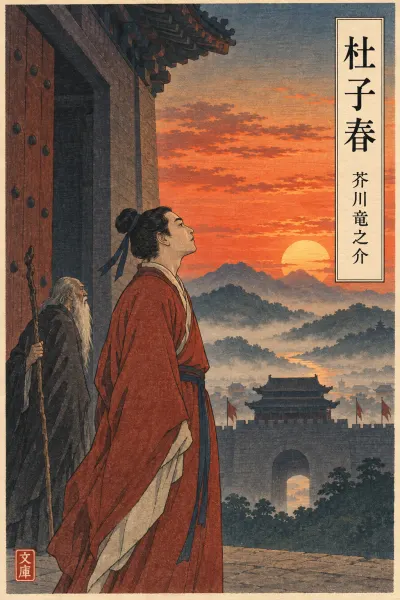
Toshishun is a short literary fairy tale by Akutagawa Ryūnosuke, retold from a Tang-dynasty Chinese story and first written for the children's magazine Akai Tori. On a spring evening at the west gate of Rakuyō, a young man who has wasted his inheritance meets a strange one-eyed old man, and his fortunes change more than once. The story moves from city luxury to a lonely mountain peak and on into Hell, as Toshishun faces a test that asks what he truly values. The tone is gentle and fable-like. A warm storyteller narrates in polite desu/masu Japanese and sometimes speaks directly to the reader. The descriptions are vivid but never cluttered. For learners, the plot is easy to follow because events repeat in a clear pattern, and the dialogue shows several speech styles side by side: the hermit's blunt plain form, Toshishun's politeness, and the stiff, archaic commands of the rulers of the underworld. The main challenge is the many Chinese place names and the literary kanji vocabulary, most of which appear only once. The emotional climax rewards readers who reach the end.
Contents
Easier versions
This story is also retold in simpler Japanese. Reading an easier version first makes the original much more approachable.
Before you read
- The narrator uses polite desu/masu forms throughout, but the dialogue does not. Use speech style to track who is talking: the hermit's おれ/お前 and plain commands, Toshishun's polite requests, and the archaic その方 used by the god-general and King Enma.
- Learn the key command early: 決して口を利くな ('never say a word'). 口を利く means 'to speak', and 決して…ない means 'never'. The whole test on Mount Gabi depends on this phrase.
- The plot is built on repetition. The meeting at the west gate happens three times with almost the same wording. Compare these scenes closely, because the small changes in Toshishun's answers carry the story's meaning.
- Learn a few core words before you start: 仙人 (hermit-sage), 黄金 (gold), 贅沢 (luxury), 地獄 (Hell), 鬼 (demon), and 馬 (horse). Most of the Chinese place names appear only once, so use the name list and read on without memorizing them.
- Watch for the narrator stepping out of the story to speak to the reader. These asides are usually easy to read and tell you how to feel about Toshishun, which makes the harder passages around them easier to follow.
Words to know
The most useful words from the notes across the story.
| Word | Meaning | JLPT |
|---|---|---|
| 眇すがめ | blind (or squinting) in one eyeArchaic; 片目眇 = blind in one eye. | — |
| 薄情はくじょう | cold-hearted, unfeelingLiterally 'thin feeling'. Describes people who drop you when you are no longer useful to them. | — |
| 佇んでたたずむ | to stand still, to lingerdictionary form: 佇むLiterary; suggests standing idle or lost in thought. | — |
| 愛想がつきたあいそがつきる | to lose all patience with, to be completely disillusioned withdictionary form: 愛想が尽きるSet phrase; literally 'one's goodwill runs out'. | — |
| 仙人せんにん | hermit-sage, a Taoist immortal with magical powers | — |
| 絶壁ぜっぺき | sheer cliff, precipice | — |
| 留守るす | absence from home; being awayEveryday word: 留守番 means house-sitting. | N4 |
| 財産ざいさん | fortune, property, assets | N3 |
| 容子ようす | appearance, the look of thingsOlder spelling of 様子. | N3 |
| 贅沢ぜいたく | luxury, extravaganceA key word of this part. 贅沢な暮らし = a life of luxury; 贅沢をする = to live extravagantly. | N3 |
| 噂うわさ | rumour, talk, news going around | N3 |
| 飽きてあきる | to grow tired of, to be fed up withdictionary form: 飽きるTakes に: 贅沢に飽きる. | N3 |
| 次第しだい | depending onNoun + 次第: 'up to ~, depends on ~'. | N3 |
| 覚悟かくご | being prepared for (something bad), resolve〜と覚悟しろ: 'be ready for the fact that…'. | N3 |
| 悪戯いたずら | mischief; prankA difficult kanji spelling of a common word, usually written in kana. | N3 |
Plot summary
Show the full summary (contains spoilers)
Toshishun, a rich man's son who has spent everything, stands idle at Rakuyō's west gate. A one-eyed old man tells him to dig where the head of his shadow falls in the evening light. Toshishun finds gold, lives in luxury, and loses his fair-weather friends once he is poor again. The same thing happens a second time. At their third meeting he refuses the gold. Guessing that the old man must be a hermit, he asks to become his disciple. The hermit, Tekkanshi, takes him to Mount Gabi and orders him not to speak, whatever happens. Toshishun stays silent through terrors, death and the tortures of Hell. Then King Enma has his parents, reborn as horses, whipped before him. When his mother tenderly tells him not to worry about them, he cries out 'Mother!' He wakes at the west gate. He has resolved to live honestly, and the hermit gives him a house at Mount Tai.
About the author
Akutagawa Ryūnosuke (1892–1927) was one of the most important writers of modern Japanese short fiction. Born in Tokyo, he studied English literature at Tokyo Imperial University, and his early story 鼻 (The Nose) won praise from Natsume Sōseki. Many of his works retell older Japanese and Chinese tales with modern psychological insight, including 羅生門 (Rashōmon) and 藪の中 (In a Grove), which later inspired Kurosawa Akira's film Rashomon. He died by suicide at the age of 35. The Akutagawa Prize was named in his honour by his friend Kikuchi Kan.