Part 1 of 7 · JLPT N2
杜子春(一) Toshishun, part 1: The Old Man at the West Gate
In this part
Toshishun, a rich man's son who has spent his whole fortune, stands hungry and homeless at the west gate of Rakuyō one spring evening, wondering whether he would be better off dead. A one-eyed old man appears and tells him to dig at night where the head of his shadow falls, promising a cartload of gold. When Toshishun looks up in surprise, the old man has vanished.
AI translation · independently checked
或春の日暮です。It was dusk on a certain spring day.
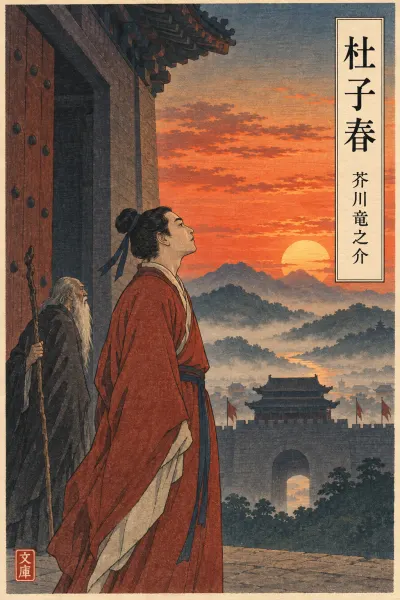
唐の都洛陽の西の門の下に、ぼんやり空を仰いでいる、一人の若者がありました。Beneath the west gate of Rakuyō, the capital of Tō, there stood a young man gazing vacantly up at the sky.
若者は名を杜子春といって、元は金持の息子でしたが、今は財産を費い尽して、その日の暮しにも困る位、憐な身分になっているのです。The young man's name was Toshishun. He had once been the son of a rich man, but now he had spent every bit of his fortune and had sunk into such a pitiful state that he could hardly get by from one day to the next.
何しろその頃洛陽といえば、天下に並ぶもののない、繁昌を極めた都ですから、往来にはまだしっきりなく、人や車が通っていました。After all, Rakuyō in those days was a city without equal under heaven, at the very height of its prosperity, so people and carts were still passing along the streets in an endless stream.
門一ぱいに当っている、油のような夕日の光の中に、老人のかぶった紗の帽子や、土耳古の女の金の耳環や、白馬に飾った色糸の手綱が、絶えず流れて行く容子は、まるで画のような美しさです。In the oily light of the setting sun that filled the whole gateway, the gauze caps worn by old men, the gold earrings of Turkish women, and the coloured-thread reins decorating white horses flowed by without a pause, a sight as lovely as a painting.
しかし杜子春は相変らず、門の壁に身を凭せて、ぼんやり空ばかり眺めていました。But Toshishun, just as before, leaned his body against the wall of the gate and did nothing but stare vacantly at the sky.
空には、もう細い月が、うらうらと靡いた霞の中に、まるで爪の痕かと思う程、かすかに白く浮んでいるのです。In the sky a thin moon had already risen, floating faint and white amid the softly trailing spring haze, so slight you might have taken it for the mark of a fingernail.
「日は暮れるし、腹は減るし、その上もうどこへ行っても、泊めてくれる所はなさそうだし――こんな思いをして生きている位なら、一そ川へでも身を投げて、死んでしまった方がましかも知れない」"The day is ending, I'm hungry, and on top of that it seems there's nowhere left that will put me up for the night, wherever I go. If I have to live feeling like this, perhaps I'd be better off throwing myself into the river and being done with it."
杜子春はひとりさっきから、こんな取りとめもないことを思いめぐらしていたのです。For some while now, Toshishun had been turning such aimless thoughts over and over by himself.
するとどこからやって来たか、突然彼の前へ足を止めた、片目眇の老人があります。Then, from who knows where, an old man blind in one eye appeared and suddenly came to a stop in front of him.
それが夕日の光を浴びて、大きな影を門へ落すと、じっと杜子春の顔を見ながら、Bathed in the light of the setting sun, he cast a great shadow across the gate, and, staring hard at Toshishun's face,
「お前は何を考えているのだ」と、横柄に声をかけました。"What are you thinking about?" he called out gruffly.
「私ですか。私は今夜寝る所もないので、どうしたものかと考えているのです」"Me, sir? I have nowhere to sleep tonight, so I was wondering what I ought to do."
老人の尋ね方が急でしたから、杜子春はさすがに眼を伏せて、思わず正直な答をしました。Because the old man's question had come so abruptly, Toshishun, as one might expect, lowered his eyes and found himself giving an honest answer.
「そうか。それは可哀そうだな」"Is that so? That's a pity."
老人は暫く何事か考えているようでしたが、やがて、往来にさしている夕日の光を指さしながら、The old man seemed to be thinking something over for a while, but presently, pointing at the evening sunlight slanting across the street,
「ではおれが好いことを一つ教えてやろう。今この夕日の中に立って、お前の影が地に映ったら、その頭に当る所を夜中に掘って見るが好い。きっと車に一ぱいの黄金が埋まっている筈だから」"Well then, I'll tell you something good. Stand in this evening sun right now, and when your shadow falls on the ground, go and dig at the spot where its head lies in the middle of the night. You're sure to find a whole cartload of gold buried there."
「ほんとうですか」"Is that true?"
杜子春は驚いて、伏せていた眼を挙げました。Toshishun raised his lowered eyes in astonishment.
ところが更に不思議なことには、あの老人はどこへ行ったか、もうあたりにはそれらしい、影も形も見当りません。But stranger still, the old man had gone who knows where, and there was no sign or shadow of anyone like him anywhere around.
その代り空の月の色は前よりも猶白くなって、休みない往来の人通りの上には、もう気の早い蝙蝠が二三匹ひらひら舞っていました。Instead, the moon in the sky had grown whiter than before, and above the ceaseless stream of passers-by in the street, two or three impatient bats were already fluttering about.
Vocabulary
| Word | Meaning | JLPT |
|---|---|---|
| 日暮ひぐれ | dusk, nightfalldictionary form: 日暮れFrom 日が暮れる, 'the day darkens'. | — |
| 仰いであおぐ | to look up atdictionary form: 仰ぐLiterary; also means 'to look up to, respect'. | N1 |
| 財産ざいさん | fortune, property, assets | N3 |
| 費い尽してつかいつくす | to spend completely, use updictionary form: 費い尽くす〜尽くす adds 'completely, to the last'. Modern writing uses 使い尽くす. | — |
| 繁昌はんじょう | prosperity, flourishingNow usually written 繁盛. 〜を極める = to reach the height of. | N1 |
| 往来おうらい | street, road; coming and goingOld-fashioned word for a busy street. | — |
| 容子ようす | appearance, the look of thingsOlder spelling of 様子. | N3 |
| 凭せてもたせる | to lean (something) againstdictionary form: 凭せる身を凭せる = to lean one's body against. Modern: もたれる 'to lean'. | — |
| 霞かすみ | (spring) haze, mistA classic image of spring in Japanese poetry. | — |
| 眇すがめ | blind (or squinting) in one eyeArchaic; 片目眇 = blind in one eye. | — |
| 横柄おうへい | arrogant, haughty, gruffNa-adjective; here 横柄に = gruffly. | — |
| 黄金おうごん | goldMore literary than きん. | N1 |
| 見当りませんみあたる | to be found, to turn updictionary form: 見当たるMostly used in the negative: 見当たらない = can't be found. | — |
| 蝙蝠こうもり | bat (animal)Usually written in kana today. | — |
Grammar
名を〜といって N3 whose name was ~; was called ~
名を〜といって: という is used in its て-form to introduce a person's name and link it to the rest of the sentence. 名を〜という is a literary, storytelling way of saying 'his name was ~', and the て-form lets the narration continue ('his name was ~, and ...').
若者は名を杜子春といって、元は金持の息子でしたが
The young man's name was Toshishun, and he had once been the son of a rich man, but
〜し、〜し N4 and ~, and what's more ~ (listing reasons)
Plain-form verbs followed by し list several reasons that pile up together. Here Toshishun lists his troubles one after another.
日は暮れるし、腹は減るし
The day is ending, I'm hungry
〜位なら〜方がまし N2 rather than ~, it would be better to ~
〜くらいなら presents an option that is unbearable, and 〜方がまし says the alternative, though bad, is still preferable. It expresses a desperate comparison.
こんな思いをして生きている位なら、一そ川へでも身を投げて、死んでしまった方がましかも知れない
If I have to live feeling like this, perhaps I'd be better off throwing myself into the river and being done with it.
〜てやろう N4 I'll do ~ for you
〜てやる is the plain, somewhat condescending form of 〜てあげる, used by a superior toward someone lower. The volitional やろう makes it an offer, fitting the old man's brusque tone.
ではおれが好いことを一つ教えてやろう
Well then, I'll tell you something good.
〜が好い (〜がいい) N2 you should ~; go ahead and ~
Attached to the dictionary form, 〜がいい gives a firm recommendation or instruction, often from someone speaking down to the listener.
その頭に当る所を夜中に掘って見るが好い
Go and dig at the spot where its head lies in the middle of the night.
〜筈だ N3 should be ~; is sure to be ~
はず expresses the speaker's confident expectation based on reasoning or knowledge. With きっと and から, the old man strongly assures Toshishun of the gold.
きっと車に一ぱいの黄金が埋まっている筈だから
You're sure to find a whole cartload of gold buried there.