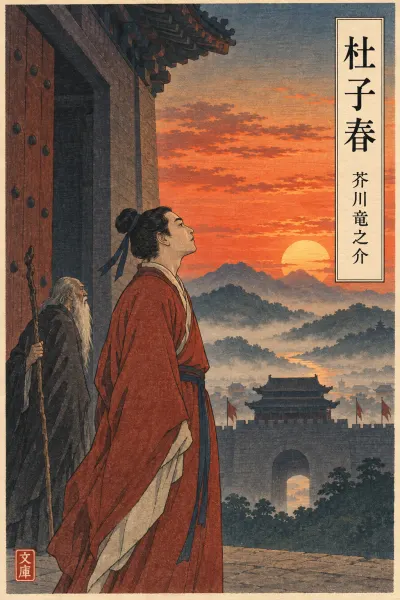
 N5 · easy
Simplified retelling · JLPT N5
杜子春 Toshishun in easy Japanese (N5)
This is our own simplified retelling of Toshishun and the Hermit of Mount Gabi, written for N5 learners and checked word by word against the N5 vocabulary list. A few story words and grammar patterns go beyond N5; the notes below give each one's level. It keeps the characters, events and ending of the original. When it feels easy, move on to the N4 version or the original text.
The story in brief
Toshishun is poor until a mysterious old man twice shows him where money is buried, and twice he spends it all. Tired of false friends, he asks the old man, a hermit, to teach him. On a mountain he stays silent through terrible trials and even death, but in Hell he cries out when he sees his parents beaten. He wakes at the west gate again, glad to live as a good, hard-working man, and the old man gives him a house.
AI translation · independently checked
はるのゆうがた、大きなまちの西のもんの下に、わかい男がたっていました。One spring evening, a young man was standing under the west gate of a great city.
名まえはとししゅんです。His name was Toshishun.
お金もねるところもありません。He had no money and no place to sleep.
おじいさんが来て、「何をしていますか。」と聞きました。An old man came up and asked, "What are you doing?"
「ねるところがありません。」とこたえると、「あそこの下にお金がありますよ。」といって、どこかへ行きました。When Toshishun answered, "I have no place to sleep," the old man said, "There is money under that spot over there," and went off somewhere.
よるにそこを見ると、お金がたくさんありました。When he looked there that night, he found a great deal of money.
とししゅんは大きないえをかって、毎日友だちとおさけをのみました。Toshishun bought a big house and drank wine with his friends every day.
でも、三年でお金をぜんぶつかいました。But in three years he had spent all the money.
友だちはもう来ません。His friends no longer came.
おじいさんはまたお金のあるところをおしえました。The old man once again told him where there was money.
でも、また三年でぜんぶつかいました。But again, in three years, he spent it all.
つぎにおじいさんが来ると、とししゅんはいいました。The next time the old man came, Toshishun spoke.
「お金はもういりません。お金がない人とは、だれも話しません。あなたはせんにんですね。わたしの先生になってください。」おじいさんは「いいですよ。」とこたえました。"I don't want money anymore. Nobody talks to a person who has no money. You are a hermit with magic powers, aren't you? Please become my teacher." The old man answered, "Very well."
二人はそらをとんで、高い山へ行きました。The two of them flew through the sky to a high mountain.
「何が来ても、こえを出さないでください。」とおじいさんはいって、出かけました。"Whatever comes, please do not make a sound," said the old man, and he went away.
よるに、大きなとらと白いへびが来ました。In the night, a huge tiger and a white snake came.
つよいかぜと雨も来ました。A strong wind and rain came too.
つぎに大きな男が来て、「だれだ。」と聞きました。Next, a giant of a man came and demanded, "Who are you?"
でも、とししゅんは何もいいません。But Toshishun said nothing.
男はナイフでとししゅんをきって、とししゅんはしにました。The man cut Toshishun with a knife, and Toshishun died.
じごくで、えんまが「なぜ山の上にいましたか。」と聞きました。In Hell, King Enma asked, "Why were you on top of the mountain?"
おにたちはとししゅんを、とてもあついところやさむいところへ入れました。The demons put Toshishun into terribly hot places and terribly cold places.
でも、とししゅんは何もいいませんでした。But Toshishun still said nothing.
すると、うまが来ました。Then some horses came.
しんだ父と母でした。They were his dead father and mother.
おにたちはうまをむちでたくさんうちました。The demons struck the horses again and again with whips.
うまはいたくて、なきました。The horses cried out in pain.
小さなこえがしました。A small voice could be heard.
母のこえです。It was his mother's voice.
「わたしたちはだいじょうぶです。あなたがげんきなら、それでいいです。何もいわないでください。」"We are all right. As long as you are well, that is enough. Please don't say anything."
とししゅんはうまのそばへはしって行って、「お母さん!」と大きなこえでいいました。Toshishun ran to the horses' side and cried out in a loud voice, "Mother!"
すると、とししゅんはまた西のもんの下にいました。Then Toshishun was under the west gate again.
おじいさんが「せんにんにはなりませんでしたね。」といいました。The old man said, "So you did not become a hermit."
「はい。でも、それでよかったです。父と母を見て、何もいわないのはいやです。」"No. But I'm glad it turned out this way. I don't want to see my father and mother and say nothing."
「これから何になりますか。」「毎日よくはたらいて、いい人になります。」"What will you become from now on?" "I will work hard every day and become a good person."
おじいさんは「山の南にわたしのいえがあります。そのいえをあなたにあげます。今、いえのそばにもものはながたくさんさいていますよ。」といって、行きました。The old man said, "I have a house on the south side of a mountain. I will give that house to you. Right now, a great many peach blossoms are blooming beside it," and then he went away.
Vocabulary
| Word | Meaning | JLPT |
|---|---|---|
| もんもん | gate (of a city or building)dictionary form: 門Old cities had large gates in their walls; here it is the city's west gate. | N5 |
| ねるねる | to sleepdictionary form: 寝るねるところ = a place to sleep. A verb in plain form can describe a noun directly. | N5 |
| つかいましたつかう | to use; to spend (money)dictionary form: 使うお金をつかう = to spend money. | N5 |
| いりませんいる | to needdictionary form: 要るNot the same as いる 'to be'. 〜はいりません = 'I don't need ~.' | N5 |
| せんにんせんにん | hermit with magic powers; immortal sagedictionary form: 仙人A wise person from Chinese legend who lives in the mountains and can fly. | — |
| とんでとぶ | to flydictionary form: 飛ぶそらをとぶ = to fly through the sky; を marks the space you move through. | N5 |
| こえこえ | voice; sound made by a person or animaldictionary form: 声こえを出す = to make a sound, to speak out. 大きなこえで = in a loud voice. | N5 |
| じごくじごく | Helldictionary form: 地獄The opposite is 天国 (てんごく, Heaven). | N1 |
| おにたちおに | demon; ogredictionary form: 鬼たち makes a plural for people and creatures: おにたち = the demons. | N3 |
| うまうま | horsedictionary form: 馬 | N3 |
| はたらいてはたらく | to workdictionary form: 働くよくはたらく = to work hard. | N5 |
| さいてさく | (of flowers) to bloomdictionary form: 咲くはながさいています = the flowers are in bloom. | N5 |
Grammar
〜と (when…) N4 when / upon doing ~
Plain form of a verb + と connects two events: when the first happens, the second follows or is discovered. Here, looking there leads to finding the money.
よるにそこを見ると、お金がたくさんありました。
When he looked there that night, he found a great deal of money.
〜ないでください N5 please don't ~
The ない-form of a verb + でください makes a polite request not to do something. 出さない + でください = please don't let out (a voice).
こえを出さないでください。
Please do not make a sound.
〜になる N5 to become ~
A noun + になる means 'to become' that thing. With てください it becomes a polite request: 'please become ~'.
わたしの先生になってください。
Please become my teacher.
〜ても N4 even if ~; no matter ~
The て-form + も means 'even if'. With a question word like 何, it means 'no matter what': 何が来ても = whatever comes.
何が来ても、こえを出さないでください。
Whatever comes, please do not make a sound.
〜なら N4 if ~; as long as ~
なら after a noun or な-adjective sets a condition. The mother says that if her son is well, nothing else matters.
あなたがげんきなら、それでいいです。
As long as you are well, that is enough.
〜くて (reason) N4 because it is ~, (so) …
An い-adjective changes い to くて to link to the next part, often giving the reason. いたい → いたくて: because it hurt, the horses cried.
うまはいたくて、なきました。
The horses cried out in pain.