Part 1 of 3 · JLPT N2
月夜のでんしんばしら Tsukiyo no Denshinbashira, part 1: The Telegraph Poles Start to March
In this part
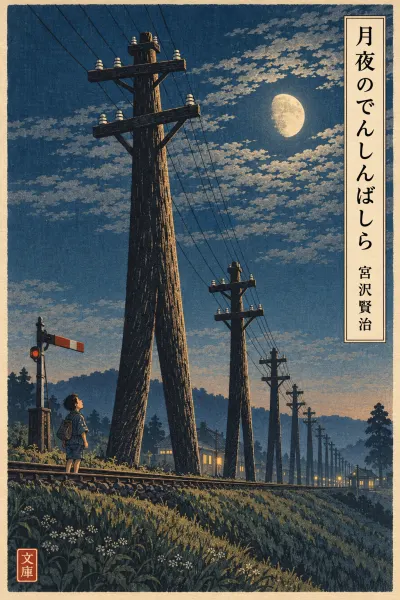
One moonlit night, Kyōichi walks alone beside a railway line toward a station. Suddenly a signal drops, and the row of humming telegraph poles begins marching north, singing an old-fashioned war song and sneering at him as they pass. Two weary poles stagger along with their arms linked, and a lively pole behind them bullies them to keep walking.
AI translation · independently checked
ある晩、恭一はぞうりをはいて、すたすた鉄道線路の横の平らなところをあるいて居りました。One night, Kyōichi put on his straw sandals and was walking briskly along the flat ground beside the railway tracks.
たしかにこれは罰金です。This was certainly something you could be fined for.
おまけにもし汽車がきて、窓から長い棒などが出ていたら、一ぺんになぐり殺されてしまったでしょう。What's more, if a train had come along with a long pole or some such thing sticking out of a window, he would have been struck dead in a single blow.
ところがその晩は、線路見まわりの工夫もこず、窓から棒の出た汽車にもあいませんでした。But that night no track-patrol worker came by, and he didn't meet any train with a pole sticking out of its window.
そのかわり、どうもじつに変てこなものを見たのです。Instead, he saw something really quite peculiar.
九日の月がそらにかかっていました。A nine-day-old moon hung in the sky.
そしてうろこ雲が空いっぱいでした。And mackerel clouds filled the whole sky.
うろこぐもはみんな、もう月のひかりがはらわたの底までもしみとおってよろよろするというふうでした。The mackerel clouds all looked as if the moonlight had soaked right down to the bottom of their insides, and they were reeling and swaying.
その雲のすきまからときどき冷たい星がぴっかりぴっかり顔をだしました。Every now and then, through the gaps between the clouds, cold stars peeped out, twinkle, twinkle.
恭一はすたすたあるいて、もう向うに停車場のあかりがきれいに見えるとこまできました。Kyōichi walked briskly on until he came to a spot where he could clearly see the lovely lights of the station up ahead.
ぽつんとしたまっ赤なあかりや、硫黄のほのおのようにぼうとした紫いろのあかりやらで、眼をほそくしてみると、まるで大きなお城があるようにおもわれるのでした。There was a lone bright-red light, and there were hazy purple lights like burning sulphur, so that when he narrowed his eyes it seemed as if a great castle stood there.
とつぜん、右手のシグナルばしらが、がたんとからだをゆすぶって、上の白い横木を斜めに下の方へぶらさげました。Suddenly the signal post on his right gave its body a clattering shake and tilted the white crossbar at its top down at a slant.
これはべつだん不思議でもなんでもありません。There was nothing strange about this at all.
つまりシグナルがさがったというだけのことです。In short, the signal had simply dropped, that was all.
一晩に十四回もあることなのです。It happens as many as fourteen times a night.
ところがそのつぎが大へんです。But what came next was something tremendous!
さっきから線路の左がわで、ぐゎあん、ぐゎあんとうなっていたでんしんばしらの列が大威張りで一ぺんに北のほうへ歩きだしました。The row of telegraph poles on the left side of the tracks, which had been humming gwaaan, gwaaan for some time, all at once began to march off northward, swaggering grandly.
みんな六つの瀬戸もののエボレットを飾り、てっぺんにはりがねの槍をつけた亜鉛のしゃっぽをかぶって、片脚でひょいひょいやって行くのです。Every one of them was decked with six china epaulettes and wore a tin cap topped with a wire spear, and they went hopping along on one leg.
そしていかにも恭一をばかにしたように、じろじろ横めでみて通りすぎます。And as they passed by, they stared sidelong at Kyōichi as if to mock him.
うなりもだんだん高くなって、いまはいかにも昔ふうの立派な軍歌に変ってしまいました。Their humming grew louder and louder, and now it had turned into a splendid, very old-fashioned war song.
「ドッテテドッテテ、ドッテテド、"Dot-te-te, dot-te-te, dot-te-te-do,
でんしんばしらのぐんたいはThe army of the telegraph poles
はやさせかいにたぐいなしFor speed hath no peer in all the world.
ドッテテドッテテ、ドッテテドDot-te-te, dot-te-te, dot-te-te-do,
でんしんばしらのぐんたいはThe army of the telegraph poles
きりつせかいにならびなし。」For discipline stands unmatched on earth!"
一本のでんしんばしらが、ことに肩をそびやかして、まるでうで木もがりがり鳴るくらいにして通りました。One telegraph pole went by with its shoulders thrown back especially proudly, so much that even its crossarms creaked and rattled.
みると向うの方を、六本うで木の二十二の瀬戸もののエボレットをつけたでんしんばしらの列が、やはりいっしょに軍歌をうたって進んで行きます。Looking over, Kyōichi saw that further off a row of telegraph poles with six crossarms and twenty-two china epaulettes was marching along too, singing the war song with the others.
「ドッテテドッテテ、ドッテテド"Dot-te-te, dot-te-te, dot-te-te-do,
二本うで木の工兵隊The two-armed poles, the Engineer Corps,
六本うで木の竜騎兵The six-armed poles, the bold Dragoons,
ドッテテドッテテ、ドッテテドDot-te-te, dot-te-te, dot-te-te-do,
いちれつ一万五千人Fifteen thousand in a single line,
はりがねかたくむすびたり」With wire bound fast, each one to each."
どういうわけか、二本のはしらがうで木を組んで、びっこを引いていっしょにやってきました。For some reason, two poles came along together with their crossarms linked, limping.
そしていかにもつかれたようにふらふら頭をふって、それから口をまげてふうと息を吐き、よろよろ倒れそうになりました。Then they shook their heads groggily as if utterly worn out, twisted their mouths and let out a long phew, and tottered as though they were about to fall over.
するとすぐうしろから来た元気のいいはしらがどなりました。At once a sprightly pole coming right behind them bellowed at them.
「おい、はやくあるけ。はりがねがたるむじゃないか。」"Oi, get moving! The wire's going slack, can't you see?"
ふたりはいかにも辛そうに、いっしょにこたえました。The two of them answered together, sounding truly miserable.
「もうつかれてあるけない。あしさきが腐り出したんだ。長靴のタールもなにももうめちゃくちゃになってるんだ。」"We're too tired to walk any more. Our feet have started to rot. The tar on our boots and everything else is a total mess."
うしろのはしらはもどかしそうに叫びました。The pole behind them shouted impatiently.
「はやくあるけ、あるけ。きさまらのうち、どっちかが参っても一万五千人みんな責任があるんだぞ。あるけったら。」"Hurry up and walk, walk! If either one of you lot gives out, all fifteen thousand of us get the blame, you hear? Walk, I said!"
Vocabulary
| Word | Meaning | JLPT |
|---|---|---|
| すたすたすたすた | briskly, at a quick steady paceOnomatopoeic adverb for walking quickly without looking around. | — |
| 罰金ばっきん | a fine (penalty paid in money)Walking on railway land was an offence that could be fined. | — |
| 工夫こうふ | labourer, railway workerRead こうふ in this sense; the same kanji read くふう means 'device, contrivance'. | N2 |
| 変てこへんてこ | weird, odd, peculiarColloquial, playful version of 変. | — |
| 停車場ていしゃば | railway stationOld-fashioned word; today 駅 is used. | — |
| 大威張りおおいばり | swaggering, with great prideFrom 威張る 'to act important, boast'. | — |
| しゃっぽしゃっぽ | cap, hatOld loanword from French chapeau. | — |
| 軍歌ぐんか | military song, war song | — |
| そびやかしてそびやかす | to square (one's shoulders) proudlydictionary form: そびやかすAlmost always used as 肩をそびやかす, a haughty posture. | — |
| うで木うでぎ | crossarm (of a pole)dictionary form: 腕木Literally 'arm wood'; the crossbars holding the wires and insulators. | — |
| 竜騎兵りゅうきへい | dragoon (mounted soldier)竜 dragon + 騎 riding + 兵 soldier. | — |
| たるむたるむ | to go slack, to sag | N1 |
| もどかしそうにもどかしい | impatient, frustrated (at slowness)dictionary form: もどかしいExpresses irritation when things don't move as fast as one wants. | — |
| きさまらきさま | you lot (rude)dictionary form: 貴様Very rough 'you', typical of old military speech; 〜ら makes it plural. | — |
| 参ってもまいる | to give out, to collapse, to be beatendictionary form: 参るBesides the humble 'go/come', 参る also means 'to be worn out or defeated'. | N4 |
Grammar
〜たら〜てしまったでしょう N4 if ~ had happened, (something) would have ended up ~
A たら condition paired with a past conjecture describes a hypothetical outcome that did not actually happen. てしまう adds the sense of an unfortunate, irreversible result.
もし汽車がきて、窓から長い棒などが出ていたら、一ぺんになぐり殺されてしまったでしょう。
If a train had come with a long pole sticking out of a window, he would have been struck dead in a single blow.
まるで〜ようにおもわれる N3 it seems just as if ~
まるで〜よう gives a vivid comparison, and the passive-spontaneous 思われる means 'it naturally comes to seem', without a deliberate thinker.
まるで大きなお城があるようにおもわれるのでした。
It seemed just as if a great castle stood there.
〜なし (classical) N1 there is no ~
なし is the classical form of ない, giving the song a stiff, old-fashioned tone. たぐいなし and ならびなし both mean 'without equal'.
はやさせかいにたぐいなし
For speed hath no peer in all the world.
〜たり (classical) N1 completed state: has done / is done
Classical auxiliary たり attached to the 連用形 marks a completed action or resulting state, like modern 〜ている/〜た. Not to be confused with the modern listing 〜たり〜たり.
はりがねかたくむすびたり
With wire bound fast together.
〜そうになる N3 to be about to ~, nearly ~
The verb stem + そうになる shows something was on the verge of happening. Here the poles almost fall over.
よろよろ倒れそうになりました。
They tottered as though about to fall over.
〜ったら N2 I said ~! (impatient insistence)
Added to a command or statement, ったら expresses exasperation at having to repeat oneself. あるけったら means 'Walk, I told you!'
あるけったら。
Walk, I said!