Upper intermediate · JLPT N2
月夜のでんしんばしらTsukiyo no Denshinbashira — The Night the Telegraph Poles Marched
- JLPT N2
- 4,254 characters
- 3 parts
- about 35 minutes
- 3 easier versions
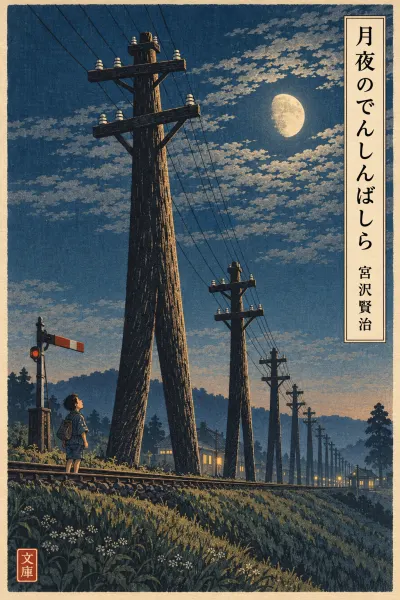
月夜のでんしんばしら is a short fantasy by Miyazawa Kenji in which ordinary railway scenery comes to life. One moonlit night a boy named Kyōichi is walking beside a railway line when a signal drops and the whole row of telegraph poles begins marching, singing a stiff old war song and mocking him as they pass. A strange little old man appears to drill them and claims great authority over everything electric. The tone is playful and slightly eerie: the narrator tells the story in warm, polite storybook Japanese, the poles hum and stomp in lively onomatopoeia, and the old man brags and barks orders. For a learner, the narration is the easier layer, with short scenes, a single setting and a small cast. The real challenge is the marching songs, which use classical literary grammar such as 〜なり, 〜たり, べき and などて〜べき in an old-fashioned military style. These verses are short and repetitive, so you can study them line by line with the notes. The old man's gruff plain speech offers a useful contrast with the narrator's polite voice.
Contents
Easier versions
This story is also retold in simpler Japanese. Reading an easier version first makes the original much more approachable.
Before you read
- Learn the onomatopoeia before you start. Words such as すたすた, ぐゎあん and the poles' marching sound ドッテテ carry much of the action and atmosphere, and they recur throughout.
- Treat the songs as a separate mini-text. Look for classical endings: 〜なり and 〜のごとくなり (≈ 〜だ / 〜のようだ), 〜たり and 〜たる as perfective forms (≈ 〜た / 〜ている), 〜なし (≈ 〜ない), and などて〜べき (a rhetorical 'why should…?'). Once you know these, the repeated verses become much easier.
- Notice the three voices. The narrator uses polite past forms (〜ました) and storyteller phrases like まるで〜ようにおもわれる. The poles sing in classical style. The old man uses blunt plain forms and drill commands, including the colloquial topic marker 〜ったら.
- Watch for 〜そうになる ('nearly does…') and 〜たら〜てしまったでしょう ('if…, it would surely have…'), which the narrator uses to describe Kyōichi's near-mishaps and reactions.
- Expect a lot of hiragana where you might expect kanji, beginning with でんしんばしら (電信柱) in the title. Read such words aloud to recognise them, and learn 電信 (telegraph), 信号 (signal), 停車場 (station) and 電燈 (electric light) early.
Words to know
The most useful words from the notes across the story.
| Word | Meaning | JLPT |
|---|---|---|
| 軍歌ぐんか | military song, war song | — |
| そびやかしてそびやかす | to square (one's shoulders) proudlydictionary form: そびやかすAlmost always used as 肩をそびやかす, a haughty posture. | — |
| うで木うでぎ | crossarm (of a pole)dictionary form: 腕木Literally 'arm wood'; the crossbars holding the wires and insulators. | — |
| 竜騎兵りゅうきへい | dragoon (mounted soldier)竜 dragon + 騎 riding + 兵 soldier. | — |
| 参ってもまいる | to give out, to collapse, to be beatendictionary form: 参るBesides the humble 'go/come', 参る also means 'to be worn out or defeated'. | N4 |
| 電報でんぽう | telegram電報をかける/打つ = to send a telegram. | N4 |
| 石こく | koku, an old unit of volume (about 180 litres)No English equivalent; read こく (not いし) as a measure of rice, oil, etc. | N4 |
| 気の毒きのどく | pitiful; feeling sorry for someone気の毒になる means 'to come to feel sorry (for someone)'. | N3 |
| 一種いっしゅ | a kind, a type〜の一種 = 'a kind of ~'. | N3 |
| 迷惑めいわく | trouble, nuisance, inconvenience迷惑する = to be put out by something. | N3 |
| 工夫こうふ | labourer, railway workerRead こうふ in this sense; the same kanji read くふう means 'device, contrivance'. | N2 |
| あいかわらずあいかわらず | as before, as usual, stilldictionary form: 相変わらず | N2 |
| 規律きりつ | discipline, order規律がいい = well disciplined. | N2 |
| たるむたるむ | to go slack, to sag | N1 |
| すたすたすたすた | briskly, at a quick steady paceOnomatopoeic adverb for walking quickly without looking around. | — |
Plot summary
Show the full summary (contains spoilers)
On a night lit by a nine-day-old moon, Kyōichi walks alone beside a railway line toward a station. A signal suddenly drops, and the humming telegraph poles start marching north, singing an old war song and sneering at him. Two tired poles stagger along arm in arm while a livelier one bullies them onward. A small, yellow-faced old man in a ragged grey coat appears and drills the poles with shouted commands. He offers Kyōichi a friendly handshake, but the boy receives a violent electric shock, which the old man dismisses as the weakest kind. The old man then boasts that he commands all electricity and tells silly stories about people who misunderstand telegraphs and electric lights. When a train approaches, he orders the poles to freeze, dives under the train to fix its lights, and the brightly lit carriages pull into the station.
About the author
Miyazawa Kenji was a poet and writer of children's stories from Hanamaki in Iwate Prefecture. He studied agricultural science in Morioka and later taught at an agricultural school. He devoted much of his life to helping local farmers improve their methods and their cultural lives. He was a devout Buddhist, and his faith, love of nature and interest in science run through his writing. His fame came after his death, with works such as 銀河鉄道の夜, 風の又三郎 and the poem 雨ニモマケズ.