Part 3 of 3 · JLPT N2
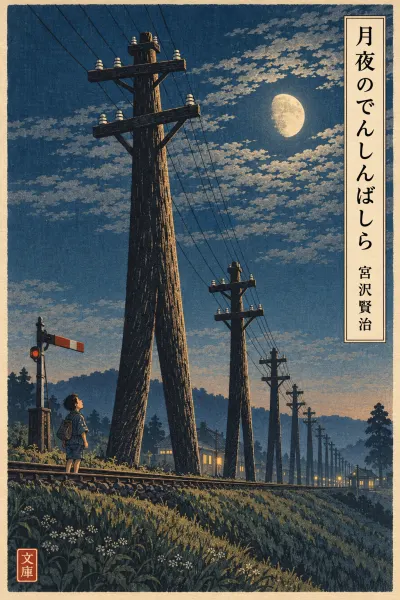
月夜のでんしんばしら Tsukiyo no Denshinbashira, part 3: The General of Electricity Halts His Army
In this part
The old man boasts that he is the commander of all electricity and tells silly stories about people who misunderstand telegraphs and electric lights. When a train approaches, he orders the marching telegraph poles to freeze. He then dives under the train to fix its lights, the carriages light up, and the train pulls into the station.
AI translation · independently checked
「おれは電気総長だよ。」"I'm the Supreme Chief of Electricity, that's who."
恭一も少し安心してKyōichi felt a little more at ease, and
「電気総長というのは、やはり電気の一種ですか。」とききました。asked, "This Supreme Chief of Electricity — is that a kind of electricity too?"
するとじいさんはまたむっとしてしまいました。At this the old man got huffy all over again.
「わからん子供だな。ただの電気ではないさ。つまり、電気のすべての長、長というのはかしらとよむ。とりもなおさず電気の大将ということだ。」"What a dim child you are! It's not just any old electricity. It means the chief of all electricity — and 'chief' you read as 'head.' In other words, it means the general of electricity."
「大将ならずいぶんおもしろいでしょう。」恭一がぼんやりたずねますと、じいさんは顔をまるでめちゃくちゃにしてよろこびました。"If you're a general, that must be a lot of fun," Kyōichi asked absently, and the old man screwed up his whole face with delight.
「はっはっは、面白いさ。それ、その工兵も、その竜騎兵も、向うのてき弾兵も、みんなおれの兵隊だからな。」"Ha ha ha, fun? Of course it's fun! Look — those engineers, those dragoons, those grenadiers over there, every one of them is my soldier, see!"
じいさんはぷっとすまして、片っ方の頬をふくらせてそらを仰ぎました。The old man put on a smug, prim look, puffed out one cheek, and gazed up at the sky.
それからちょうど前を通って行く一本のでんしんばしらに、Then, at a telegraph pole that happened to be passing right in front of him,
「こらこら、なぜわき見をするか。」とどなりました。he bellowed, "Hey, hey! What are you looking sideways for?"
するとそのはしらはまるで飛びあがるぐらいびっくりして、足がぐにゃんとまがりあわててまっすぐを向いてあるいて行きました。The pole got such a fright it nearly jumped into the air; its legs went all wobbly and bent, and it hurried on with its eyes fixed straight ahead.
次から次とどしどしはしらはやって来ます。One after another, the poles came tramping along.
「有名なはなしをおまえは知ってるだろう。そら、むすこが、エングランド、ロンドンにいて、おやじがスコットランド、カルクシャイヤにいた。むすこがおやじに電報をかけた、おれはちゃんと手帳へ書いておいたがね、」"You know the famous story, don't you? See, there was a son living in England, in London, and his father was in Scotland, in Calkshire. The son sent his father a telegram — I wrote it down properly in my notebook, mind you,"
じいさんは手帳を出して、それから大きなめがねを出してもっともらしく掛けてから、また云いました。The old man took out his notebook, then took out a big pair of spectacles and put them on with great solemnity before going on.
「おまえは英語はわかるかい、ね、センド、マイブーツ、インスタンテウリイすぐ長靴送れとこうだろう、するとカルクシャイヤのおやじめ、あわてくさっておれのでんしんのはりがねに長靴をぶらさげたよ。"Do you understand English, eh? 'Send my boots instantaneously' — that is, 'Send boots at once.' And what does that old fool of a father in Calkshire do? He flies into a flap and hangs a pair of boots on my telegraph wire!
はっはっは、いや迷惑したよ。それから英国ばかりじゃない、十二月ころ兵営へ行ってみると、おい、あかりをけしてこいと上等兵殿に云われて新兵が電燈をふっふっと吹いて消そうとしているのが毎年五人や六人はある。Ha ha ha, oh, what a nuisance that was! And it's not only Britain, either. Go to an army barracks around December, and every year there'll be five or six new recruits who are told by the Honourable Lance Corporal, 'Hey, go and put out the lights,' and try to blow out the electric lamps — puff, puff!
おれの兵隊にはそんなものは一人もないからな。おまえの町だってそうだ、はじめて電燈がついたころはみんながよく、電気会社では月に百石ぐらい油をつかうだろうかなんて云ったもんだ。Not one of my soldiers is like that, you know. And your town's no different — back when the electric lights first went on, everybody used to say things like, 'I wonder if the electric company burns about a hundred koku of oil a month.'
はっはっは、どうだ、もっともそれはおれのように勢力不滅の法則や熱力学第二則がわかるとあんまりおかしくもないがね、どうだ、ぼくの軍隊は規律がいいだろう。軍歌にもちゃんとそう云ってあるんだ。」Ha ha ha, how about that? Mind you, to someone like me who understands the Law of Conservation of Energy and the Second Law of Thermodynamics, it's not all that funny. Well, what do you say — my army's very well disciplined, isn't it? Even our marching song says so, plain as day."
でんしんばしらは、みんなまっすぐを向いて、すまし込んで通り過ぎながら一きわ声をはりあげて、The telegraph poles all faced straight ahead and, looking very prim and proper as they marched past, raised their voices louder than ever
「ドッテテドッテテ、ドッテテド"Dottete dottete, dottete do,
でんしんばしらのぐんたいのThe army of the telegraph poles —
その名せかいにとどろけり。」Its name doth thunder through the world!"
と叫びました。they shouted.
そのとき、線路の遠くに、小さな赤い二つの火が見えました。Just then, far down the line, two small red lights came into view.
するとじいさんはまるであわててしまいました。At this the old man fell into a complete panic.
「あ、いかん、汽車がきた。誰かに見附かったら大へんだ。もう進軍をやめなくちゃいかん。」"Oh, blast, here comes a train! It'll be a disaster if anyone spots us. We've got to stop marching right now."
じいさんは片手を高くあげて、でんしんばしらの列の方を向いて叫びました。The old man raised one hand high, turned toward the line of telegraph poles, and shouted,
「全軍、かたまれい、おいっ。」"Whole army — freeeeze! Hup!"
でんしんばしらはみんな、ぴったりとまって、すっかりふだんのとおりになりました。The telegraph poles all stopped dead and went back to being exactly as they always were.
軍歌はただのぐゎあんぐゎあんといううなりに変ってしまいました。The marching song turned into nothing but an ordinary humming — gwaan, gwaan.
汽車がごうとやってきました。With a roar, the train came on.
汽缶車の石炭はまっ赤に燃えて、そのまえで火夫は足をふんばって、まっ黒に立っていました。The coal in the locomotive was burning bright red, and in front of it the stoker stood with his legs planted firmly, a pitch-black figure.
ところが客車の窓がみんなまっくらでした。But the windows of the passenger carriages were all completely dark.
するとじいさんがいきなり、Then all of a sudden the old man
「おや、電燈が消えてるな。こいつはしまった。けしからん。」と云いながらまるで兎のようにせ中をまんまるにして走っている列車の下へもぐり込みました。said, "Well, now, the lights are out! Oh, this is bad. This won't do at all!" — and, curling his back up round like a rabbit, he dived underneath the moving train.
「あぶない。」と恭一がとめようとしたとき、客車の窓がぱっと明るくなって、一人の小さな子が手をあげてJust as Kyōichi cried "Look out!" and tried to stop him, the carriage windows suddenly blazed with light, and a little child raised a hand
「あかるくなった、わあい。」と叫んで行きました。and shouted, "The lights are on! Hooray!" as the train went by.
でんしんばしらはしずかにうなり、シグナルはがたりとあがって、月はまたうろこ雲のなかにはいりました。The telegraph poles hummed quietly, the signal rose with a clack, and the moon went back in among the mackerel clouds.
そして汽車は、もう停車場へ着いたようでした。And the train, it seemed, had already arrived at the station.
Vocabulary
| Word | Meaning | JLPT |
|---|---|---|
| 総長そうちょう | supreme chief, head of an entire organisation総 = 'all, overall' + 長 = 'head'; today used for university presidents or chiefs of staff. | — |
| 一種いっしゅ | a kind, a type〜の一種 = 'a kind of ~'. | N3 |
| むっとしてむっとする | to get sulky, take offencedictionary form: むっとするDescribes a sudden, visible flash of displeasure. | — |
| とりもなおさずとりもなおさず | in other words, that is to saydictionary form: 取りも直さずFormal, somewhat old-fashioned; here used pompously. | — |
| 大将たいしょう | general; boss, chiefAlso used jokingly for the leader of any group. | — |
| 竜騎兵りゅうきへい | dragoon (mounted soldier)Along with 工兵 (engineers) and 擲弾兵 (grenadiers), a European-style military rank the poles are dressed up as. | — |
| わき見わきみ | looking aside, letting one's eyes wanderわき = 'side'; common in わき見運転 'inattentive driving'. | — |
| 電報でんぽう | telegram電報をかける/打つ = to send a telegram. | N4 |
| 迷惑めいわく | trouble, nuisance, inconvenience迷惑する = to be put out by something. | N3 |
| 新兵しんぺい | new recruit新 'new' + 兵 'soldier'; compare 兵営 'barracks' in the same sentence. | — |
| 石こく | koku, an old unit of volume (about 180 litres)No English equivalent; read こく (not いし) as a measure of rice, oil, etc. | N4 |
| 規律きりつ | discipline, order規律がいい = well disciplined. | N2 |
| 進軍しんぐん | a march, an advance (of troops) | — |
| けしからんけしからん | outrageous, this won't doOld-fashioned, scolding tone typical of stern elderly men. | — |
Grammar
〜というのは N3 as for (the term) ~; what ~ means is
Picks out a word or idea as the topic in order to define or ask about it. Kyōichi uses it to ask what the strange title means, and the old man echoes it when explaining the kanji 長.
電気総長というのは、やはり電気の一種ですか。
This Supreme Chief of Electricity — is that a kind of electricity too?
〜なら N4 if (it is) ~
Takes what the other person has just said as a premise and comments on it. Here Kyōichi picks up the word 'general' and draws a conclusion from it.
大将ならずいぶんおもしろいでしょう。
If you're a general, that must be a lot of fun.
〜たもんだ N3 used to (do), would often (do)
Past tense + もの(もん)だ recalls a habit or common occurrence in the past, often with nostalgia. もん is the casual spoken form of もの.
電気会社では月に百石ぐらい油をつかうだろうかなんて云ったもんだ。
They used to say things like, 'I wonder if the electric company burns about a hundred koku of oil a month.'
〜けり N1 classical past / exclamatory ending
〜り (classical perfective/resultative auxiliary). It attaches to the e-row form of a four-row (yodan) verb: とどろく → とどろけ+り. It marks a completed action whose result continues, roughly 'has resounded' or 'is resounding'. The song uses it for a grand, old-fashioned military tone. This is not the auxiliary けり, which would attach to the 連用形 (とどろきけり). Example: その名せかいにとどろけり。 — Its name resounds throughout the world.
その名せかいにとどろけり。
Its name doth thunder through the world!
〜なくちゃいかん N4 must ~, have to ~
なくちゃ is a contraction of なくては, and いかん is the gruff colloquial form of いけない. Together they express strong obligation in casual speech.
もう進軍をやめなくちゃいかん。
We've got to stop marching right now.
〜ながら N4 while ~ing
Attached to a verb stem, it shows two actions done at the same time by the same subject. The old man talks and dives under the train in one motion.
「おや、電燈が消えてるな。こいつはしまった。けしからん。」と云いながら
while saying, "Well, now, the lights are out! Oh, this is bad. This won't do at all!"