 N3 · easy
Simplified retelling · JLPT N3
月夜のでんしんばしら Tsukiyo no Denshinbashira in easy Japanese (N3)
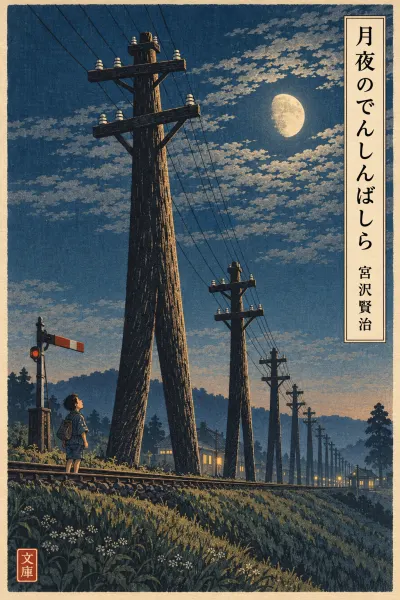
This is our own simplified retelling of The Night the Telegraph Poles Marched, written for N3 learners and checked word by word against the N3 vocabulary list. A few story words and grammar patterns go beyond N3; the notes below give each one's level. It keeps the characters, events and ending of the original. When it feels easy, move on to the original text.
The story in brief
One night Kyōichi walks beside the railway and sees the telegraph poles come alive and march north, singing an old army song, led by a small, bossy old man who calls himself the Supreme Commander of Electricity. The old man gives Kyōichi a shocking handshake and boasts about his disciplined soldiers. When a train comes, he halts the poles, then dives under the dark train, and its electric lights suddenly come on.
AI translation · independently checked
ある晩、きょういちという男の子が、きしゃのせんろの横の平らな所を歩いていました。One night, a boy named Kyōichi was walking along the flat ground beside the railway tracks.
本当は、そこを歩いてはだめです。Really, you are not supposed to walk there.
見つかったら、お金を払わなければなりません。If you are caught, you have to pay a fine.
きしゃの窓から長い物が出ていたら、とても危ないです。And if something long is sticking out of a train window, it is very dangerous.
でも、その晩は誰にも会いませんでした。But that night he did not meet anyone at all.
その代わりに、とても不思議なものを見たのです。Instead, he saw something very strange.
空には月が出ていました。The moon was out in the sky.
うろこぐもが空いっぱいに広がっていました。Mackerel clouds were spread all across the sky.
くもの間から、ときどき冷たいほしが光りました。Now and then, cold stars shone between the clouds.
きょういちは、遠くに駅の光が見える所まで来ました。Kyōichi came to a place where he could see the lights of a station far away.
赤い光や青い光が見えます。He could see red lights and blue lights.
目をほそくして見ると、大きなおしろのようでした。When he narrowed his eyes and looked, it was like a great castle.
とつぜん、右の方のシグナルが体を動かして、白い木を下の方へ向けました。Suddenly, the signal on the right moved its body and pointed its white wooden arm downward.
これは不思議ではありません。There was nothing strange about this.
一晩に十四回もあることです。It happens as many as fourteen times a night.
でも、その次が大変でした。But what came next was serious trouble.
せんろの左にならんでいたでんしんばしらが、みんないっしょに北の方へ歩き始めたのです。The telegraph poles lined up on the left of the tracks all began walking north together.
でんしんばしらはみんな、白いアクセサリーを付けて、ぼうしをかぶっていました。Every one of the telegraph poles wore white ornaments and had a cap on.
そして一本の足で、元気に歩いていきます。And off they went, walking briskly on one leg.
きょういちを見ると、ばかにしたように笑って通っていきました。When they saw Kyōichi, they laughed as if mocking him and passed on by.
でんしんばしらは、古いぐんたいの歌を歌っていました。The telegraph poles were singing an old army song.
「でんしんばしらのぐんたいは、世界でいちばん速いぐんたい。でんしんばしらのぐんたいは、世界でいちばんきそくを守るぐんたい。」"The army of the telegraph poles, the swiftest army in the world! The army of the telegraph poles, the army that best obeys the rules in all the world!"
向こうの方にも、別のでんしんばしらの列が、歌いながら進んでいきます。Farther off, too, another column of telegraph poles was marching on, singing as it went.
そのとき、二本のでんしんばしらが、おたがいに体を支えながら、つらそうに歩いてきました。Just then, two telegraph poles came walking along, propping each other up and looking miserable.
とても疲れたように頭をふって、今にも倒れそうでした。They shook their heads as if terribly tired and looked ready to fall over at any moment.
すると、後ろから来た元気なでんしんばしらが、大きな声で言いました。Then a lively telegraph pole coming up from behind shouted at them.
「おい、早く歩け。はりがねがのびてしまうじゃないか。」"Hey, walk faster! You'll stretch the wires, won't you!"
二本は言いました。The two of them said,
「もう疲れて歩けない。足の先がくさってきたんだ。」"We're too tired to walk any more. The tips of our feet have started to rot."
「早く歩け。一本がだめになったら、一万五千本みんなの責任なんだぞ。」"Walk faster! If even one pole fails, all fifteen thousand of us are to blame, you hear?"
二本は仕方がなく、また歩き始めました。The two had no choice, and they began walking again.
そして、遠くのはやしの方へ見えなくなりました。And they disappeared from sight toward a distant wood.
月がくもから出て、月の光が強くなりました。The moon came out from the clouds, and the moonlight grew stronger.
でんしんばしらは、みんなとてもうれしそうです。The telegraph poles all looked very happy.
きょういちの前に来ると、わざと背をのばしたり、笑ったりして通っていきました。When they came in front of Kyōichi, they made a show of stretching up tall or laughing as they passed by.
でんしんばしらは、川の水のように次から次へとやって来ます。The telegraph poles came on and on, one after another, like the water of a river.
きょういちは見ているだけで疲れてしまいました。Kyōichi grew tired just from watching them.
頭が痛くなって、だまって下を見ていました。His head began to ache, and he stood silently looking down.
すると、遠くから「一、二、一、二」という声が聞こえてきました。Then, from far away, he heard a voice calling, "One, two, one, two."
上を見ると、背のひくいおじいさんが来ます。When he looked up, a short old man was coming.
古いコートを着て、列を見ながら、大きな声で「一、二」と言っていました。He wore an old coat, and as he watched the column, he was calling out loudly, "One, two!"
おじいさんに見られたでんしんばしらは、かたくなって、まっすぐ前を見て進みました。Any telegraph pole the old man looked at went stiff and marched on, staring straight ahead.
おじいさんはきょういちの前まで来て、しばらくきょういちを見ました。The old man came right up to Kyōichi and looked at him for a while.
それから、でんしんばしらに「ふつうに歩け」と言いました。Then he said to the telegraph poles, "At ease, march normally!"
でんしんばしらは少し楽に歩きながら、また歌を歌いました。The telegraph poles walked a little more easily and began singing their song again.
おじいさんは体を少しまげて言いました。The old man bent forward a little and said,
「おまえは、さっきからわたしたちを見ていたのかい。」"So, you've been watching us all this while, have you?"
「ええ、見ていました。」"Yes, I have."
「そうか。じゃ、仕方がない。友だちになろう。さあ、あくしゅしよう。」"I see. Well then, nothing for it. We'll be friends. Come on, let's shake hands."
おじいさんは大きなきいろい手を出しました。The old man held out a big yellow hand.
きょういちも仕方がなく手を出しました。Kyōichi had no choice, and held out his hand too.
おじいさんが手をつかむと、おじいさんの目から青い光が出ました。When the old man gripped his hand, a blue light flashed from the old man's eyes.
きょういちの体に強い電気が走って、後ろに倒れそうになりました。A powerful electric shock ran through Kyōichi's body, and he almost fell over backward.
「ずいぶん強かったかね。でも、これはとてもよわいほうだよ。もう少し強くあくしゅしたら、おまえの体は全部やけてしまうよ。」"Pretty strong, eh? But that was one of the weak ones. If I shook hands a bit harder, your whole body would burn to a crisp."
きょういちはとても怖くなって、歯が鳴りました。Kyōichi grew very frightened, and his teeth chattered.
体もふるえていました。His body was shaking, too.
おじいさんはそれを見て、気のどくに思ったようです。The old man saw this and seemed to feel sorry for him.
少し静かに言いました。He spoke a little more quietly.
「わたしは電気そうちょうだよ。」"I am the Supreme Commander of Electricity."
きょういちは少し安心して聞きました。Kyōichi felt a little relieved and asked,
「電気そうちょうというのは、電気の一つですか。」"Is a Supreme Commander of Electricity a kind of electricity?"
おじいさんは、また怒ってしまいました。The old man got angry again.
「分からない子供だな。ただの電気ではない。電気の中で、いちばん上の人ということだ。」"What a dim child you are! I'm not just electricity. It means I'm the one at the very top of all electricity!"
「いちばん上の人なら、とても面白いでしょう。」"If you're the one at the very top, it must be great fun."
おじいさんは、とても喜びました。The old man was delighted.
「ああ、面白いさ。このでんしんばしらは、みんなわたしのへいたいだからな。」"Oh, it's fun all right! Every one of these telegraph poles is my soldier, you see."
それから、前を通るでんしんばしらに「こら、なぜ横を見るか」と大きな声で言いました。Then he bellowed at a telegraph pole passing in front of him, "You there! Why are you looking sideways?"
そのでんしんばしらはとてもびっくりして、まっすぐ前を向いて歩いていきました。That telegraph pole got a terrible fright and marched off, facing straight ahead.
おじいさんはノートとめがねを出して、話を始めました。The old man took out a notebook and a pair of glasses and began to tell a story.
「有名な話を知っているだろう。イギリスで、むすこがお父さんに電報を送った。『すぐに長靴を送ってください』とね。するとお父さんは、わたしのはりがねに長靴を掛けたんだよ。いや、困ったよ。」"You know the famous story, don't you? In England, a son sent his father a telegram: 'Please send me boots at once,' it said. And what does the father do? He hangs the boots on my wire! Well, what a nuisance that was!"
「それから、電気を口で吹いて消そうとする人も、毎年いる。でも、わたしのへいたいには、そんな者は一人もいない。どうだ、わたしのぐんたいは、きそくをよく守るだろう。」"And then every year there are people who try to blow out an electric light with their mouths. But among my soldiers there isn't a single one like that. Well? My army keeps the rules nicely, doesn't it?"
でんしんばしらはまっすぐ前を向いて、もっと大きな声で歌いました。The telegraph poles faced straight ahead and sang in even louder voices.
「でんしんばしらのぐんたいの、その名は世界に知られている。」"Oh, the army of the telegraph poles, its name is famed throughout the world!"
そのとき、せんろの遠くに、小さな赤い火が二つ見えました。Just then, two small red lights came into view far down the tracks.
おじいさんは急に困ってしまいました。The old man suddenly looked flustered.
「あ、だめだ。きしゃが来た。誰かに見つかったら大変だ。もう止めなければ。」"Oh, no good! The train's coming. It'll be a disaster if someone spots us. I'll have to halt them now."
おじいさんは手を高く上げて言いました。The old man raised his hand high and said,
「みんな、止まれ。」"Company, halt!"
でんしんばしらはみんなすっと止まって、いつものでんしんばしらにもどりました。The telegraph poles all stopped smoothly and turned back into ordinary telegraph poles.
歌も、ただの低い音に変わりました。Their song, too, changed into nothing but a low hum.
きしゃが大きな音を立てて来ました。The train came roaring along.
前の方では、火が赤くもえていました。At the front, a fire was burning red.
でも、きしゃの窓は、みんな暗いままでした。But the train's windows all stayed dark.
するとおじいさんは「おや、電気が消えている。これはだめだ」と言いました。Then the old man said, "Oh? The lights are out. This won't do!"
そして、うさぎのように背中をまるくして、走っているきしゃの下へ入っていきました。And curling his back like a rabbit, he slipped in underneath the moving train.
「危ない。」"Look out!"
きょういちが止めようとしたとき、きしゃの窓に急に電気がつきました。Just as Kyōichi tried to stop him, the lights in the train's windows suddenly came on.
小さな子供が手を上げて、「電気がついた」と喜んで言いました。A little child raised its hands and said happily, "The lights came on!"
でんしんばしらは静かに鳴っていました。The telegraph poles were humming quietly.
シグナルは、また上へ上がりました。The signal went back up again.
月はまたうろこぐもの中に入りました。The moon went back into the mackerel clouds.
そして、きしゃはもう駅に着いたようでした。And the train seemed to have already reached the station.
Vocabulary
| Word | Meaning | JLPT |
|---|---|---|
| 不思議ふしぎ | strange, mysteriousA na-adjective; 不思議なもの = a strange thing. | N3 |
| うろこぐもうろこぐも | mackerel clouds (small, scale-like clouds)dictionary form: 鱗雲うろこ means 'fish scales'; くも becomes ぐも by rendaku. | — |
| シグナルしぐなる | railway signalOld-fashioned loanword from English 'signal'; today 信号 is more common. | — |
| でんしんばしらでんしんばしら | telegraph poledictionary form: 電信柱電信 (telegraph) + 柱 (pillar); はしら becomes ばしら. Today often 電柱. | — |
| ばかにしたばかにする | to make fun of, to look down ondictionary form: ばかにする | — |
| ぐんたいぐんたい | army, troopsdictionary form: 軍隊 | N3 |
| きそくきそく | rules, regulationsdictionary form: 規則きそくを守る = to obey the rules. | N4 |
| 列れつ | line, column (of marchers) | N3 |
| 支えささえる | to support, to hold updictionary form: 支える | N3 |
| くさってくさる | to rotdictionary form: 腐る | N3 |
| 責任せきにん | responsibility, blame | N3 |
| 仕方がなくしかたがない | having no choice, reluctantlydictionary form: 仕方がないLiterally 'there is no way (to do otherwise)'. | — |
| あくしゅあくしゅ | handshakedictionary form: 握手あくしゅする = to shake hands. | N3 |
| 気のどくきのどく | pitiful; 気のどくに思う = to feel sorry fordictionary form: 気の毒 | N3 |
Grammar
〜なければなりません N4 must, have to
The negative conditional of a verb plus なりません expresses obligation. 払わなければなりません means 'you have to pay'.
見つかったら、お金を払わなければなりません。
If you are caught, you have to pay a fine.
今にも〜そうだ N3 look as if about to ~ at any moment
The verb stem plus そう describes how something looks about to happen; 今にも strengthens it to 'at any moment'.
今にも倒れそうでした。
They looked ready to fall over at any moment.
〜たように N3 as if ~, in a way that looks like ~
ように after a past-tense verb describes the manner of an action by comparison. Here it describes how the poles laughed.
ばかにしたように笑って通っていきました。
They laughed as if mocking him and passed on by.
〜たり〜たりする N4 do things like ~ and ~
Listing actions with the たり form shows examples of what someone does, not a complete list. Here the poles stretch up and laugh, among other things.
わざと背をのばしたり、笑ったりして通っていきました。
They made a show of stretching up tall or laughing as they passed by.
〜ようとする N3 try to ~, be about to ~
The volitional form plus とする means attempting an action. 消そうとする人 means 'people who try to blow it out'.
電気を口で吹いて消そうとする人も、毎年いる。
Every year there are people who try to blow out an electric light with their mouths.
〜てしまうじゃないか N3 you'll end up ~, won't you!
てしまう marks an unwanted result, and じゃないか turns it into a rough, scolding appeal to the listener.
はりがねがのびてしまうじゃないか。
You'll stretch the wires, won't you!