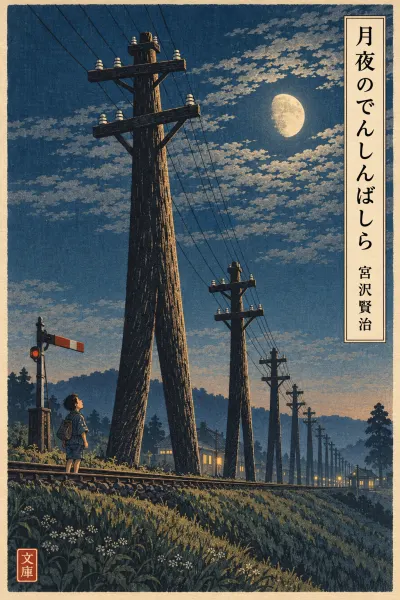
 N5 · easy
Simplified retelling · JLPT N5
月夜のでんしんばしら Tsukiyo no Denshinbashira in easy Japanese (N5)
This is our own simplified retelling of The Night the Telegraph Poles Marched, written for N5 learners and checked word by word against the N5 vocabulary list. A few story words and grammar patterns go beyond N5; the notes below give each one's level. It keeps the characters, events and ending of the original. When it feels easy, move on to the N4 version or the original text.
The story in brief
One moonlit night, Kyōichi watches the telegraph poles beside the railway line march north, singing as they go. A little old man in an old coat arrives, shakes Kyōichi's hand with an electric shock, and says he is the chief of all electricity and the poles are his soldiers. When a train comes, the poles stand still again, and the old man dives under the train to switch its dark lights back on.
AI translation · independently checked
ある ばん、きょういちは せんろの よこを あるいて いました。One night, Kyōichi was walking beside the railway line.
そらには 月が 出て いました。The moon was out in the sky.
前の ほうに、えきの 電気が きれいに ありました。Up ahead, the station lights were shining beautifully.
すると、せんろの 左の でんしんばしらが、みんな あるいて、北へ 行きました。Then all the telegraph poles on the left of the line started walking, and off they went to the north.
でんしんばしらは 一本の あしで あるきます。Telegraph poles walk on one leg.
そして、大きな こえで うたを うたいます。And they sing a song in loud voices.
「わたしたちは いちばん はやい。いちばん りっぱだ。」"We are the fastest of all! We are the finest of all!"
でんしんばしらは、きょういちを 見て わらいながら 行きます。The telegraph poles looked at Kyōichi and laughed as they marched along.
二本の でんしんばしらが つかれて いました。Two of the telegraph poles were tired.
「もう あしが いたいよ。」"Oh, my leg hurts already!"
後ろの でんしんばしらが 大きな こえで いいました。A telegraph pole behind them spoke up in a loud voice.
「はやく あるいて。わたしたちは はりがねで みんな いっしょだよ。」"Hurry up and walk! The wires tie us all together, you know!"
二本は また あるいて 行きました。The two poles started walking again.
でんしんばしらは つぎから つぎへ 来ます。The telegraph poles came on, one after another.
きょういちは つかれて、あたまが いたく なりました。Kyōichi grew tired, and his head began to ache.
すると、ふるい コートを きた 小さい おじいさんが 来ました。Just then, a little old man in an old coat came along.
おじいさんは 「一、二、一、二。」と いいながら、でんしんばしらを 見て いました。The old man was watching the telegraph poles and counting, "One, two, one, two!"
おじいさんは きょういちの 前で とまりました。The old man stopped in front of Kyōichi.
「こんばんは。きみは 見て いましたか。」"Good evening. Were you watching, then?"
「はい、見て いました。」"Yes, I was watching."
「じゃあ、友だちに なりましょう。あくしゅを しましょう。」"Well then, let's be friends. Let's shake hands on it!"
おじいさんは 大きな きいろい てを 出しました。The old man held out a big yellow hand.
きょういちも てを 出しました。Kyōichi held out his hand too.
すると、おじいさんの めが パチパチと 青く なりました。Then the old man's eyes crackled and flashed blue.
きょういちの からだに 電気が 入りました。Electricity went into Kyōichi's body.
とても いたかったです。It hurt very much.
「これは とても よわい 電気ですよ。」"That's only very weak electricity, you know!"
きょういちの はが ガチガチと いいました。Kyōichi's teeth went clack-clack-clack.
おじいさんは やさしく いいました。The old man spoke kindly.
「わたしは でんきそうちょうです。電気の いちばん 上の 人ですよ。」"I am the Commander-in-Chief of Electricity. The very top man in all of electricity, that's me!"
「それは おもしろいですか。」"Is that fun?"
「はい、おもしろいよ。でんしんばしらは みんな わたしの へいたいですからね。」"Oh yes, it's fun! All the telegraph poles are my soldiers, after all!"
おじいさんは 外国の 話も しました。The old man also told a story about a foreign country.
「子どもが 遠い まちの お父さんに でんぽうを 出しました。『すぐ 長い くつを ください。』 お父さんは わたしの はりがねに くつを かけましたよ。ははは。」"A boy sent a telegram to his father in a faraway town: 'Please send long boots at once.' And his father hung the boots on my wire! Ha ha ha!"
その 後、遠い ところに、きしゃの 赤い 電気が 二つ 出ました。After that, far away, the two red lights of a train appeared.
「あ、きしゃが 来ました。みんな、とまって ください!」"Ah, here comes a train! Everyone, halt!"
でんしんばしらは みんな とまって、いつもの でんしんばしらに なりました。All the telegraph poles stopped and became ordinary telegraph poles again.
うたも ありません。There was no more singing.
小さい こえで 「ゴーン、ゴーン。」と いって いるだけです。They only hummed softly, "Gong, gong."
きしゃが 来ました。The train came.
でも、まどが みんな くらかったです。But all its windows were dark.
「あ、電気が きえて いる!」"Oh no, the lights are out!"
おじいさんは そう いって、はしって いる きしゃの 下に 入りました。With that, the old man dived under the moving train.
「あぶない!」と きょういちが いいました。"Look out!" cried Kyōichi.
すると、まどが あかるく なりました。Then the windows lit up.
小さい 男の子が てを 上げて、「あかるく なった!」と いいました。A little boy raised his hands and shouted, "The lights came on!"
月は また くもの 中に 入りました。The moon went back behind the clouds.
きしゃは もう えきに ついたでしょう。By now the train has probably reached the station.
Vocabulary
| Word | Meaning | JLPT |
|---|---|---|
| せんろせんろ | railway line, railway trackdictionary form: 線路 | N2 |
| でんしんばしらでんしんばしら | telegraph poledictionary form: 電信柱From 電信 (telegraph) + 柱 (pillar); はしら becomes ばしら in the compound. Today it is also used for any utility pole. | — |
| りっぱりっぱ | fine, splendid, granddictionary form: 立派A な-adjective. | N5 |
| つかれてつかれる | to get tireddictionary form: 疲れるつかれています means 'is tired' (a state that results from getting tired). | N5 |
| はりがねはりがね | wiredictionary form: 針金Literally 'needle metal'. Here it means the telegraph wires joining the poles. | N2 |
| あくしゅあくしゅ | handshakedictionary form: 握手あくしゅをする means 'to shake hands'. | N3 |
| へいたいへいたい | soldier(s)dictionary form: 兵隊 | N2 |
| でんぽうでんぽう | telegramdictionary form: 電報でんぽうを出す means 'to send a telegram'. | N4 |
| きしゃきしゃ | steam traindictionary form: 汽車An old-fashioned word. Modern Japanese usually says 電車 or 列車. | N4 |
| とまってとまる | to stop, to haltdictionary form: 止まる | N5 |
| くらかったくらい | darkdictionary form: 暗いOpposite: あかるい (bright). | N5 |
| きえてきえる | to go out (of a light), to disappeardictionary form: 消えるきえている means 'is out, is off'. | N5 |
| あぶないあぶない | dangerous; Look out!dictionary form: 危ないOn its own it works as a warning shout. | N5 |
Grammar
〜ながら N4 while doing ~
Add ながら to the verb's ます-stem to show two actions happening at the same time. The main action comes at the end of the sentence. Here the poles laugh while they keep walking.
でんしんばしらは、きょういちを 見て わらいながら 行きます。
The telegraph poles looked at Kyōichi and laughed as they marched along.
い-adjective(〜く)+ なる N5 to become ~
Change the final い of an い-adjective to く and add なる to say that something becomes that way. いたい becomes いたくなる, 'to start to hurt'.
きょういちは つかれて、あたまが いたく なりました。
Kyōichi grew tired, and his head began to ache.
〜ましょう N5 let's ~
Change ます to ましょう to suggest doing something together. In 友だちになりましょう, なる after に means 'become'.
じゃあ、友だちに なりましょう。あくしゅを しましょう。
Well then, let's be friends. Let's shake hands on it!
〜から(reason) N5 because ~
から after a sentence gives the reason. Here it comes after the main idea, おもしろい, and explains why: the poles are his soldiers. The ね at the end adds a friendly 'you see'.
でんしんばしらは みんな わたしの へいたいですからね。
All the telegraph poles are my soldiers, after all!
〜だけ N5 only, just
だけ limits something to just that. ているだけです means 'they are only doing ~ and nothing else'.
小さい こえで 「ゴーン、ゴーン。」と いって いるだけです。
They only hummed softly, "Gong, gong."
〜でしょう N5 probably ~
でしょう after a plain-form verb shows that the speaker is guessing. Here the narrator guesses that the train has reached the station.
きしゃは もう えきに ついたでしょう。
By now the train has probably reached the station.