 N4 · easy
Simplified retelling · JLPT N4
月夜のでんしんばしら Tsukiyo no Denshinbashira in easy Japanese (N4)
This is our own simplified retelling of The Night the Telegraph Poles Marched, written for N4 learners and checked word by word against the N4 vocabulary list. A few story words and grammar patterns go beyond N4; the notes below give each one's level. It keeps the characters, events and ending of the original. When it feels easy, move on to the N3 version or the original text.
The story in brief
On a moonlit night, Kyōichi watches the telegraph poles beside the railway line start marching north, singing as they go. A small old man who calls himself the Electricity Commander-in-Chief gives Kyōichi an electric handshake, shouts orders at the poles, and tells funny stories about people who do not understand electricity. When a train comes, the poles freeze, and the old man slips under the train to switch its lights back on.
AI translation · independently checked
あるばん、きょういちはせんろのよこを歩いていました。One night, Kyōichi was walking beside the railway line.
空には月が出ていて、くもがたくさんありました。The moon was out in the sky, and there were lots of clouds.
向こうに駅のひかりが見えました。Over in the distance he could see the lights of the station.
赤いひかりや青いひかりがあって、とてもきれいでした。There were red lights and blue lights, and they were very pretty.
すると、右のシグナルがきゅうに動きました。Then the signal on the right suddenly moved.
シグナルの白い木が、下のほうへ動いたのです。The signal's white wooden arm had dropped downward.
これは毎ばんあることです。This happens every night.
でも、そのつぎが大へんでした。But what happened next was really something.
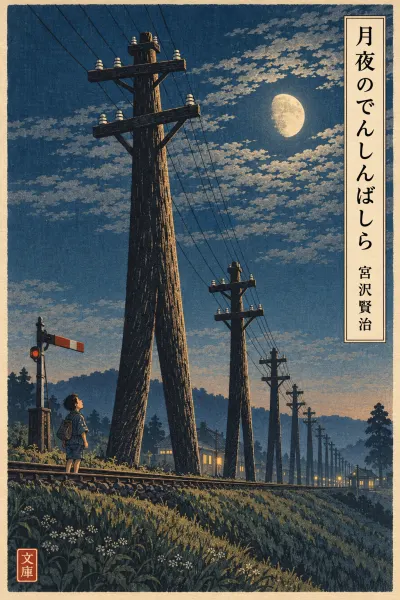
線路の左にならんでいたでんしんばしらが、みんな北のほうへ歩き始めたのです。The telegraph poles that stood in a row to the left of the track all began to walk off toward the north.
足は一つですが、上手にすすみます。They have only one leg each, but they march along very nicely.
そして、きょういちを見て、わらいながら通っていきます。And as they passed, they looked at Kyōichi and laughed.
でんしんばしらは、大きなこえで歌を歌っていました。The telegraph poles were singing a song in loud voices.
「ドッテテドッテテ、ドッテテド、"Dottete-dottete, dottete-do,
でんしんばしらのへいたいは、We soldiers of the telegraph poles
世界でいちばんはやいぞ。」Are swiftest in all the world, ho!"
向こうにも、ほかのでんしんばしらのへいたいがいました。Over on the other side, there were more telegraph-pole soldiers too.
同じように歌いながら、すすんでいました。They were marching along, singing in just the same way.
二つのでんしんばしらが、とてもつかれて歩いてきました。Two of the telegraph poles came walking along, terribly tired.
今にもたおれそうです。They looked as if they might fall over at any moment.
うしろのでんしんばしらが、大きなこえでいいました。The pole behind them said in a loud voice,
「早く歩け。はりがねがだめになるぞ。」"Walk faster! You'll ruin the wires!"
「もうつかれて歩けないよ。足がわるくなったんだ。」"We're too tired to walk any more. Our legs have gone bad."
「歩け、歩け。一人が止まると、みんながこまるんだ。」"Walk! Walk! If one of us stops, everybody's in trouble!"
二人は、また歩き始めました。The two of them started walking again.
月がくもから出て、あたりが明るくなりました。The moon came out from the clouds, and everything around grew bright.
でんしんばしらは、みんなとても楽しそうです。The telegraph poles all looked very happy.
でんしんばしらは、川の水のように、つぎからつぎへと来ます。Like the water in a river, the telegraph poles kept coming, one after another.
きょういちは見ているだけでつかれて、下を見ていました。Kyōichi grew tired just from watching, and he looked down at the ground.
すると、とおくから「いち、に、いち、に」というこえが聞こえてきました。Then, from far away, he heard a voice calling, "One, two, one, two."
上を見ると、せのひくい小さなおじいさんが来ました。When he looked up, a short little old man was coming his way.
古くてきたないコートを着ています。He was wearing an old, dirty coat.
おじいさんに見られたでんしんばしらは、まっすぐ前を見て、まじめに歩きます。Any telegraph pole the old man looked at stared straight ahead and marched along properly.
おじいさんは、きょういちの前で止まりました。The old man stopped in front of Kyōichi.
「きみは、さっきから見ていたのかい。」"Have you been watching all this time?"
「はい、見ていました。」"Yes, I've been watching."
「そうか。じゃあ、友だちになろう。さあ、あくしゅしよう。」"That so? Well then, let's be friends. Come on, shake hands!"
おじいさんは、大きなきいろい手を出しました。The old man held out a big yellow hand.
きょういちも手を出しました。Kyōichi held out his hand too.
すると、おじいさんの目から青いひかりが出ました。Then a blue light flashed from the old man's eyes.
きょういちの体に、強い電気が走りました。A strong electric shock ran through Kyōichi's body.
きょういちは、うしろにたおれそうになりました。Kyōichi nearly fell over backward.
「これでも、いちばんよわいほうだよ。もっと強くしたら、きみは黒くなってしまうよ。」"And that's the weakest I've got! Any stronger and you'd end up burnt black!"
きょういちはとてもこわくなって、何もいえませんでした。Kyōichi was so frightened that he couldn't say a thing.
おじいさんは、少しやさしくいいました。The old man spoke a little more gently.
「わたしは、でんきそうちょうだよ。」"I'm the Electricity Commander-in-Chief, I am."
「でんきそうちょうも、電気なんですか。」"Is an Electricity Commander-in-Chief made of electricity too?"
「わからない子だな。電気のへいたいの、いちばん上の人だ。」"Slow, aren't you? I'm the very top man of the electric soldiers!"
「それは、おもしろいでしょう。」"That must be fun."
おじいさんは、とてもよろこびました。The old man was very pleased.
「おもしろいよ。このでんしんばしらは、みんなわたしのへいたいだからな。」"Fun? You bet it is! Every one of these telegraph poles is my soldier, see!"
そして、前を通るでんしんばしらに「前を見て歩け。」と大きなこえを出しました。Then he bellowed at the telegraph poles passing in front of him: "Eyes front as you march!"
でんしんばしらはびっくりして、まっすぐ前を見て歩いていきました。The poles jumped in surprise and marched on, looking straight ahead.
おじいさんは、おもしろい話もしました。The old man also told some funny stories.
「外国で、むすこがお父さんに電報をうった。『くつをすぐに送れ。』とね。するとお父さんは、わたしのはりがねに、くつを下げたんだよ。それから、電気を口でふいてけそうとする人も、毎年いる。でも、わたしのへいたいには、そんな人は一人もいないよ。」"Over in a foreign country, a son sent his father a telegram: 'Send boots at once.' Just like that. And what does the father do? Hangs the boots on my wire! And every year there are folks who try to blow the electric light out with their mouths. But among my soldiers, there's not a single one like that!"
でんしんばしらは、もっと大きなこえで歌いました。The telegraph poles sang even louder.
「ドッテテドッテテ、ドッテテド、"Dottete-dottete, dottete-do,
でんしんばしらのへいたいのThe name of the telegraph-pole soldiers
名前は世界で有名だ。」Is famed throughout the world, ho!"
すると、せんろのとおくに、小さな赤い火が二つ見えました。Then, far down the line, two small red lights came into view.
おじいさんは、とてもこまりました。The old man was very troubled.
「あ、きしゃが来た。人に見つかったら大へんだ。」"Ah, a train's coming! If people spot us, we're done for!"
おじいさんは手を高く上げて、大きなこえでいいました。The old man raised his hand high and shouted,
「みんな、止まれ。」"All of you — halt!"
でんしんばしらはみんな止まって、いつものでんしんばしらになりました。The poles all stopped and became ordinary telegraph poles again.
歌は、風の音のようにかわりました。Their song changed into something like the sound of the wind.
きしゃが来ました。The train came.
でも、きしゃのまどは、みんなくらかったです。But the train's windows were all dark.
「おや、電気がきえているな。これはだめだ。」"Well, now, the lights are out. This won't do."
おじいさんはそういって、走るきしゃの下に入っていきました。With that, the old man went in under the moving train.
「あぶない。」"Look out!"
きょういちがそういうと、きしゃのまどがきゅうに明るくなりました。Just as Kyōichi said that, the train's windows suddenly lit up.
小さな子どもが手を上げて、A small child raised his hands
「明るくなった。わあい。」"It's bright again! Hooray!"
といって、通っていきました。and said that as he went by.
でんしんばしらはしずかになっていて、シグナルはまた上がりました。The telegraph poles had gone quiet, and the signal rose again.
月は、またくもの中に入りました。The moon went back in among the clouds.
きしゃは、もう駅に着いたようでした。It seemed the train had already reached the station.
Vocabulary
| Word | Meaning | JLPT |
|---|---|---|
| せんろせんろ | railway line, railway trackdictionary form: 線路Written 線路 later in the passage; 線 = line, 路 = road. | N2 |
| シグナルしぐなる | railway signalFrom English 'signal'; here an old signal with a wooden arm that moves up and down. | — |
| でんしんばしらでんしんばしら | telegraph poledictionary form: 電信柱電信 (telegraph) + 柱 (pole); 柱 はしら becomes ばしら by rendaku. | — |
| へいたいへいたい | soldier(s)dictionary form: 兵隊The poles march like a line of soldiers. | N2 |
| つかれてつかれる | to get tireddictionary form: 疲れる | N5 |
| たおれそうたおれる | to fall over, to collapsedictionary form: 倒れる | N4 |
| はりがねはりがね | wiredictionary form: 針金Here, the telegraph wires strung between the poles. | N2 |
| あくしゅあくしゅ | handshakedictionary form: 握手Used with する: あくしゅする = to shake hands. | N3 |
| 電気でんき | electricity; electric lightMeans both 'electricity' and 'the (electric) light', as in 電気がきえている. | N5 |
| でんきそうちょうでんきそうちょう | Electricity Commander-in-Chiefdictionary form: 電気総長総長 is a title for the head of a whole organisation; the old man invents a grand military rank for himself. | — |
| 電報でんぽう | telegramTo send a telegram is 電報をうつ (打つ). | N4 |
| 下げたさげる | to hang (something) from; to lowerdictionary form: 下げる | N4 |
| きしゃきしゃ | steam traindictionary form: 汽車汽 = steam; the older word for a train pulled by a steam engine. | N4 |
| きえてきえる | to go out (of a light), to disappeardictionary form: 消えるIntransitive; the transitive partner is 消す けす 'to put out', as in けそうとする. | N5 |
Grammar
〜始める N4 to begin doing
Attach 始める to the masu-stem of a verb to say that an action starts. 歩く → 歩き始める 'begin to walk'.
みんな北のほうへ歩き始めたのです。
They all began to walk off toward the north.
〜ながら N4 while doing
Masu-stem + ながら shows two actions done at the same time by the same subject; the main action comes last. Here the poles march and sing at once.
同じように歌いながら、すすんでいました。
They were marching along, singing in just the same way.
〜そう (looks like it will…) N4 looks as if it is about to…
Masu-stem + そう describes what seems about to happen, based on how things look. 今にも adds 'at any moment'.
今にもたおれそうです。
They looked as if they might fall over at any moment.
〜と (whenever / if) N4 if / when A happens, B (naturally) follows
Plain present form + と links a condition to a result that always or automatically follows. One pole stopping always causes trouble for everyone.
一人が止まると、みんながこまるんだ。
If one of us stops, everybody's in trouble!
〜てしまう N4 to end up doing; something regrettable happens
Te-form + しまう shows that a result is complete and usually unwanted. The old man warns that a stronger shock would turn Kyōichi black.
もっと強くしたら、きみは黒くなってしまうよ。
Any stronger and you'd end up burnt black!
〜(よ)うとする N3 to try to do; to attempt
Volitional form + とする means to try to do something (or to be about to do it). けす → けそう + とする: these people try to blow out an electric light, which is a humorous mistake, since an electric light can't be blown out.
電気を口でふいてけそうとする人も、毎年いる。
And every year there are folks who try to blow the electric light out with their mouths.