Part 1 of 3 · JLPT N3
月夜とめがね Tsukiyo to Megane, part 1: A Spectacle-Seller at the Window
In this part
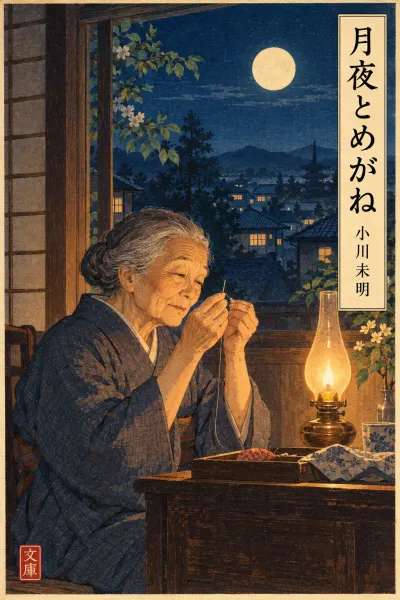
On a calm moonlit night when town and fields alike are wrapped in green leaves, an old woman sits alone sewing by lamplight, struggling to thread her needle because her eyes have grown dim. Someone taps at her door and then calls to her from under the window, and she finds a short, bearded man in dark glasses who says he sells spectacles. She asks for a pair that will suit her eyes, and he takes a large tortoiseshell-rimmed pair from his box and hands it to her.
AI translation · independently checked
町も、野も、いたるところ、緑の葉につつまれているころでありました。It was the time of year when the town and the fields alike, everywhere you looked, were wrapped in green leaves.
おだやかな、月のいい晩のことであります。It happened on a mild evening with a lovely moon.
しずかな町のはずれにおばあさんは住んでいましたが、おばあさんは、ただひとり、窓の下にすわって、針しごとをしていました。An old woman lived on the edge of a quiet town, and she sat all alone beneath her window, doing her needlework.
ランプの火が、あたりを平和に照らしていました。The light of the lamp shone peacefully on everything around her.
おばあさんは、もういい年でありましたから、目がかすんで、針のめどによく糸が通らないので、ランプの火に、いくたびも、すかしてながめたり、また、しわのよった指さきで、ほそい糸をよったりしていました。The old woman was well on in years, and her eyes had grown dim, so the thread would not go easily through the eye of the needle. Again and again she held it up against the lamplight to peer at it, or twisted the thin thread between her wrinkled fingertips.
月の光は、うす青く、この世界を照らしていました。The moonlight shone a pale blue over this world.
なまあたたかな水の中に、木立も、家も、丘も、みんなひたされたようであります。It was as though the trees, the houses and the hills had all been steeped in lukewarm water.
おばあさんは、こうしてしごとをしながら、自分のわかいじぶんのことや、また、遠方のしんせきのことや、はなれてくらしている孫娘のことなどを、空想していたのであります。As she went on with her work, the old woman was daydreaming about the days when she was young, about her relatives far away, and about her granddaughter, who lived apart from her.
目ざまし時計の音が、カタ、コト、カタ、コトとたなの上できざんでいる音がするばかりで、あたりはしんとしずまっていました。The only sound was the alarm clock on the shelf ticking away, tick, tock, tick, tock, and all around her was perfectly still.
ときどき町の人通りのたくさんな、にぎやかな巷の方から、なにか物売りの声や、また、汽車の行く音のような、かすかなとどろきがきこえてくるばかりであります。Now and then, from the busy, crowded streets of the town, there came only the voice of some street seller, or a faint rumble like the sound of a passing train.
おばあさんは、いま自分はどこにどうしているのかすら、思いだせないように、ぼんやりとして、ゆめをみるようにおだやかな気持ですわっていました。The old woman sat there dreamily, as if she could not even remember where she was or what she was doing, in a mood as peaceful as a dream.
このとき、外の戸をコト、コトたたく音がしました。Just then there came a sound of tapping, tap, tap, on the outer door.
おばあさんは、だいぶ遠くなった耳を、その音のする方にかたむけました。The old woman turned her ears, which had grown rather hard of hearing, toward the sound.
いまじぶん、だれもたずねてくるはずがないからです。For no one could possibly be coming to call at this hour.
きっとこれは、風の音だろうと思いました。Surely it was only the sound of the wind, she thought.
風は、こうして、あてもなく野原や、町を通るのであります。The wind, after all, wanders aimlessly like this over the fields and through the town.
すると、こんどは、すぐ窓の下に、小さな足音がしました。Then, this time, there was the sound of small footsteps right below the window.
おばあさんは、いつもににず、それをききつけました。Unlike her usual self, the old woman caught the sound.
「おばあさん、おばあさん。」と、だれかよぶのであります。"Grandmother, Grandmother," someone was calling.
おばあさんは、さいしょは、自分の耳のせいではないかと思いました。At first the old woman wondered whether it was just her ears playing tricks on her.
そして、手を動かすのをやめていました。And she stopped moving her hands.
「おばあさん、窓をあけてください。」と、また、だれかいいました。"Grandmother, please open the window," someone said again.
おばあさんは、だれが、そういうのだろうと思って、立って、窓の戸をあけました。Wondering who could be saying such a thing, the old woman stood up and opened the window shutter.
外は、青白い月の光が、あたりをひるまのように、明るく照らしているのであります。Outside, the pale moonlight was lighting everything up as brightly as in the daytime.
まどの下には、背のあまり高くない男が立って、上をむいていました。Beneath the window stood a man, not very tall, looking up.
男は、黒いめがねをかけて、ひげがありました。The man wore dark glasses and had a beard.
「私はおまえさんを知らないが、だれですか。」と、おばあさんはいいました。"I don't know you. Who are you?" said the old woman.
おばあさんは、見しらない男の顔を見て、この人はどこか家をまちがえてたずねてきたのではないかと思いました。Looking at the stranger's face, the old woman thought he must have come calling at the wrong house.
「私は、めがね売りです。いろいろなめがねをたくさん持っています。この町へは、はじめてですが、じつに気持のいいきれいな町です。今夜は月がいいから、こうして売って歩くのです。」と、その男はいいました。"I am a seller of spectacles. I carry a great many spectacles of every kind. This is my first time in this town, but it is truly a pleasant and pretty town. The moon is so fine tonight that I am going about like this, selling my wares," said the man.
おばあさんは、目がかすんで、よく針のめどに、糸が通らないでこまっていたやさきでありましたから、The old woman had just been fretting because her eyes were dim and the thread would not go properly through the eye of the needle, so
「私の目にあうような、よく見えるめがねはありますかい。」と、おばあさんはたずねました。"Have you got a pair of spectacles that would suit my eyes and let me see well?" she asked.
男は手にぶらさげていた箱のふたをひらきました。The man opened the lid of the box he had been carrying in his hand.
そして、その中から、おばあさんにむくようなめがねをよっていましたが、やがて、一つのべっこうぶちの大きなめがねを取り出して、これを、窓から顔を出したおばあさんの手にわたしました。Then he sorted through it for spectacles that might suit the old woman, and before long he took out one large pair with tortoiseshell rims and handed it to the old woman, who had put her head out of the window.
Vocabulary
| Word | Meaning | JLPT |
|---|---|---|
| いたるところいたるところ | everywhere, all overdictionary form: 至る所Often written 至る所; literally 'every place one reaches'. | — |
| つつまれてつつむ | to wrap, to cover (here passive: to be wrapped in)dictionary form: 包むCommonly used figuratively: 緑に包まれる, 霧に包まれる. | N4 |
| はずれはずれ | outskirts, edge (of a town)dictionary form: 外れ町のはずれ = the edge of town; also 'a miss / blank' in a lottery. | — |
| かすんでかすむ | to grow dim, blurry (of eyesight)dictionary form: 霞むAlso used for mist or haze over a landscape. | N1 |
| めどめど | eye of a needledictionary form: 針孔Today usually 針の穴; めど also means 'prospect, aim' (目処). | — |
| すかしてすかす | to hold up against the light to look throughdictionary form: 透かす | — |
| 空想くうそう | daydreaming, imagining空 'empty' + 想 'thought'. | N2 |
| しんとしんと | (utterly) silent, hushedMimetic word for deep silence, often with しずまる. | — |
| 巷ちまた | streets, town quarter where people gatherLiterary word; also 'the world at large' (巷の噂 = street gossip). | — |
| とどろきとどろき | rumble, roardictionary form: 轟きFrom 轟く 'to roar, to rumble'. | — |
| かたむけましたかたむける | to tilt, to turn (one's ear) towarddictionary form: 傾ける耳を傾ける = to listen attentively. | N1 |
| ききつけましたききつける | to catch (a sound), to hear and noticedictionary form: 聞きつける | — |
| やさきやさき | just when, at the very momentdictionary form: 矢先〜ていたやさき = right when one was doing/feeling something. Literally 'arrowhead'. | — |
| べっこうぶちべっこうぶち | tortoiseshell rims (of glasses)dictionary form: 鼈甲縁べっこう = tortoiseshell + ふち 'rim' with rendaku → ぶち. | — |
Grammar
〜であります N1 is (formal, old-fashioned narration)
A very formal, old-fashioned equivalent of です, used here by the storyteller to give the narration a gentle, oral, fairy-tale tone. 〜のであります adds an explanatory nuance.
おだやかな、月のいい晩のことであります。
It happened on a mild evening with a lovely moon.
〜たり〜たりする N4 doing things such as A and B
Lists representative actions done repeatedly or alternately. Here it shows the old woman alternately peering at the needle and twisting the thread.
ランプの火に、いくたびも、すかしてながめたり、また、しわのよった指さきで、ほそい糸をよったりしていました
Again and again she held it up against the lamplight to peer at it, or twisted the thin thread between her wrinkled fingertips.
〜ばかりで N3 nothing but, only
After a verb, ばかり stresses that this is the only thing happening. The ticking clock is the only sound, which emphasises the silence.
カタ、コト、カタ、コトとたなの上できざんでいる音がするばかりで、あたりはしんとしずまっていました
The only sound was the alarm clock on the shelf ticking away, tick, tock, tick, tock, and all around her was perfectly still.
〜はずがない N3 there is no way that…, cannot possibly
Expresses the speaker's strong conviction that something is impossible based on reasoning. The old woman is sure no visitor would come so late. からです gives this as the reason for her listening.
いまじぶん、だれもたずねてくるはずがないからです。
For no one could possibly be coming to call at this hour.
〜ではないかと思う N3 to wonder whether…, to suspect that…
A softened way of stating a guess: literally 'I think, isn't it…?'. Here the old woman suspects her ears are deceiving her.
自分の耳のせいではないかと思いました
She wondered whether it was just her ears playing tricks on her.