Intermediate · JLPT N3
月夜とめがねTsukiyo to Megane — Glasses by Moonlight
- JLPT N3
- 3,745 characters
- 3 parts
- about 31 minutes
- 2 easier versions
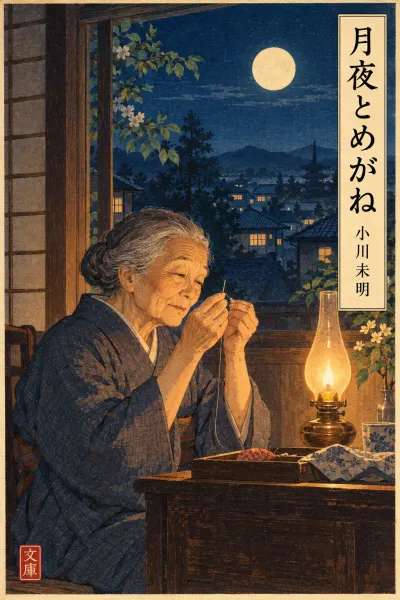
"Glasses by Moonlight" is a short fairy tale by Ogawa Mimei. It takes place on one quiet, moonlit night in early summer. An old woman lives alone at the edge of a calm town. She is sewing by lamplight, but her eyes have grown weak and she cannot thread her needle. Then two unexpected visitors knock at her door. The first is a peddler selling spectacles. The second is a tearful young girl who has hurt her finger. The story moves slowly and gently. Distant street sellers and trains, the scent of flowers and perfume, and soft repeated sounds such as カタ、コト and トン、トン create a dreamy, half-real mood. The narrator uses an old-fashioned polite literary style (〜であります, 〜のであります). This will feel formal at first, but it is very regular and soon becomes easy to follow. The three speakers sound clearly different: the old woman is warm and folksy, the seller is businesslike, and the girl is extremely respectful. That makes the dialogue good practice for hearing register. The vocabulary is mostly everyday, and the sentences are long but clear, which suits a learner moving into N3-level prose.
Contents
Easier versions
This story is also retold in simpler Japanese. Reading an easier version first makes the original much more approachable.
Before you read
- Get used to the narrator's endings 〜であります and 〜のであります first. They are simply an old-fashioned, storytelling form of です and のです. Read them as ordinary statements and keep going.
- Notice how the narrator guesses at what people think or feel instead of stating it, using 〜とみえて (it seems that…), 〜のであろう (it must be that…), and 〜ではないかと思う (she wondered whether…). These phrases carry much of the story's soft, uncertain mood.
- Listen for the differences in speech. The old woman uses casual, old-fashioned forms such as 〜ておくれ (please do…), ありますかい, and どれ (well now, let me see). The girl uses honorifics such as おいでなさいます and なさっている. Sorting out who is speaking by register will help you follow the dialogue.
- Learn a few key nouns before you start: 月夜 (moonlit night), めがね (spectacles), 針 (needle), 糸 (thread), 香水 (perfume), 工場 (factory), 指 (finger), 花園 (flower garden), and 蝶/ちょう (butterfly). Most of the plot turns on these words.
- Do not get stuck on the repeated sound words such as カタ、コト and トン、トン. They imitate small noises, like tapping or rattling. They are there for rhythm and atmosphere, so read them aloud and enjoy them rather than looking them up.
Words to know
The most useful words from the notes across the story.
| Word | Meaning | JLPT |
|---|---|---|
| かすんでかすむ | to grow dim, blurry (of eyesight)dictionary form: 霞むAlso used for mist or haze over a landscape. | N1 |
| かたむけましたかたむける | to tilt, to turn (one's ear) towarddictionary form: 傾ける耳を傾ける = to listen attentively. | N1 |
| めどめど | eye of a needledictionary form: 針孔Today usually 針の穴; めど also means 'prospect, aim' (目処). | — |
| つつまれてつつむ | to wrap, to cover (here passive: to be wrapped in)dictionary form: 包むCommonly used figuratively: 緑に包まれる, 霧に包まれる. | N4 |
| ふだんふだん | usually; normallydictionary form: 普段 | N3 |
| やとわれていますやとう | to employ; (passive) to be employeddictionary form: 雇う | N3 |
| たびたびたびたび | often, many timesdictionary form: 度々A little more formal than よく in this sense. | N3 |
| さかりさかり | peak, height (of blooming)dictionary form: 盛りいまをさかりと咲く = to be in full bloom right now. | N3 |
| 空想くうそう | daydreaming, imagining空 'empty' + 想 'thought'. | N2 |
| さっそくさっそく | at once; without delaydictionary form: 早速 | N2 |
| ふけてふける | (of night) to grow latedictionary form: 更けるUsed with 夜 or 時刻: 夜が更ける. | N2 |
| つまずいてつまずく | to trip; to stumbledictionary form: 躓く | N2 |
| かきねかきね | hedge, fencedictionary form: 垣根 | N2 |
| 暦こよみ | calendar; almanacOld-fashioned word; today カレンダー is more common. | N1 |
| しみているしみる | to soak in; to permeatedictionary form: 染みる | N1 |
Plot summary
Show the full summary (contains spoilers)
On a calm moonlit night, an old woman sits sewing by lamplight, but her dim eyes keep her from threading her needle. A short, bearded man in dark glasses calls at her window and says he sells spectacles. He gives her a large tortoiseshell-rimmed pair. With them she can see everything clearly, so she happily buys them, and he vanishes into the night. Soon there is another knock. A beautiful girl with tearful eyes says she works at the town's perfume factory and has cut her finger on the way home. The old woman offers to treat the wound. When she puts on her new glasses, she sees that the girl is really a butterfly with an injured leg. She remembers the old tale that butterflies take human form and visit wakeful houses on quiet moonlit nights. She leads the girl into her back flower garden, where the girl silently disappears. The old woman says good night and goes to bed.
About the author
Ogawa Mimei was a Japanese writer from Niigata Prefecture. He is often called the father of modern Japanese children's literature, and he is sometimes described as 'the Japanese Andersen.' He studied at Tokyo Senmon Gakkō (now Waseda University), where his teacher Tsubouchi Shōyō is said to have given him the pen name Mimei. He wrote both fiction for adults and fairy tales, and he later devoted himself mainly to children's stories. His tales are known for their lyrical, often melancholy atmosphere and their concern for the weak and the lonely. Among his best-known works is 赤い蝋燭と人魚 (The Red Candles and the Mermaid).