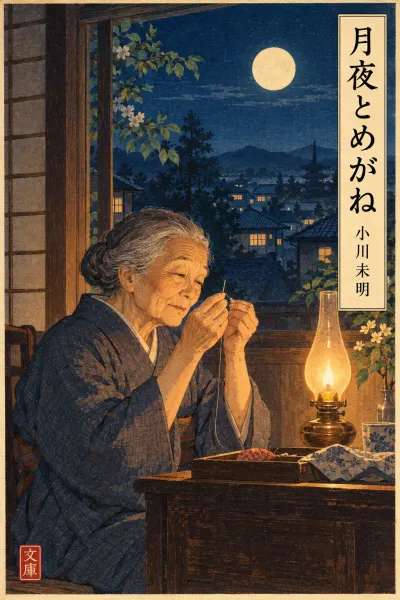
Part 3 of 3 · JLPT N3
月夜とめがね Tsukiyo to Megane, part 3: A Butterfly Visitor in the Moonlit Garden
In this part
The old woman offers to treat the girl's bleeding finger, but when she puts on her new glasses she sees that her visitor is really a butterfly with an injured leg. She recalls the old tale that butterflies take human form and visit wakeful houses on calm moonlit nights, and she leads the girl out to the flower garden, where the girl silently vanishes. The old woman wishes everyone good night and goes back inside to sleep.
AI translation · independently checked
「そんなら、おまえは、私を知っているのですか。」と、おばあさんはたずねました。"Then you know me, do you?" asked the old woman.
「私は、この家の前をこれまでたびたび通って、おばあさんが、窓の下で針しごとをなさっているのを見て知っています。」と、少女は答えました。"I have often passed in front of this house, and I have seen you, ma'am, doing your needlework beneath the window, so I know you," answered the girl.
「まあ、それはいい子だ。どれ、そのけがをした指を、私に見せなさい。なにか薬をつけてあげよう。」と、おばあさんはいいました。"My, what a good child you are. Now then, let me see that hurt finger of yours. I'll put some medicine on it for you," said the old woman.
そして、少女をランプの近くまでつれてきました。And she brought the girl over close to the lamp.
少女はかわいらしい指を出して見せました。The girl held out her pretty little finger to show her.
すると、まっ白な指から赤い血が流れていました。Red blood was flowing from the pure white finger.
「あ、かわいそうに、石ですりむいて切ったのだろう。」と、おばあさんは、口のうちでいいましたが、目がかすんで、どこから血が出るのかよくわかりませんでした。"Oh, you poor thing, you must have scraped it on a stone and cut it," the old woman murmured to herself, but her eyes were so dim that she could not quite tell where the blood was coming from.
「さっきのめがねはどこへいった。」と、おばあさんは、たなの上をさがしました。"Now where did those glasses from a moment ago go?" said the old woman, searching the shelf.
めがねは、目ざまし時計のそばにあったので、さっそく、それをかけて、よく少女のきず口を、見てやろうと思いました。The glasses were beside the alarm clock, so she thought she would put them on at once and take a good look at the girl's wound.
おばあさんは、めがねをかけて、この美しい、たびたび自分の家の前を通ったという娘の顔を、よく見ようとしました。The old woman put on the glasses and tried to take a good look at the face of this lovely girl, who said she had so often passed in front of her house.
すると、おばあさんはたまげてしまいました。And then the old woman was astonished.
それは、娘ではなく、きれいな一つのこちょうでありました。It was not a girl at all, but a beautiful butterfly.
おばあさんは、こんなおだやかな月夜の晩には、よくこちょうが人間にばけて、夜おそくまで起きている家を、たずねることがあるものだという話を思いだしました。The old woman remembered a tale that on calm moonlit nights such as this, butterflies would often take human form and come calling at houses where people stayed up late.
そのこちょうは足をいためていたのです。This butterfly had hurt its leg.
「いい子だから、こちらへおいで。」と、おばあさんはやさしくいいました。"There's a good child, come this way," the old woman said gently.
そして、おばあさんはさきに立って、戸口から出てうらの花園の方へとまわりました。Then the old woman went ahead, out through the door, and around towards the flower garden at the back.
少女はだまって、おばあさんのあとについて行きました。The girl followed silently after her.
花園には、いろいろの花が、いまをさかりと咲いていました。In the flower garden, all kinds of flowers were blooming at their very best.
ひるまは、そこに、ちょうや、みつばちが集まっていて、にぎやかでありましたけれど、いまは、葉かげでたのしいゆめをみながらやすんでいるとみえて、まったくしずかでした。In the daytime, butterflies and honeybees gathered there and it was full of life, but now they seemed to be resting in the shade of the leaves, dreaming happy dreams, and all was perfectly still.
ただ水のように月の青白い光が流れていました。Only the pale, bluish-white light of the moon flowed like water.
あちらのかきねには、白い野ばらの花が、こんもりとかたまって、雪のように咲いています。Over by the hedge, white wild roses bloomed in thick clusters, like snow.
「娘はどこへ行った?」と、おばあさんは、ふいに、立ちどまってふりむきました。"Where has the girl gone?" said the old woman, suddenly stopping and turning around.
あとからついてきた少女は、いつのまにか、どこへすがたを消したものか、足音もなく見えなくなってしまいました。The girl who had been following behind her had vanished without a sound of footsteps, before she knew it, gone who knows where.
「みんなおやすみ、どれ私もねよう。」と、おばあさんはいって、家の中へはいって行きました。"Good night, everyone. Well, I'll go to bed too," said the old woman, and she went back into the house.
ほんとうに、いい月夜でした。It truly was a lovely moonlit night.
Vocabulary
| Word | Meaning | JLPT |
|---|---|---|
| たびたびたびたび | often, many timesdictionary form: 度々A little more formal than よく in this sense. | N3 |
| 針しごとはりしごと | needlework, sewingdictionary form: 針仕事針 (needle) + 仕事 (work), with rendaku し→じ often not shown in kana spellings; also read はりしごと. | — |
| すりむいてすりむく | to scrape, graze (skin)dictionary form: 擦りむく | — |
| かすんでかすむ | to become blurred, dim (of eyesight)dictionary form: 霞むAlso used for mist or haze over a landscape. | N1 |
| たまげてたまげる | to be astonished, amazeddictionary form: 魂消るColloquial, somewhat old-fashioned; literally 'the soul vanishes'. | — |
| こちょうこちょう | butterflydictionary form: 胡蝶A literary, poetic word for ちょう. | — |
| ばけてばける | to take the form of, transform intodictionary form: 化けるUsed for animals or spirits disguising themselves; compare お化け (ghost). | N1 |
| いためていたいためる | to hurt, injure (a body part)dictionary form: 痛める | N1 |
| さかりさかり | peak, height (of blooming)dictionary form: 盛りいまをさかりと咲く = to be in full bloom right now. | N3 |
| かきねかきね | hedge, fencedictionary form: 垣根 | N2 |
| こんもりこんもり | thickly, in a dense rounded massMimetic word for something heaped up or densely growing. | — |
| ふりむきましたふりむく | to turn around, look backdictionary form: 振り向く | — |
| すがたを消したすがたをけす | to disappear, vanish from sightdictionary form: 姿を消す | — |
Grammar
〜ようとする N3 to try to do, be about to do
The volitional form plus とする describes an attempt to do something. Here the old woman sets out to look closely at the girl's face, and the next sentence reveals what she sees.
娘の顔を、よく見ようとしました
she tried to take a good look at the girl's face
〜ことがあるものだ N2 it is said that ... sometimes happens; such things do happen
ことがある means 'sometimes happens', and ものだ adds the sense of a general truth or common belief. Together they present the butterfly legend as a well-known tendency.
よくこちょうが人間にばけて、夜おそくまで起きている家を、たずねることがあるものだ
butterflies would often take human form and come calling at houses where people stayed up late
〜とみえて N1 apparently, it seems that ... (and so)
A plain-form clause plus とみえて gives the narrator's inference from what can be observed, then links to the result. The garden's silence is explained by the guess that the insects are asleep.
いまは、葉かげでたのしいゆめをみながらやすんでいるとみえて、まったくしずかでした
now they seemed to be resting in the shade of the leaves, dreaming happy dreams, and all was perfectly still
〜ながら N4 while doing
The stem of a verb plus ながら shows two actions done at the same time by the same subject. The insects rest while dreaming.
たのしいゆめをみながらやすんでいる
resting while dreaming happy dreams
〜たものか N2 who knows (where/how) ...; one wonders
A question word plus a past-tense verb and ものか expresses uncertainty about something that cannot be known. It stresses the mystery of how the girl vanished.
どこへすがたを消したものか
gone who knows where
〜てしまう N4 to end up ..., to do completely
Attached to a verb's te-form, しまう marks an action as complete, often with surprise or regret. Here it emphasises that the girl has disappeared entirely.
足音もなく見えなくなってしまいました
she had vanished without a sound of footsteps